Remembering Hans Herrmann: one of sportscar racing's greatest
 Doug Nye
On 9th January 2026 we were saddened to hear that the veteran German driver Hans Herrmann, barely a month short of what would have been his 98th birthday, had died.
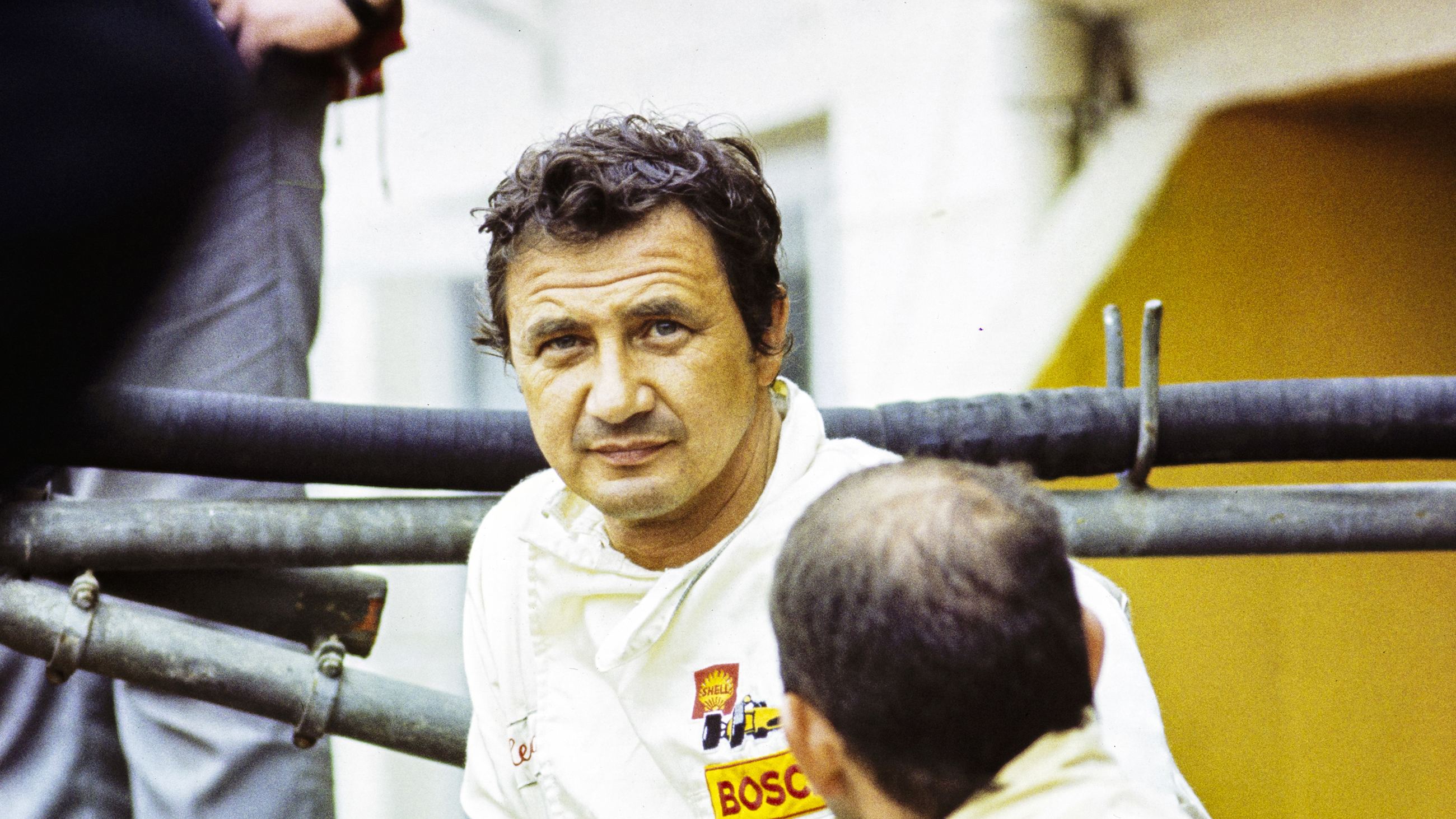
Hans had for so many years been a familiar face at the Goodwood Festival of Speed presented by Mastercard, driving both for Porsche and for Mercedes-Benz. Known in period as ‘Hans im Gluck’ – more or less ‘Lucky John’ – he had been an immensely serious and competitive endurance racing driver who added outright victories in the Targa Florio, the Sebring 12 Hours and the Daytona 24 Hours to his ultimate Le Mans triumph – which also happened to be Porsche’s first of its now record 19 wins there.
From 1953-1970 Hans Herrmann’s career majored in both Stuttgart marques. As a locally born budding racing driver from a baking and confectionery family, young Hans represented a new driving talent with great potential.
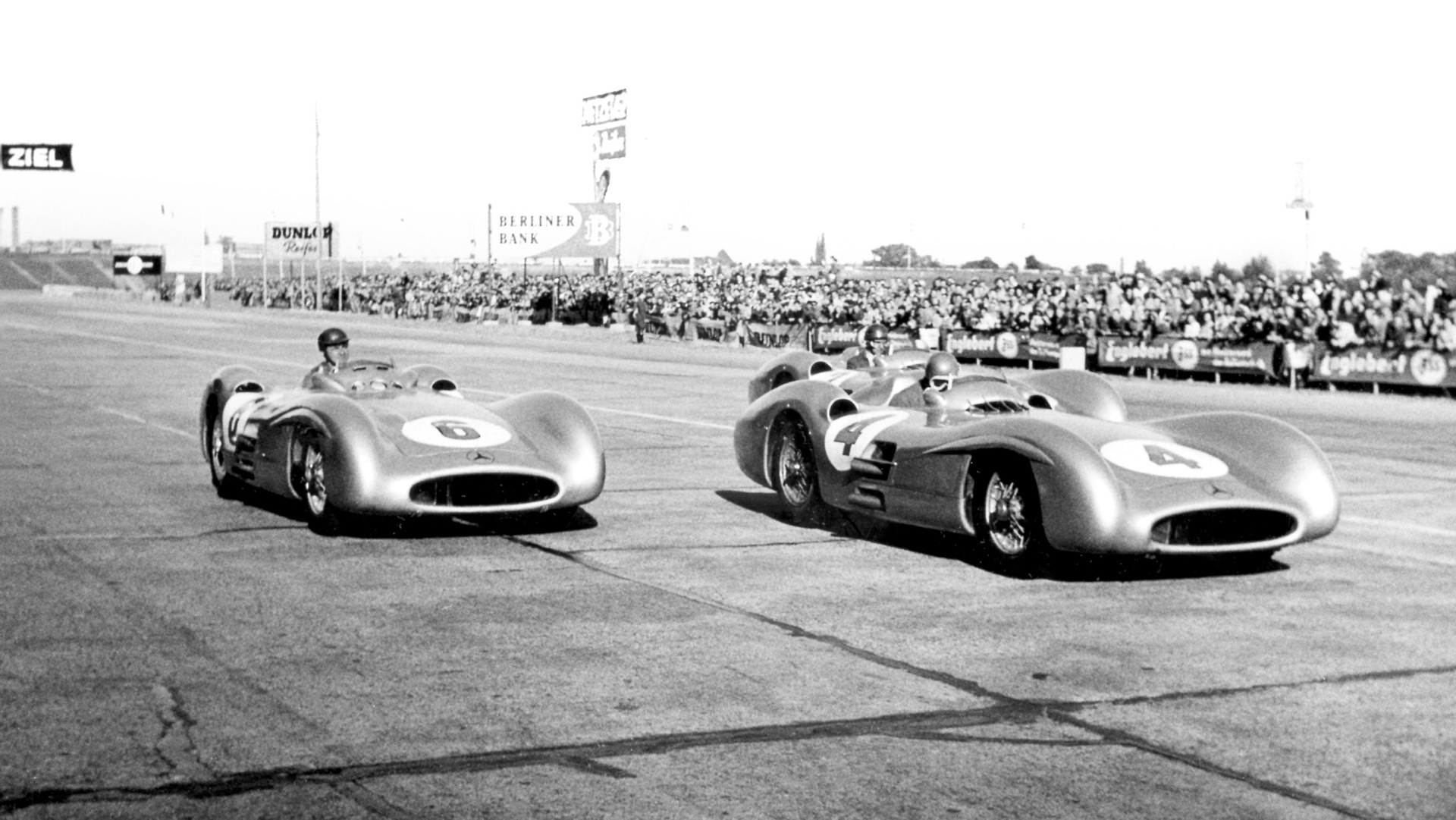
Herrmann, Fangio and race winner Kling in their Stromlinienwagen Mercedes, 1954 Berlin GP at AVUS - they finished 3-2-1.
Image credit: GP LibraryHe was only 17, in 1945, when he was conscripted into the Reich Labour Service, then assigned to the Waffen-SS. As independently-minded teenagers he and four comrades escaped transport to their assigned deployments and - in civilian clothes – headed home to Stuttgart. If apprehended, they would have been shot, but he survived and went on to complete a confectioner’s apprenticeship postwar, being intended to take over his mother's café business.
Hans thought otherwise, having caught the motor racing bug. In a private Porsche 356 he did well enough in 1953 to be noticed by Daimler-Benz AG’s renowned racing manager, Alfred Neubauer, who signed him up for the reborn Mercedes-Benz ‘Silver Arrow’ racing team of 1954 - just a junior cadet, but driving in support of senior German star Karl Kling, and with none Juan Manuel Fangio as his team leader.
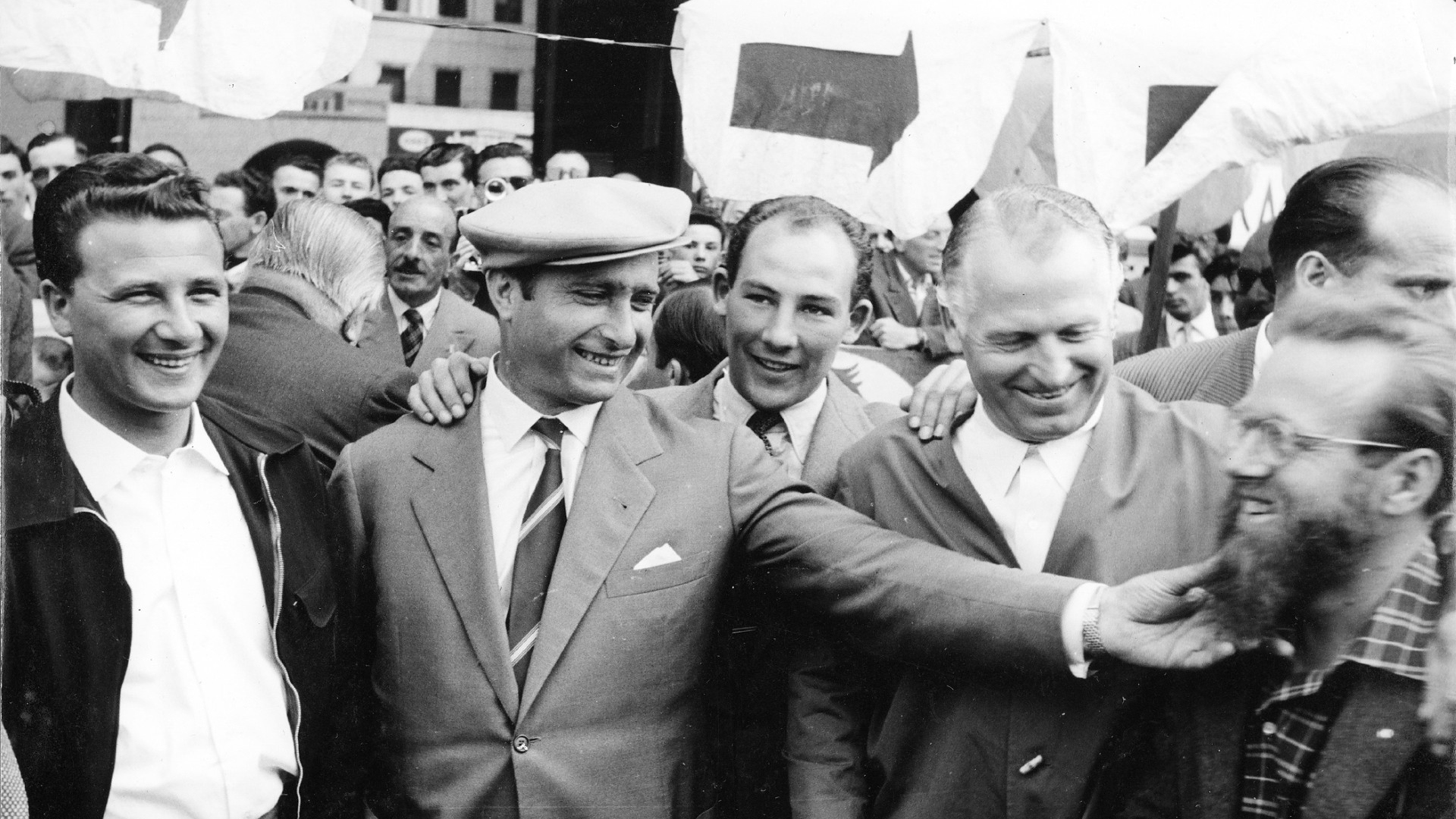
A young Herrmann with Fangio, Moss, Karl Kling and bearded Jenks - Mille Miglia Mercedes team-mates, 1955.
Image credit: GP LibraryHe soaked up experience that year as Mercedes’ number two German effectively learning from Kling’s example – and his errors. Aged only 26 against the top-class motor racing norm of the period ranging from the mid-30s to mid-40s, Hans was the factory team’s fresh-faced kid.
That changed somewhat into 1955, Mercedes’s first full year back in Grand Prix and World Sportscar Championship contention, when British rising star Stirling Moss joined the team, a year younger still.
But Hans had a very fast and promising run in the opening round of that year’s World Sportscar Championship, when he proved very fast indeed during the opening stages of Italy’s great 1,000-mile Mille Miglia only for his 300 SLR car to fail, while Moss and Fangio demolished all opposition to finish triumphantly first and second.
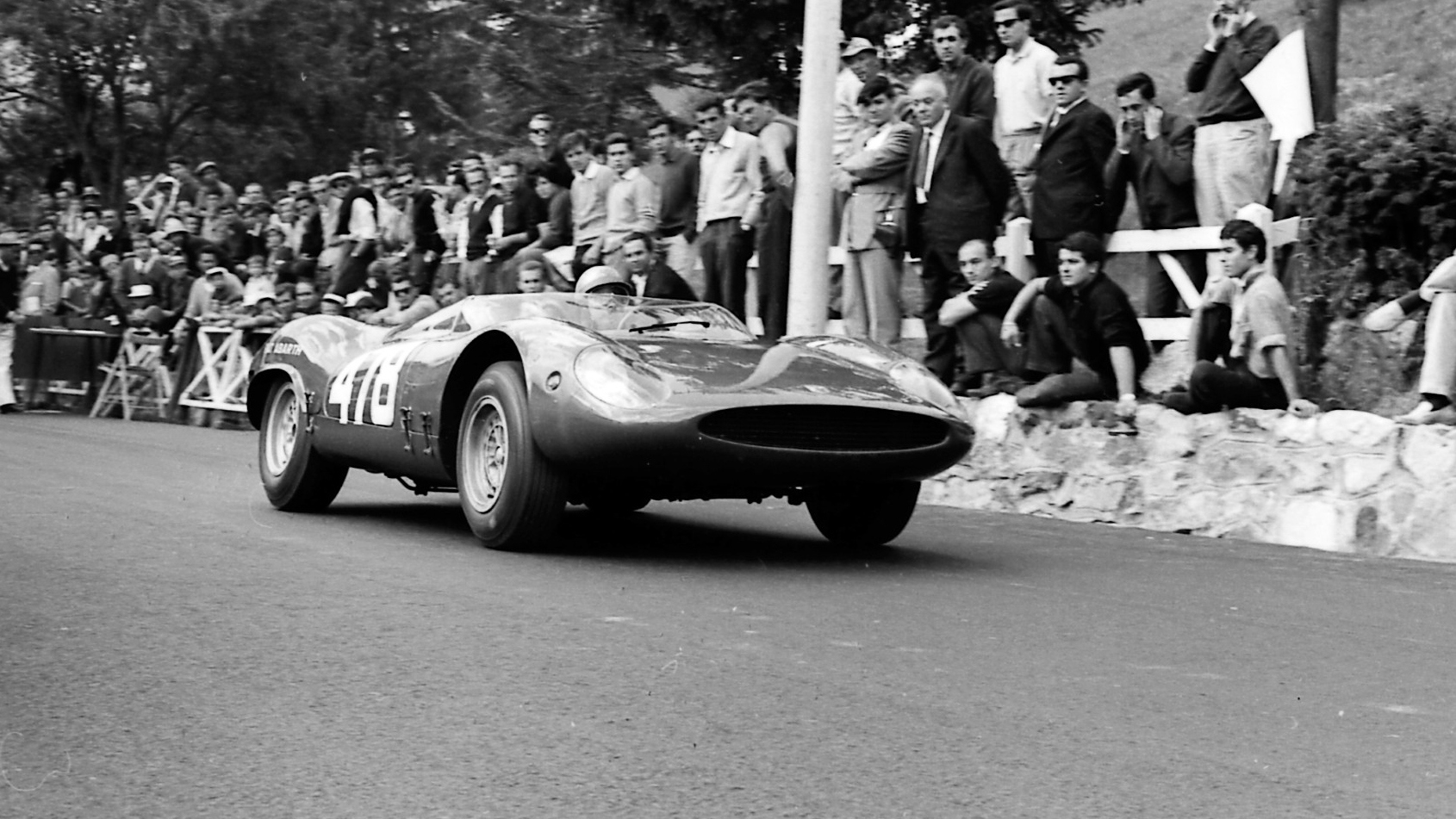
European Mountain Championship hillclimbing - Herrmann in the works Abarth at Cesana-Sestriere 1966.
Image credit: GP Library‘Lucky John’s good fortune deserted him again in practice for the following Monaco Grand Prix, when he crashed his W196 car into the Casino’s stone balustrade, badly breaking his leg. Mercedes-Benz withdrew from racing for 1956, and homeless Herrmann spent that year driving instead for Porsche at sports and GT endurance level, then lucklessly trying his hand with Maserati in 1957.
Bouncing back for 1958 he drove Carl Borgward’s advanced factory team Rennsport cars before re-establishing himself at Porsche from ‘59- ‘61. The intervening 1960 season was his best, as he and co-driver Joakim Bonnier won both the Sebring 12 Hours the Targa Florio – both qualifying rounds of the World Sportscar Championship.
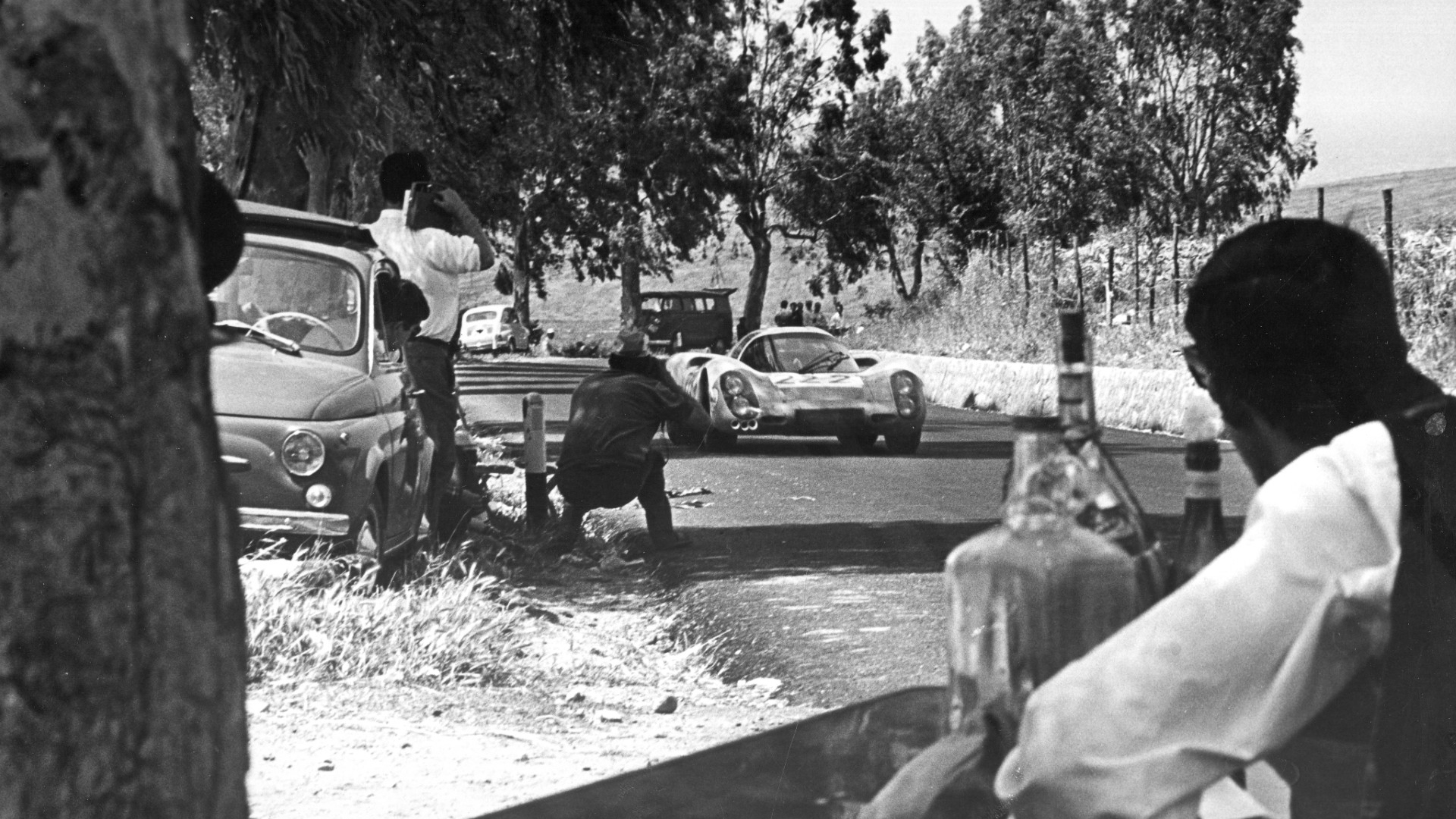
Herrmann/Jochen Neerpasch Porsche 907 at the 1968 Targa Florio.
Image credit: GP LibraryUntil that time Porsche had largely been a consistent smaller-capacity class winner at such high level, but here it established itself as a consistent title challenger despite maintaining its small-capacity class credentials.
But when Porsche graduated to 1,500cc Formula 2 and Formula 1 from 1959-‘62 it was Jo Bonnier whom team director Baron Fritz Huschke von Hanstein selected to represent the marque, together with American Dan Gurney. Hans opted instead to drive for Abarth at endurance level, while also proving himself a very effective European ‘hillclimb’ contender. After four years with Abarth he was re-engaged by Porsche from 1966.
But still his Porsche 904 and Carrera 6 mounts were essentially 2.0-litre class contenders and it was only under the reign of new chief engineer Dr Ferdinand Piech into the later ‘60s that Porsche began to develop the 3.0-litre flat-eight air-cooled-engined Porsche 908s of 1968 and ‘69 – and the unfettered 4.5- and 5.0-litre Porsche 917s that followed.
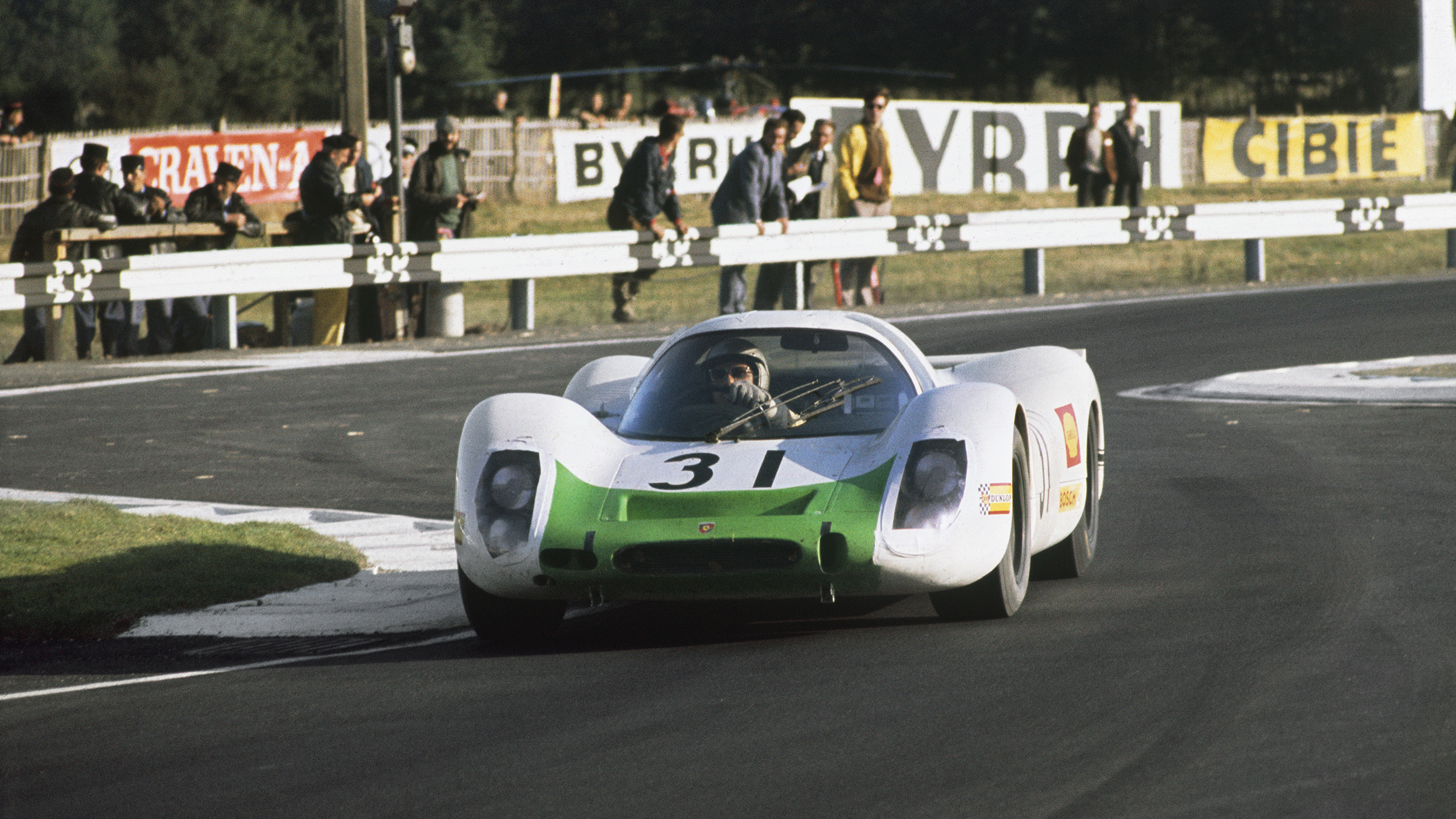
The Jo Siffert/Hans Herrmann Porsche 908 action at the 1968 Le Mans 24 Hours.
Image credit: LAT Images via Getty ImagesIn 1968 Hans co-drove the winning 908 in the Daytona 24 Hours and shared a second Sebring 12 Hours race win with Jo Siffert. He also won the Paris 1,000km, paired with team newboy Rolf Stommelen.
Team director von Hanstein’s secretary into the 1960s was Evi Butz, who subsequently married Dan Gurney. Today she recalls Hans Herrmann most warmly, telling us: “I have been friends with Hans and his wife Madeleine (Magdalena) since 1964. We have been in contact ever since, Dan and I visited them in Maichingen, a village close to Stuttgart’s old Solitude circuit, and they came to California and our AAR Eagle team some twenty years ago.
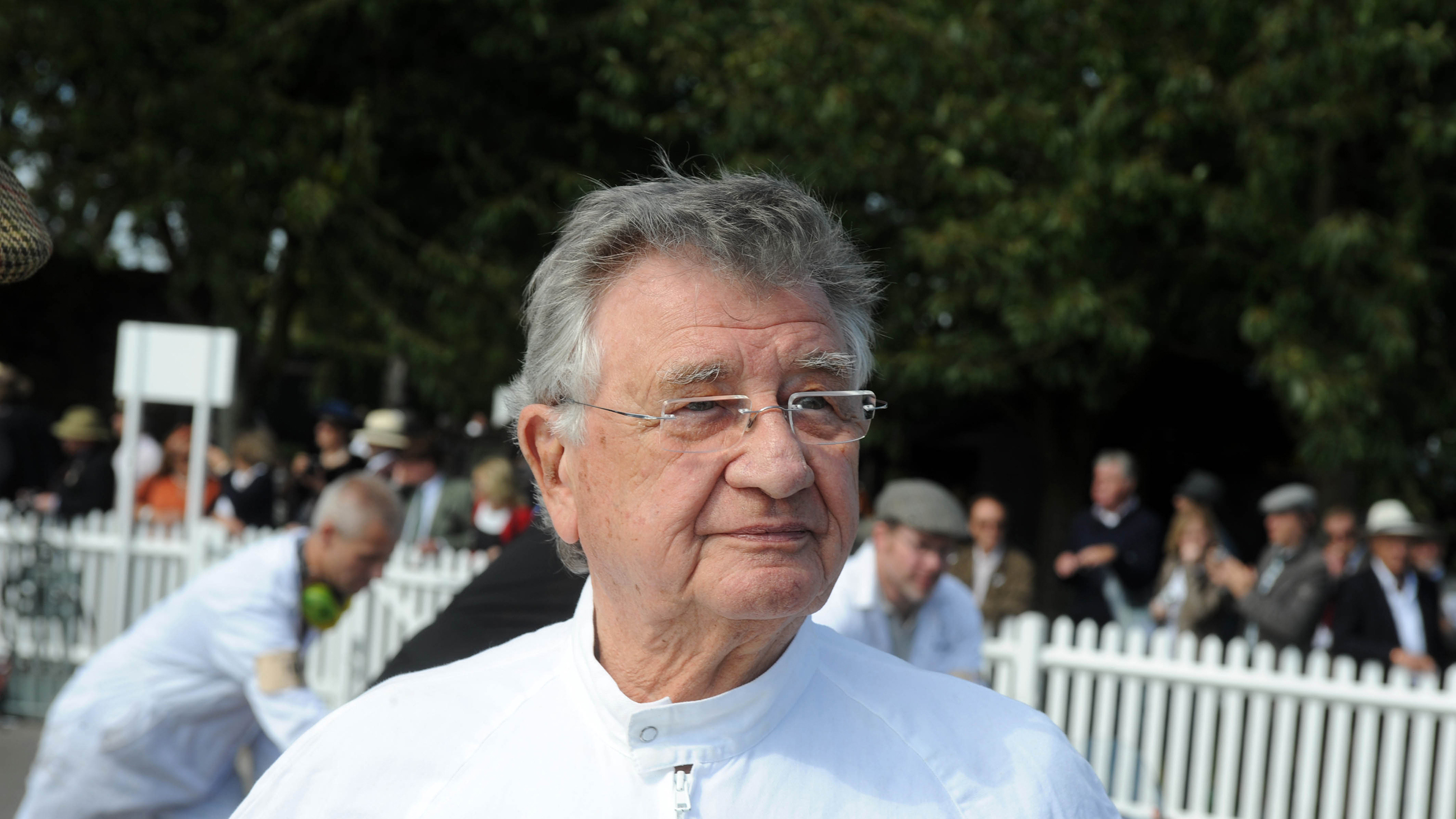
Hans Herrmann at the 2011 Goodwood Revival
Image credit: Jeff Bloxham“Their son Dino lives and works in LA. Hans was always a most friendly, low key and fun person to be around. At the factory he usually did not come over to our offices in factory two but met his team at factory one where the racing and engineering department was located. Huschke often saw him over there.
“Socially we often met at Porsche club events or at racetracks, the last time I saw him was in the summer of 2023 when I took the family to Europe. We drove a lap around the Solitude circuit and then went to the Herrmann’s for coffee and cake… Hans was in a wheelchair, but his mind was still strong.
“We followed him wheeling ahead through the surrounding forest, he maintained pole position for the next half hour! That was fun.”
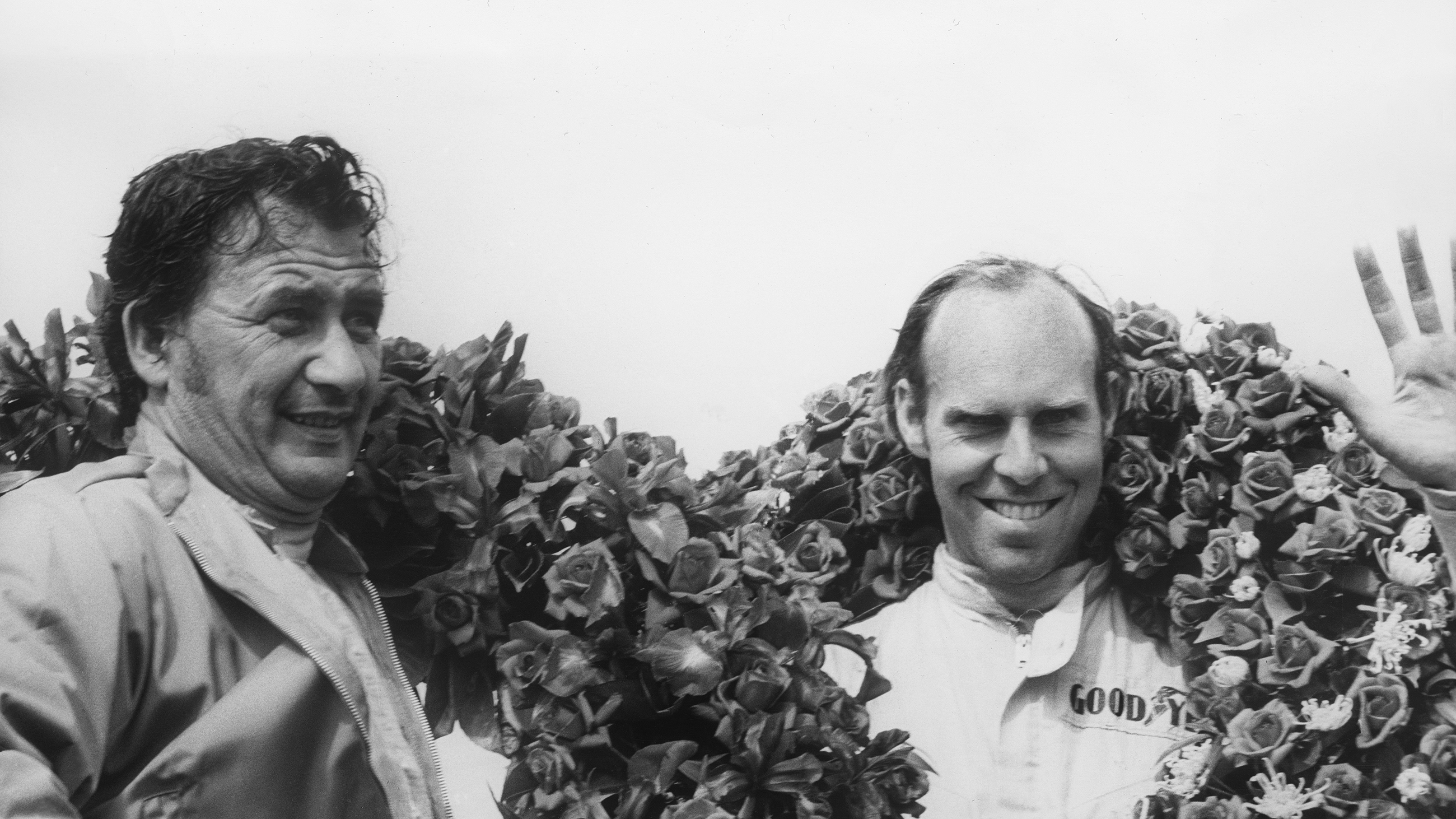
Hans Herrmann and Richard Attwood celebrate on the podium after winning the 1970 Le Mans 24 Hours with Porsche.
Image credit: LAT Images via Getty ImagesAt one early Festival of Speed Hans had been assured by former 1950s team-mate Stirling Moss that he could wear one of his old cork and canvas crash helmets from that era, since we had agreed with the RAC MSA that Moss at least could do so. The Goodwood team then had a phone call from the marshals at the Startline stating: “an old German gentleman who doesn’t speak much English, is here insisting on wearing a battered old cork and leather helmet to drive a Porsche 917”! Hans of course. The immediate problem was sorted to everyone’s satisfaction, but the ruling was subsequently clarified.
His co-driver at Le Mans in 1970 was British star Richard Attwood. Richard recalls how, after a disappointing outing at the Circuit de la Sarthe a year earlier, in the then unmanageably unstable Porsche 917, Porsche offered him choice of his preferred co-driver and car spec for the race. Richard recalls of Hans: “Driving mainly for German marques he never really needed a second language, but between us we fumbled through whatever was required, and most of the time we got by with sign language and natural understanding”.
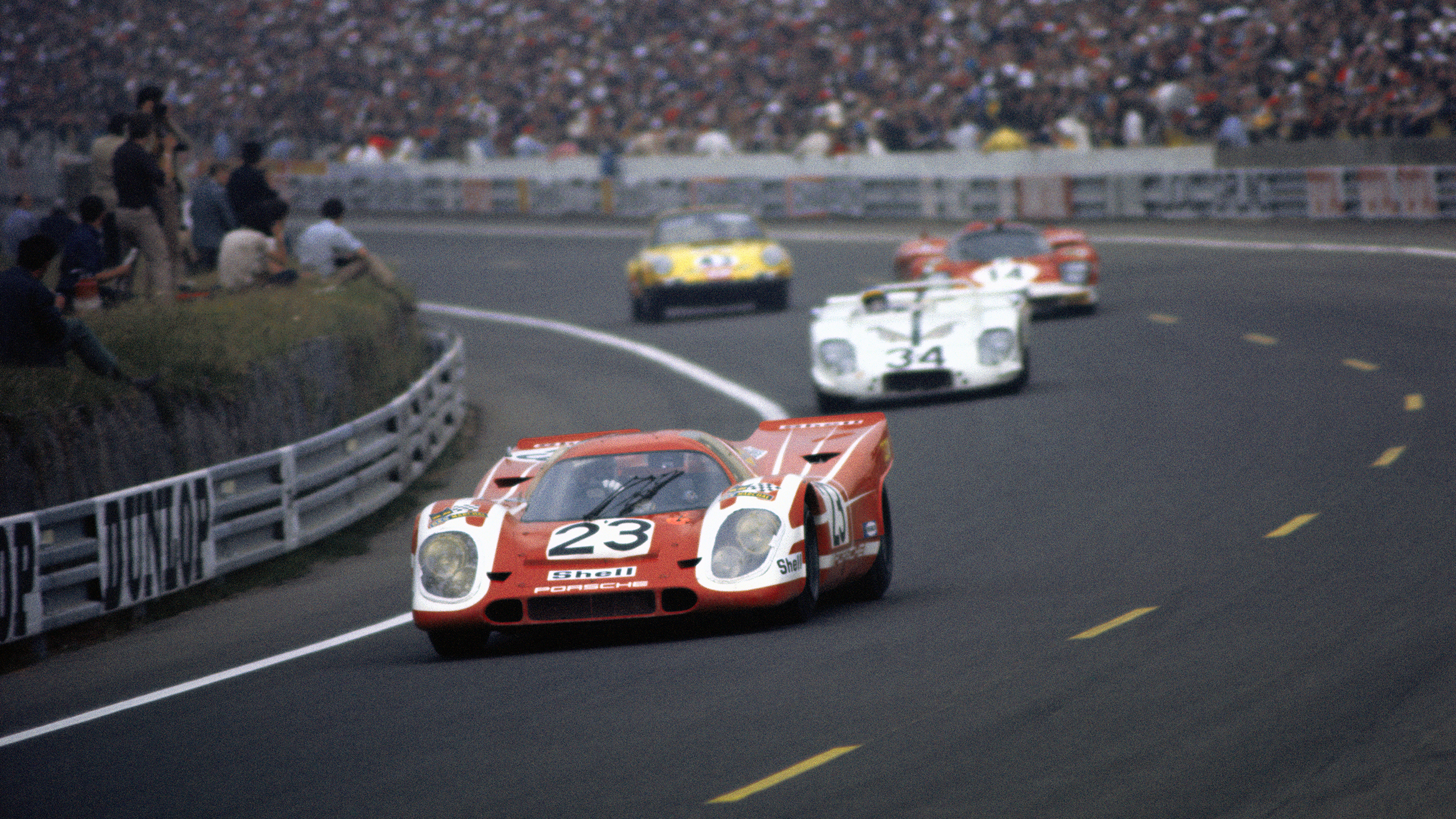
The Richard Attwood/Hans Herrmann Porsche 917K during the 1970 Le Mans 24 Hours.
Image credit: Rainer Schlegelmilch via Getty ImagesRealistically he believes they were both “…experienced enough to have slowed down a little and this all added up to at least a finish at Le Mans. I preferred the early-style 4.5-litre 917 to one of the later 5.0-litres, thinking it would be more reliable. But after qualifying 15th on the grid I thought we had no chance. I told many including my wife Veronica that we just weren’t competitive enough with the package I’d chosen, agreed to by the factory.
“I was unaware of Hans’s promise to his wife that should he win – after his car had been just narrowly beaten by Ickx’s GT40 the previous year - that he would retire straight away. Had I known this it might have made me more nervous.
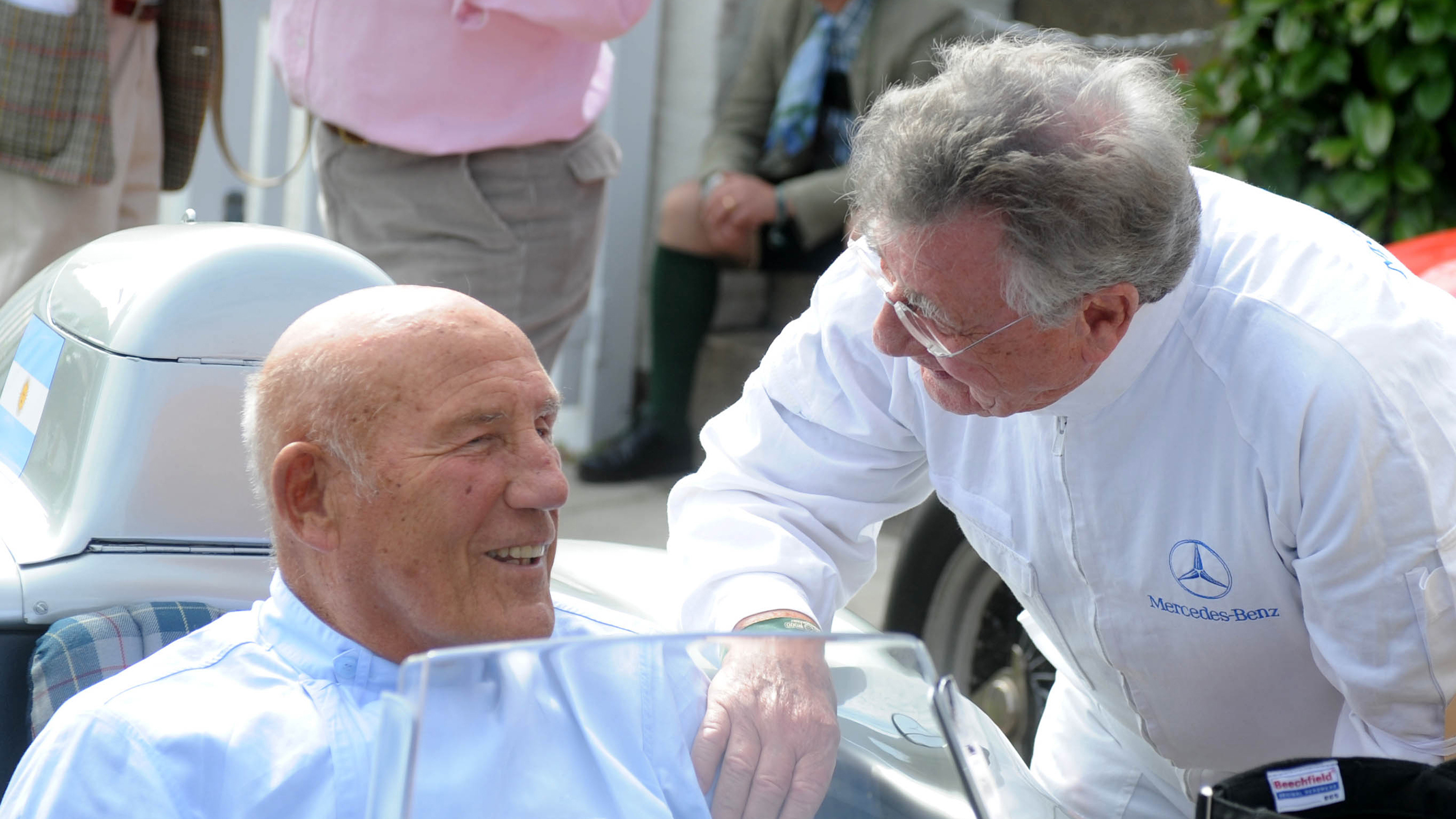
Hans Herrmann speaks to Sir Stirling Moss at the 2011 Goodwood Revival.
Image credit: Jeff Bloxham“He asked me if I could start the race and I agreed completely. Quite why was not a question to ask. Towards the end of the race he asked if he could take the flag. I had no problem with this request either. We drove as a team and any disputes could have been very negative. I didn’t realise until later that he wanted the win more than I. That last lap was his final racing lap. Nearly everyone ahead of us just made mistakes.”
Both these drivers were naturally rather shy and retiring by nature – a rarity amongst racing drivers. After his Le Mans triumph, the Swabian opted to end his active career without even finishing the season. He fulfilled his promise, then successfully devoted himself to running his car accessory company.
As a Brand Ambassador for Mercedes‑Benz Heritage in particular, he remained closely associated with motorsport. In numerous runs in Mercedes‑Benz heritage cars, he proved his adaptability to a wide variety of racing cars right up to an advanced age. In October 2012, he was honoured by the Sicilian town of Collesano for taking part in eight Targa Florio races. As a matter of honour: the former works driver arrived for the ceremony at the wheel of a Mercedes‑Benz 300 SLR – a rare flash of style.
Gert Straub was a senior technical figure of the Daimler-Benz Classic department. His father had navigated ‘Taffy’ von Trips in a Mille Miglia and Hans counted both father and son as friends. Gert told us: “The news of Hans’ death is very sad. He was always a very friendly person towards me and the Classic team.
“No superstar, he was always very down to earth, always interested how life is going. I knew him for decades and he often joined us for events and it was always a pleasure to work with him.
“He was a good friend to my old man. They knew each other since the fifties and whenever Hans came into the Stuttgart factory he always came around to the workshop to say hello and share news.”
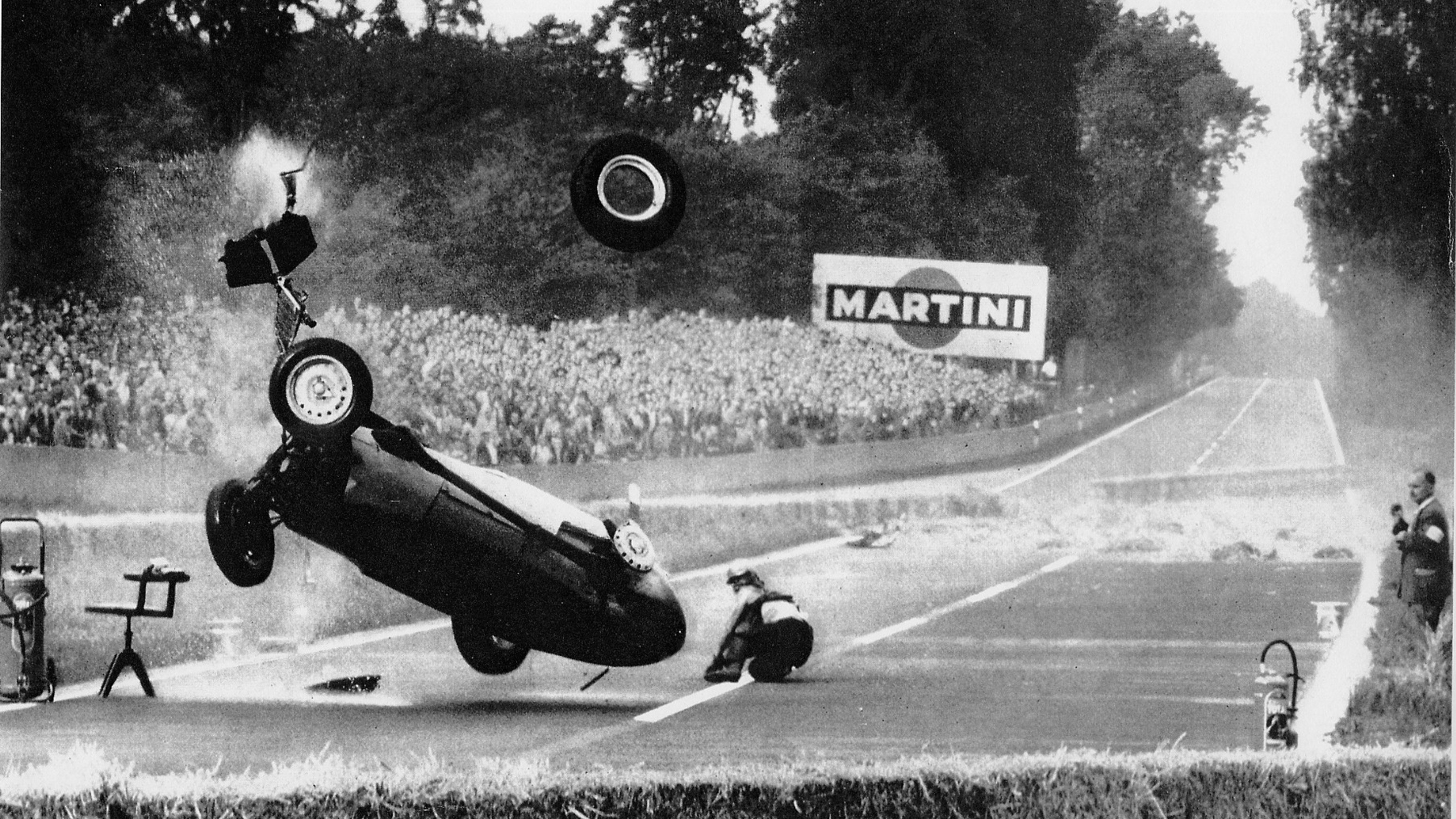
Herrmann's famous accident at the 1959 German Grand Prix at AVUS.
Image credit: GP LibraryI vividly recall one Festival lunch with Hans, asking him about his drive in the 1959 German Grand Prix at Berlin’s AVUS racetrack, when he handled a BRP-entered front-engined BRM Type 25 which had been prepared for Moss. Sadly he had the brakes fail on the rush into the autobahn-type circuit’s single 180-degree hairpin corner. The car slammed head-on into straw bales, tripped, somersaulted and threw Hans out onto the asphalt. Miraculously he scrambled to his feet and was helped away, hardly hurt.
To our great merriment he then explained how he had telephoned his Mum – convinced she would have been watching on TV - to assure her he was OK and that she should not worry. Typically Hans, he turned the story against himself, claiming that she replied sympathetically, “Oh that’s nice dear” then adding “I didn’t realise you were driving today.”
Indeed, a really good guy to the end… RIP Hans im Gluck.
Hans Herrmann
Race
Historic