

How to master the Alfa Romeo 155 | Frankel’s Insight
 Andrew Frankel
News that Super Touring cars of all varieties will be among the headline acts of the 83rd Members’ Meeting presented by Audrain Motorsport made me ponder the identity of the maddest tin-top racer I’ve driven. And I’d be lying if I said the process took more than a few seconds, because a few years ago I drove an Alfa Romeo 155 that, for the sheer drama of the way that it drove, remains one the most intense driving experiences of my life.

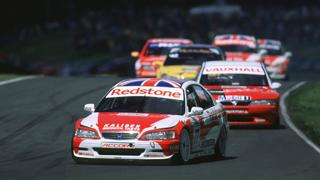
I should say now that this was not the 155 in which Gabriele Tarquini won the 1994 British Touring Car Championship, winning half of the 16 races he started and failing to finish on the podium in just one of the races he completed. That was a formidable machine, but it competed in the D2 touring car category and was very much based on the road car, retaining its front-wheel drive layout and 2-litre twin-spark engine, albeit tuned to around 289PS (213kW).
The car I drove was its big brother, which raced in the D1 category in the DTM touring car championship, a series that in Germany in the 1990s was as popular as Formula 1, maybe even more so. Just once in the 35 years that there has been a Manufacturers’ Championship in the DTM has it been won by anything other than a German car and this was the Alfa Romeo 155, in which Nicola Larini and Alessandro Nannini won 12 out of the 20 rounds of the 1993 season, Larini winning ten and therefore the Drivers’ Title, too.
Unlike cars that raced in the D2 category, D1 cars were as different to their road-going equivalents as can be. Indeed, they were almost silhouette racers. All major body panels were carbon fibre, it’s 2.5-litre V6 engine not only turned through 90-degrees to point north-south but also tuned to produce 426PS (313kW) at a screaming 12,000rpm.

It drove through a six-speed sequential gearbox, directing power to all four wheels with a 33/67 per cent rear-biased torque split and a Ferguson viscous coupling. And while the surfacing on the upper body looked fairly standard (save the rear wing), there were no rules regarding airflow below the centre line of the wheels, so a vast and complex system of spoilers, skirts and diffusers were created to exploit the airflow around and under the car to maximum possible effect.
I drove it first at Fiat’s Balocco test track and then again up the Hill at the Goodwood Festival of Speed presented by Mastercard and, like all Alfa Romeo museum cars I’ve driven, it came with a pleasing lack of instructions about how far or fast I might be able to drive it. The only thing I remember asking is what my rev limit should be, to which I was told to use the same 12,000rpm as had been allowed when racing.
It took a little time to get the hang of it, but not because it was an inordinately complex machine that took hours of getting to know before it would reveal its secrets to you. On the contrary, my mistake was to try to find my way with it slowly and gently, gathering the requisite data before really starting to push. It is an approach it recognised not at all, and appreciated even less, rewarding me with sullen truculence and I tried to figure out how to make it come alive.
It turns out the answer was not to think more, but less. Drive it like you might a Lotus 25 — all fingers, thumbs and feel — and you’ll wonder how it ever won anything. However, drive it not only like you stole it but that its irate owners are in hot pursuit and brandishing automatic weaponry, and it becomes something else again.
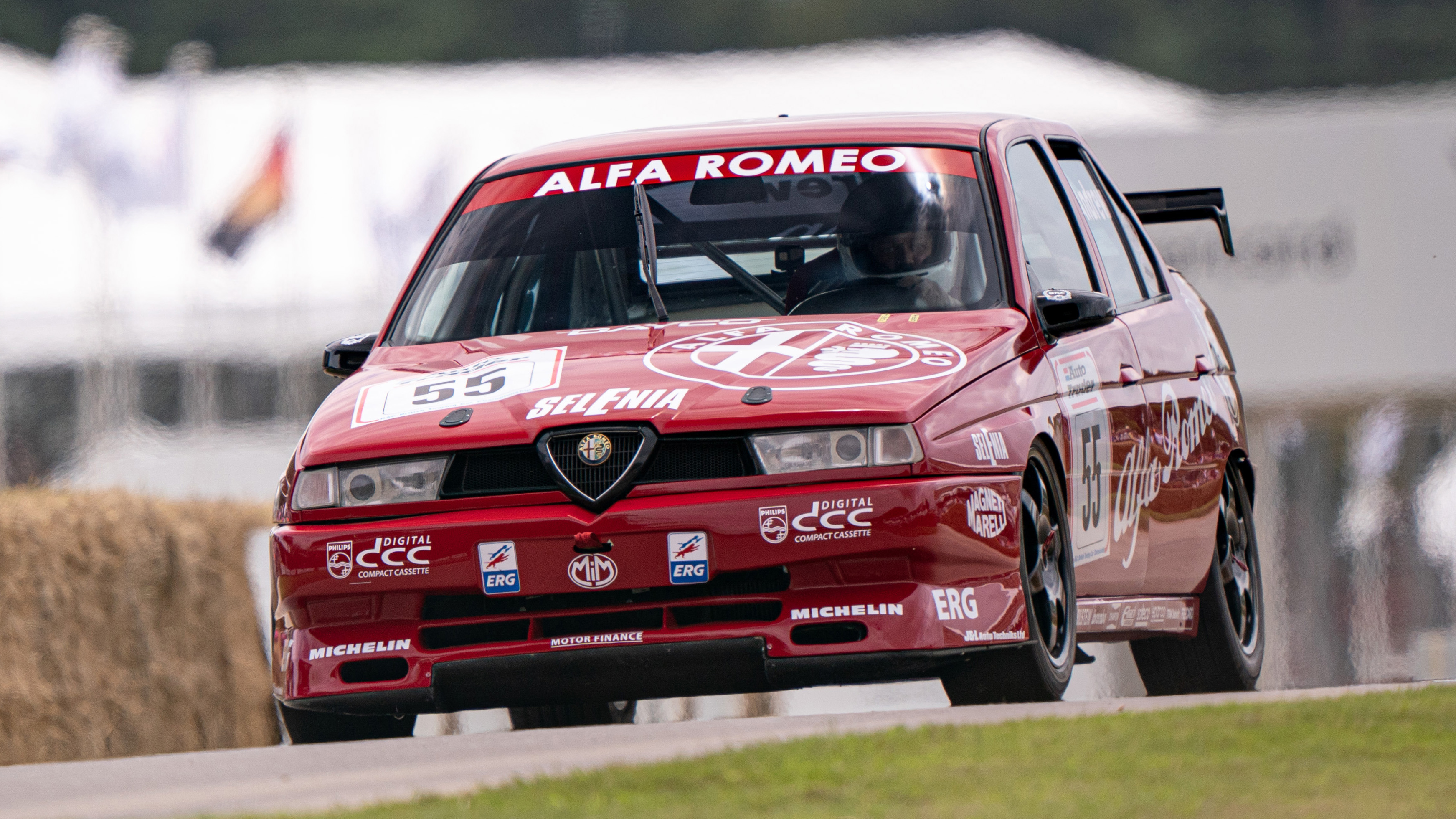
The correct approach is to be merciless with everything. The engine really only comes alive at 8,000rpm and is screaming for more as you change up at 12,000rpm. Don’t even think about using the clutch, just lift the throttle a touch on the way up and blip it to match the revs on the way down. Steam up to corners, then stand on the brakes as hard as you can and you’ll struggle to lock the hot slicks even though ABS was not incorporated until 1994.
Chuck it into the corner, still on the brakes then get back on the gas entire yards before it seems sensible and rely on that four-wheel drive traction to pull you out. If the back breaks loose, don’t lift, just keep your foot hard down, apply a wrench of counter-steer and allow physics to do the rest. Sophisticated it perhaps might not be, but my goodness it is fun.
I thought of all those other Alfa competition cars I’ve raced, mainly saloons and coupés from the ‘50s and ‘60s including several Giuliettas, an SZ, a Sprint GT, a few GTAs and even a GTAm, and the contrast between these dainty little jewels, where feel, mechanical sympathy, a good sense balance and an ability to dance on the pedals is what tends to provide the best results, and the 155 could not be more stark. It is an Alfa Romeo racing car unlike any other I’ve driven, and not one whit less interesting or enjoyable for that.
The 83rd Members' Meeting presented by Audrain Motorsport takes place on the 18th & 19th April 2026. Tickets are on sale now for GRRC Members and Fellows
You can sign up for the Fellowship now. Click here to find out more.
Photography by James Lynch and Nick Dungan.
members' meeting
83rd members' meeting
83mm
event coverage
frankel's insight
super touring
Super Touring Shoot-Out
alfa romeo
alfa romeo 155
155

Subscribe to Goodwood Road & Racing
Thank you, you’re now subscribed

How many hay bales are used at FOS?
For the last two years, 5,800 bales have been recylced into the biomass energy centre to be used for energy generation