

Taming the land speed record breaking ‘Blitzen Benz’
A land speed record car does not sound like an ideal candidate for a circuit race like the S.F. Edge Trophy at the 77th Members’ Meeting, and yet the car you see here, the Benz 200HP ‘Blitzen Benz’, did just that.
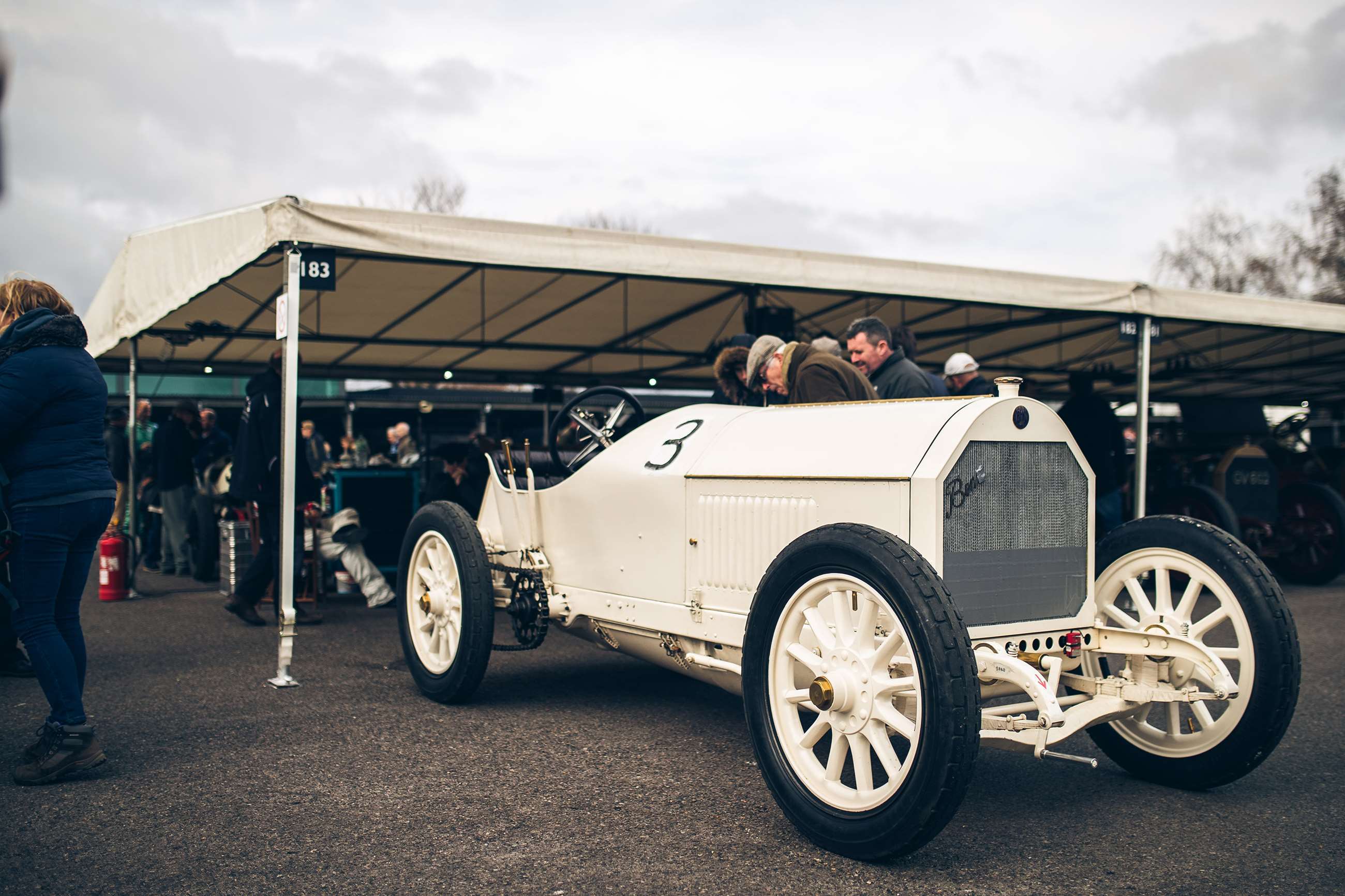
A record breaker from the very early days of motorsport, six Blitzen Benz were built by Benz & Cie, the company founded by Carl Benz in 1883. Carl Benz was against the project, failing to see the relevance of building a land speed record car when his company built regular road cars, but a Benz & Cie board member, Julius Ganss, believed that it could work publicity wonders, and so he set about building a car that would be faster than contemporary trains and planes.
Based on the 1908 Benz 150HP racer, the four-cylinder engine was bored out from 15.1-litres to 25.5-litres, upping the power output to 200 horsepower at 1,600rpm – no record-attempt or racing car from Mercedes-Benz had a bigger engine before or has had a bigger since. “It was built in 1909 to break the land speed record, which was obviously very popular to try and do at the time,” said Ben Collings, the Blitzen’s driver for 77MM. “It’s amazingly friendly to drive.”


Collings is very familiar with historic racers, having driven cars such as the 1903 Mercedes 60HP and 1925 Bentley Speed Model at Goodwood events in the past. “The engine is terribly well balanced,” he tells us. “When it’s ticking over, obviously, it’s a bit shaky, but when you have your foot down it’s really happy because the carburettor was designed and tuned to do one thing: to go very, very fast in a straight line. It’s really good at that.”
The car’s target was 200kph, a tall order back in 1909, but the car is remarkably light, tipping the scales at 1,450kg, 407kg of which is the engine. The rear wheels are chain-driven, the car uses a four-speed gearbox and the brakes are very large, but relatively ineffective, drums.


At the Benz 200HP’s first competitive outing, a sprint race in Brussels in October 1909, it not only won the race but achieved a top speed of 202.648kph. The 200kph barrier had been broken, but the car headed to America’s Daytona Beach to push a little harder in March, 1910. Having been titled the ‘Lightning Benz’ by New York Benz importer Jesse Froehlich, the ‘Blitzen Benz’, with Barney Oldfield at the wheel, clocked 211.4kph, but the record failed to meet the regulations of the day, making it a very unofficial record. It wasn’t until April 2011 that the record was extended, with ex-Buick works driver managing 228.1kph over a flying mile and 226.7kph over the flying kilometre.


Fast forward more than 100 years and it’s obvious the Blitzen is still incredibly fast, qualifying in third position for the S.F. Edge Trophy. “We just wanted to beat Duncan [Pittaway] in the Fiat,” Collings explains. “It has a huge cone clutch with a leather lining. I maybe did 30 miles in Germany last week testing. It’s slightly over-geared, with the 28-teeth sprockets, so coming into the chicane I can’t go slow enough. Off throttle, I have to try and slow the tick-over of the engine because the engine won’t tick-over slowly enough for me to go round the chicane, which is horrible. You kind of get used to it. Driving on the road is lovely.”
Is it difficult to do less than 60mph on the road in a car designed to break records? “So… First gear probably does about 50mph… I think on these sprockets we were going up a hill in third in Germany last week doing 90mph, and the hill was quite steep… It would be very interesting to see what kind of speed we were doing down the Lavant Straight.”
Collings talks us through a few of the car’s other features, including a small mixer control (the single-jet carburettor is “a bit like a hose pipe, and if you leave it on rich too much it gets really, really unhappy”), a hand fuel pump and a push-on handbrake before pointing to a small pile of daffodils by the pedals. “My vase broke, that had the daffodils in… I’m Welsh and I thought I’d have some daffodils in the car. Well I don’t know where it’s gone, but I’ve still got the flowers, so that’s good.”
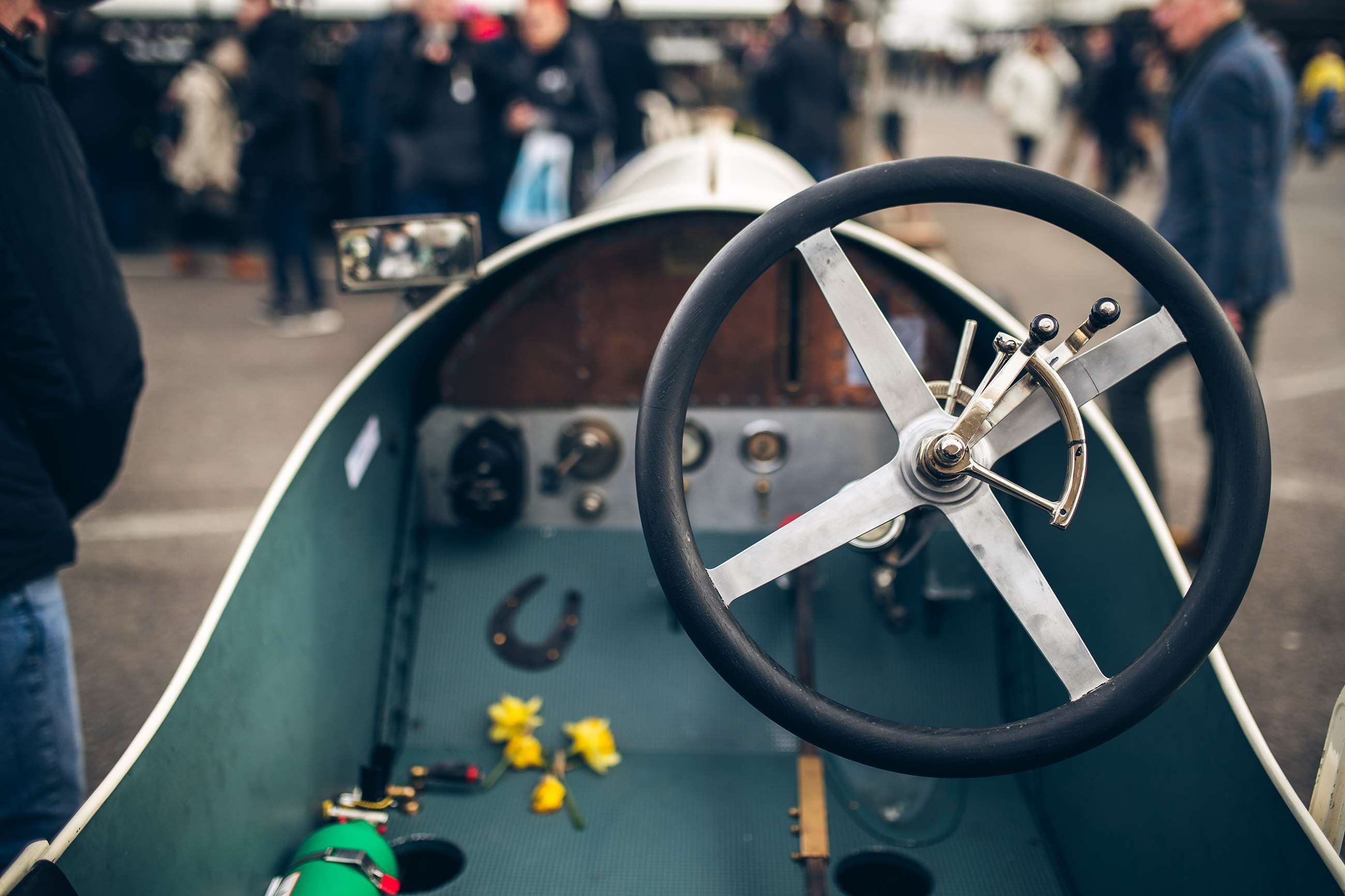
While the Blitzen probably won’t be able to match its Edwardian pace, we ask how Collings expects the car to perform in the race. “The first lap will be really interesting. With a leather clutch I can’t smoke it off the line… We’ll see, I don’t know. As long as I beat Duncan, that’s fine.”
Is anything likely to prove problematic? “Nothing. There’s nothing. The vase – that was a nice vase. It’s gone – that’s a real problem.” Collings finished third overall, just 21 seconds off the lead but, crucially, more than a lap ahead of Duncan Pittaway. Unfortunately he never did find the vase.
Photography by Tom Shaxson, track image by Jochen Van Cauwenberge.
77MM
Members Meeting
Blitzen Benz
Mercedes-Benz
SF Edge Trophy


Subscribe to Goodwood Road & Racing
Thank you, you’re now subscribed

How many hay bales are used at FOS?
For the last two years, 5,800 bales have been recylced into the biomass energy centre to be used for energy generation