

This century-old Sunbeam will return to the track at Members’ Meeting
At the 83rd Members’ Meeting presented by Audrain Motorsport, a remarkable car that marked the inception of a long partnership between two great names of British motor racing will return to competition for the first time since 1969.
For schoolboys in the 1920s and ’30s there was no shortage of heroic racing drivers, airmen and adventurers to idolise, but there were names that stood out amongst the often distinguished and occasionally eccentric crowd.
Sir Henry Segrave was certainly one of them. As a commissioned officer with the Royal Warwickshire Regiment, he fought, quite literally, hand-to-hand in the mud of World War I before joining the young pioneers of flight in the newly formed Royal Air Corps. After the war, like many others, he gravitated toward Surrey and in addition to his many Brooklands victories he became the first British driver to win a Grand Prix in a British car.
He was also the first to travel faster than 200mph on land, the first person to exceed 100mph on water and the first to hold both land and water speed records concurrently. In 1929, Segrave became the first man to be knighted for his contribution to motorsport.
In short, he left an indelible mark on British life and, by most accounts, did it all with the greatest possible grace and élan and the least possible fuss and fanfare. Such were his achievements that the Royal Automobile Club continues to award the Segrave Trophy to any British national who has demonstrated “Outstanding Skill, Courage and Initiative on Land, Water and in the Air.”
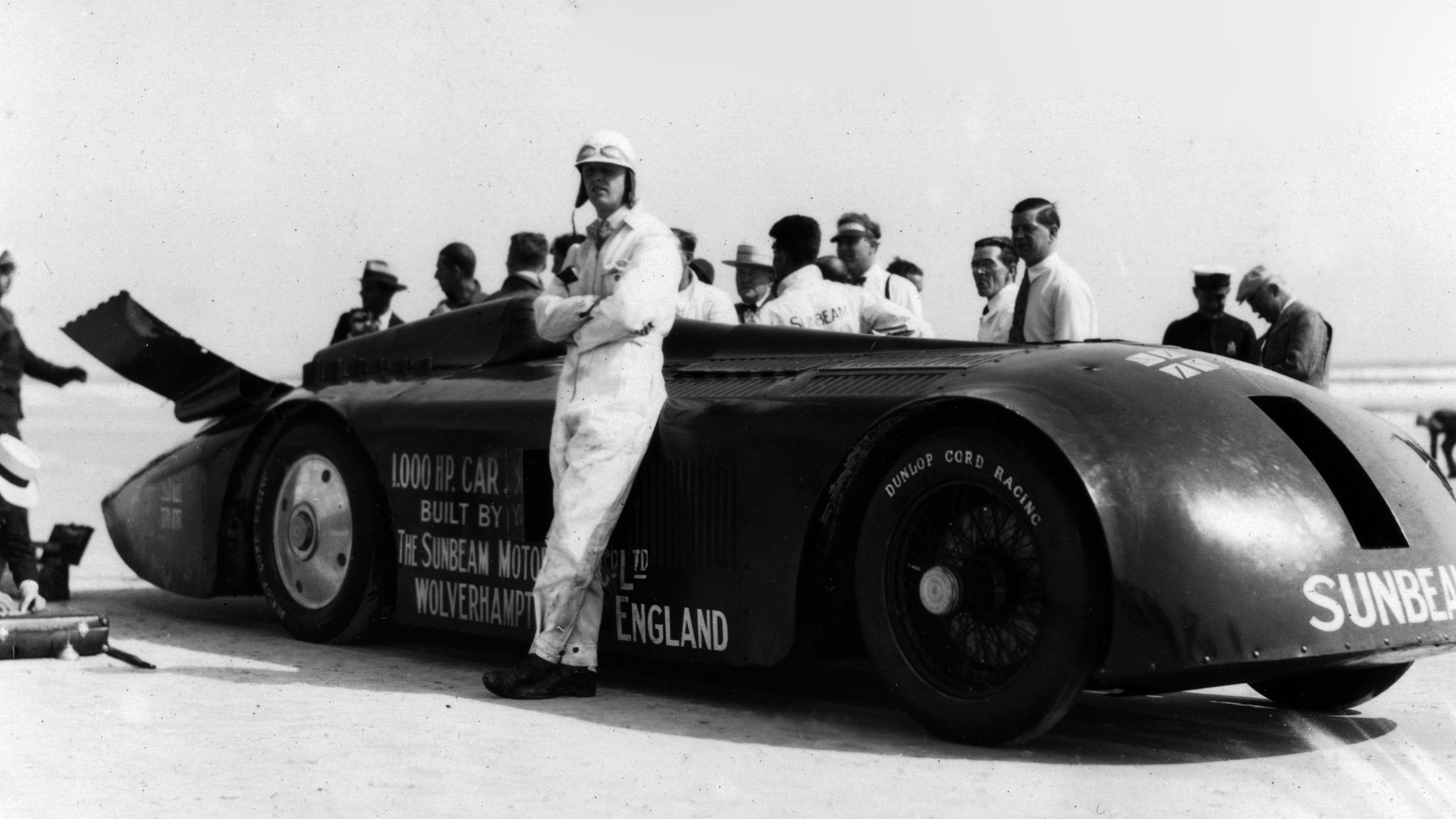
With the Sunbeam 1000hp 'Slug', Segrave attemped a world land speed record at Daytona 1927.
Image credit: Getty ImagesBegin, for a moment, to comprehend the audacity of his land-speed record machines. From the Sunbeam Tiger of 1926, to the twin-engined 1000hp ‘Slug’ and the gargantuan Golden Arrow, it should come as no surprise that his name is synonymous with speed. His love for it, perhaps ignited in the cockpit of a DH2 biplane over the battlefields of the Somme, found its early satisfaction on the concrete banking of Brooklands.
It was there, in an Opel, that he first caught the attention of Louis Coatalen, then the driving force behind S.T.D. Motors. His deft handling of the errant car as it slewed across the track on a burst tyre persuaded Coatalen that he was a driver of rare promise. A works drive for 1921 followed, and the die was cast for a long and fruitful partnership.
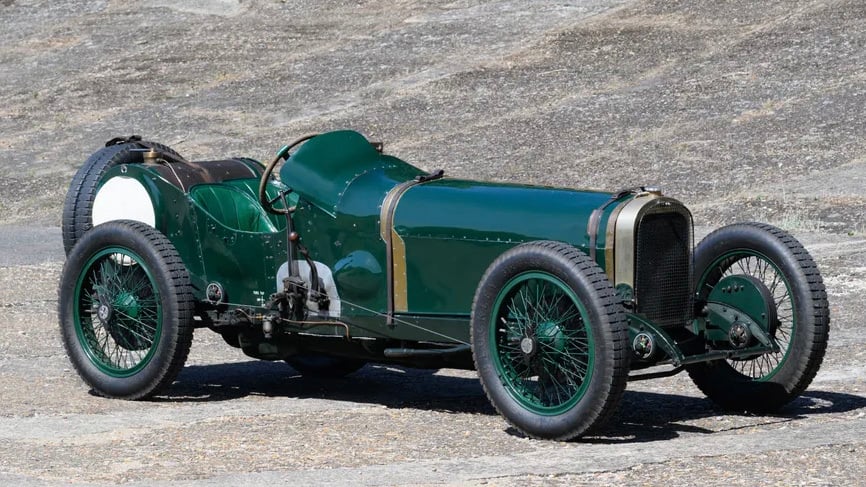
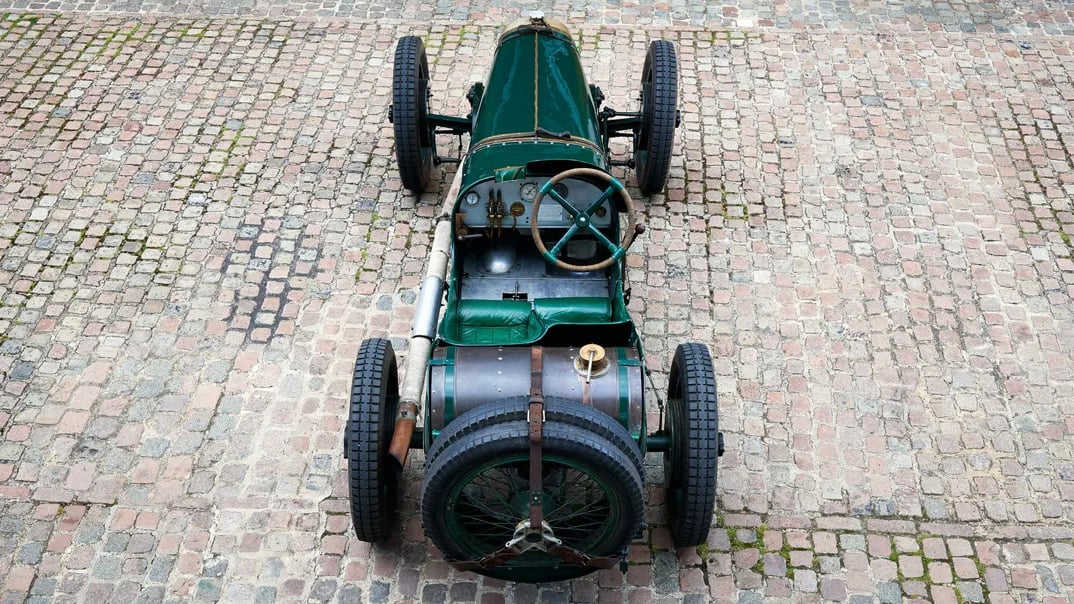
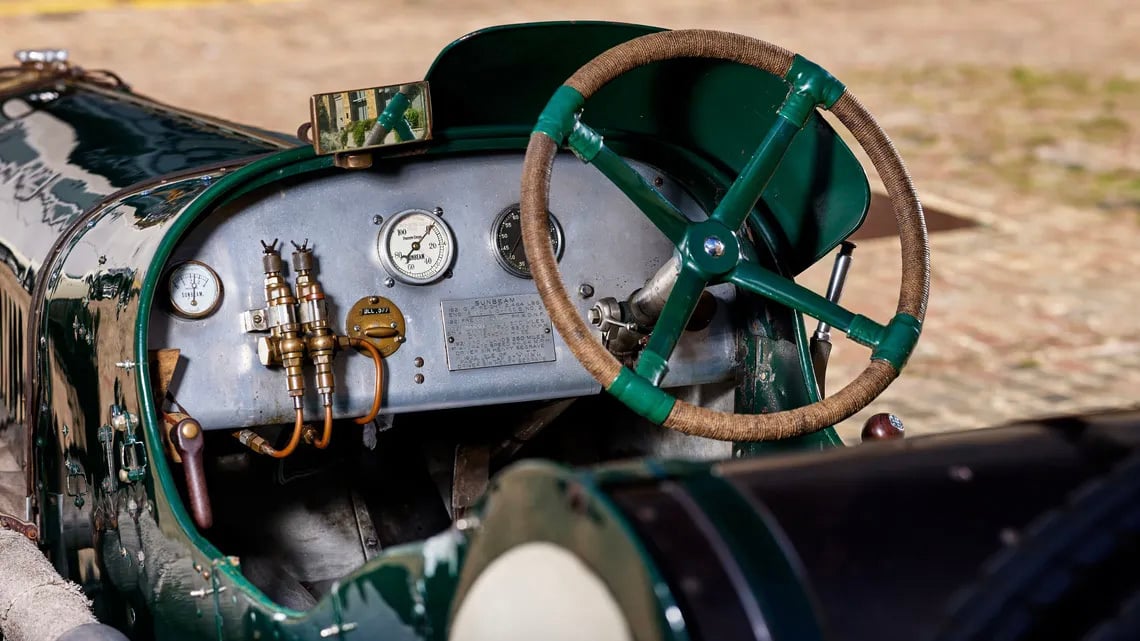
The car that appears on the grid of the S.F. Edge Trophy represents Segrave’s first works drive for Coatalen’s S.T.D. concern. Drawing on insights gained from wartime aero engine design, and in keeping with the emerging orthodoxy established before the war, the 3.0-litre, eight-cylinder machine featured twin overhead camshafts operating four valves per cylinder, dry-sump lubrication and four-wheel braking.
Fed by four Claudel Hobson carburettors, it produced in the region of 109PS (81kW) at 4,000rpm. In layout and conception, it bore a striking resemblance to the work of Ernest Henry, whose influence loomed large over Grand Prix design in this period.
Though often retrospectively described as a Sunbeam, the car did not always carry that name. In keeping with Coatalen’s curious and often confusing branding practices, the 3.0-litre cars were entered under the Talbot designation at the 1921 French Grand Prix.
Regardless of nomenclature, for Segrave it represented his first true opportunity on the Grand Prix stage with a fully works-backed team, and the significance of that opportunity was not lost on him. Of this, his first great road race, he would later write that even if he had an axle broken he would somehow have contrived to complete the distance. “To get there meant more than anything else in the world to me at that time.”
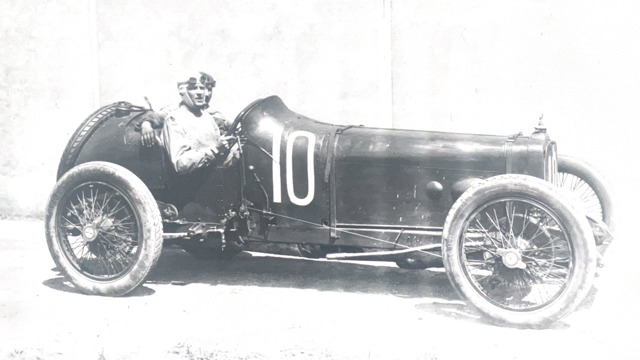
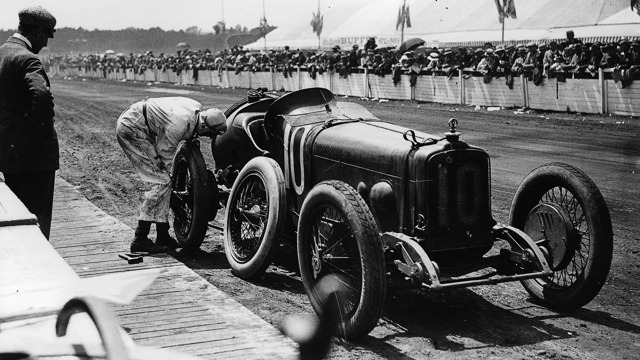
The car had already shown promise earlier in the year at Indianapolis, where it proved competitive, if not victorious, against the formidable American machines. Yet preparations for the French Grand Prix were thrown into disarray when a coal strike disrupted activity at the Wolverhampton works.
With both his own and the company’s reputation uppermost in his mind, Coatalen initially withdrew all entries. Segrave, along with Kenelm Lee Guinness, pressed their case with determination and in the end Coatalen relented. A reduced team was permitted to run, and after a week of intense effort the cars were made ready for the start.
To understand why these machines appeared under so many different names, one must briefly untangle the story of Sunbeam, Talbot and Darracq and their amalgamation into S.T.D. Motors.
It is not the simplest of narratives, and is perhaps best left to more dedicated historians, but what is clear is that Coatalen presided over its competition efforts with singular authority. In the early 1920s, cars of essentially identical design were entered under a variety of different designations — Sunbeam, Talbot, Talbot-Darracq or Darracq — according to circumstance and commercial intent.
As individual marques they achieved only intermittent success, yet taken together their record is far more impressive. The JCC 200 Mile Race at Brooklands, for instance, was won five times by S.T.D. machinery, albeit under three different names.
Guided by the philosophy that “racing improves the breed”, Coatalen had already established a formidable reputation before the WWI. In the 1912 Coupe de l’Auto, run alongside the Grand Prix for 3.0-litre cars, Sunbeam secured a remarkable 1–2–3 finish, with Victor Rigal also placing third overall.
Jean Chassagne took third in the 1913 French Grand Prix in a 4.5-litre six-cylinder Sunbeam, before that same year saw further success at Brooklands, where records fell at an average speed of over 90mph sustained for 12 hours. Kenelm Lee Guinness added another third place in the 1913 Grand Prix, and in 1914 Sunbeam claimed outright victory in the RAC Tourist Trophy.
How much of Coatalen’s 1914 ‘TT’ success owed itself to the ideas of Ernest Henry and the group of engineers and drivers known as “Les Charlatans”, is a question that may never be fully resolved. Working with Peugeot and inspired by drivers such as Jules Goux, Georges Boillot and Paul Zuccarelli, Henry devised an engine architecture that would redefine the racing car.
First realised in the Peugeot L76 of 1912, it combined twin overhead camshafts with four inclined valves per cylinder, a hemispherical combustion chamber and centralised ignition.
While none of these elements were entirely new in isolation, their effective integration in a single design was revolutionary. The 7.6-litre engine produced 132PS (97kW) and, in the hands of Georges Boillot, proved capable of defeating much larger opposition. In the years that followed, variations of the design would dominate Grand Prix racing, the Coupe de l’Auto, Indianapolis and the record books at Brooklands.
It is said that, aided by Peugeot’s own enthusiasm for publicity, Coatalen managed to obtain one of these Grand Prix engines and have it quietly examined by his engineers. Whether viewed as inspired pragmatism or something more questionable, the result was clear: the new architecture was simply too effective to ignore.
Much as the rear-engined revolution would sweep through the sport half a century later, so too did this design philosophy take hold, and in time it would be adopted by almost every serious manufacturer.
War interrupted European racing, but the canny Coatalen stole a march on his competitors by fielding cars in American events, and in 1916 scored an impressive fifth place at Indianapolis with a 4.9-litre six-cylinder development of the earlier Grand Prix machines. Meanwhile, the Sunbeam works had been incredibly busy during the war building aero engines, producing no fewer than 22 different types and significantly extending its Wolverhampton facility. By the time peace returned in 1918, Sunbeam was in a better position than most to resume its racing ambitions.
For Segrave and his trusted mechanic, Jules Moriceau, the French Grand Prix was a baptism of fire — and rock. The Le Mans course, which ran to a distance of around 520km, was in an appalling state of repair, its unmetalled roads strewn with stones of all shapes and sizes. Such was the havoc wrought that Segrave and Moriceau were forced to change tyres no fewer than 14 times, while one errant stone pierced the oil tank, necessitating a Heath Robinson repair with torn cloth.
It was not just the car that was assailed:
“When following Murphy along one of the short pieces of straight, Murphy’s car picked up a big stone off the road and hurled it back like a bullet. The stone struck my car with such force that it went clean through the wire mesh stone guard which formed a rudimentary windscreen […] struck the steering wheel — severing the cord wound around it — and then hit Moriceau on the head, knocking him practically unconscious and cutting him badly.”
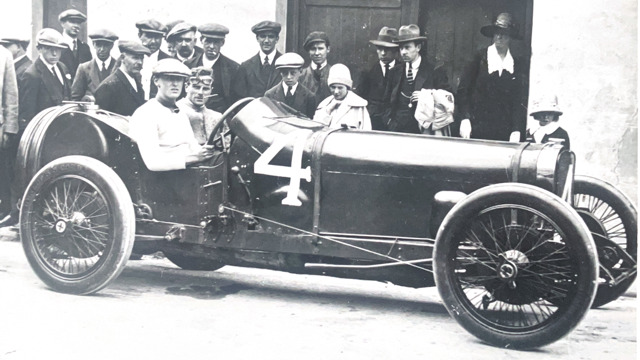
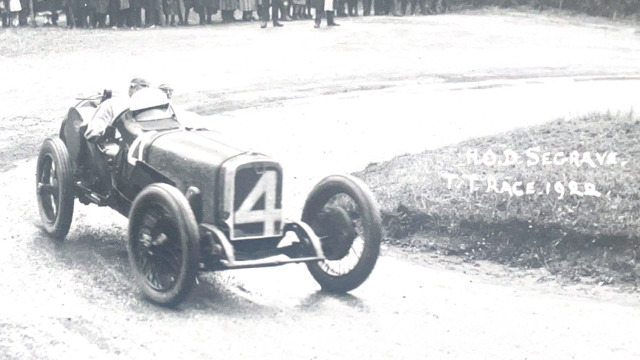
After a Herculean effort, the S.T.D. cars were outclassed by the well-prepared Ballot team and the ground-breaking hydraulic brakes of the Duesenbergs. Segrave, true to his word, nursed his car — and his mechanic — to the finish, but there was no one left running behind him.
Following disappointment in France, Coatalen withdrew all S.T.D. entries for the inaugural Italian Grand Prix, and with the change to a 2.0-litre formula in 1922 the 3.0-litre cars would contest no further Grands Prix. In 1922, however, the RAC Tourist Trophy was revived for the first time in eight years and was held, for the last time for cars, on the roads of the Isle of Man. Open to machines of up to 3.0-litres, Sunbeam entered three modified 1921 cars for Jean Chassagne, Segrave and Kenelm Lee Guinness.
The ‘Dreadnought Grey’ Sunbeams lined up against three white and red Bentleys and three scarlet Vauxhalls. The race was run in atrocious wind and rain, conditions which Chassagne, the eventual winner, would later describe as a “nightmare in a sea of mud.”
A broken clutch prevented Guinness from starting, while magneto failure forced Segrave to retire on lap five — though not before he had set both the fastest lap in practice and in the race itself. It fell to the experienced Chassagne to carry the fight, and in overcoming the treacherous conditions he secured victory and with it a place in history for the 3.0-litre straight-eight Sunbeams of 1921, earning them, in retrospect, the ‘TT’ designation.
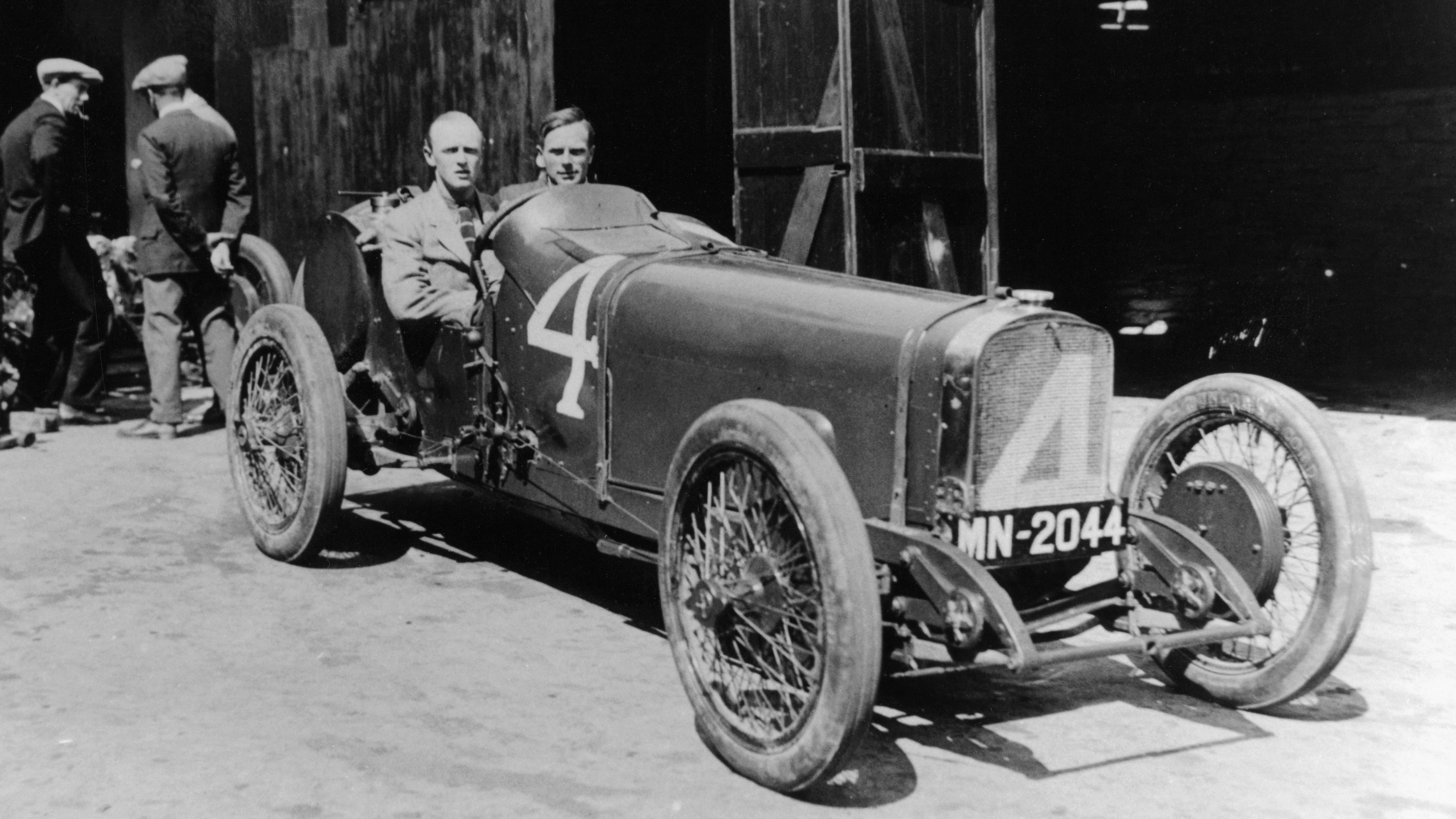
Segrave in a Sunbeam at the Isle of Man for the 1922 RAC Tourist Trophy.
Image credit: Getty ImagesThe Isle of Man proved the triumphant swansong of a brief competition career. Segrave’s Chassis No. 2 was later converted for road use by the Works and passed through a succession of knowledgeable custodians, from early private ownership to the Rootes Motor Museum and later to the Donington Collection. It remains a beautifully preserved and evocative survivor from a period of motor racing from which few of its contemporaries endure.
Yet its true significance lies not in its victories or failures, but as the starting point of a great British story. For it was with this car that Segrave first took his place at the wheel of a works S.T.D. Grand Prix machine — the beginning of a partnership with Sunbeam that would carry him from promising newcomer to national hero and record-breaker.
Its return to the track this weekend for the S.F. Edge Trophy is therefore more than the reawakening of a historic racing car; it is the revival of the moment at which one of British motor racing’s most remarkable stories first gathered momentum.
The 83rd Members' Meeting presented by Audrain Motorsport takes place on the 18th & 19th April 2026. Tickets are now sold out. You can sign up for ticket alerts for 2027 and join the Fellowship today so you can be alerted when tickets for 84MM go on sale.
Images courtesy of Tom Edwardes and Getty Images.
members' meeting
83mm
event coverage
S.F. Edge Trophy
S.F. Edge Trophy feature
Sunbeam

Subscribe to Goodwood Road & Racing
Thank you, you’re now subscribed

How many hay bales are used at FOS?
For the last two years, 5,800 bales have been recylced into the biomass energy centre to be used for energy generation