
Nürburgring 1957: Fangio’s day of days
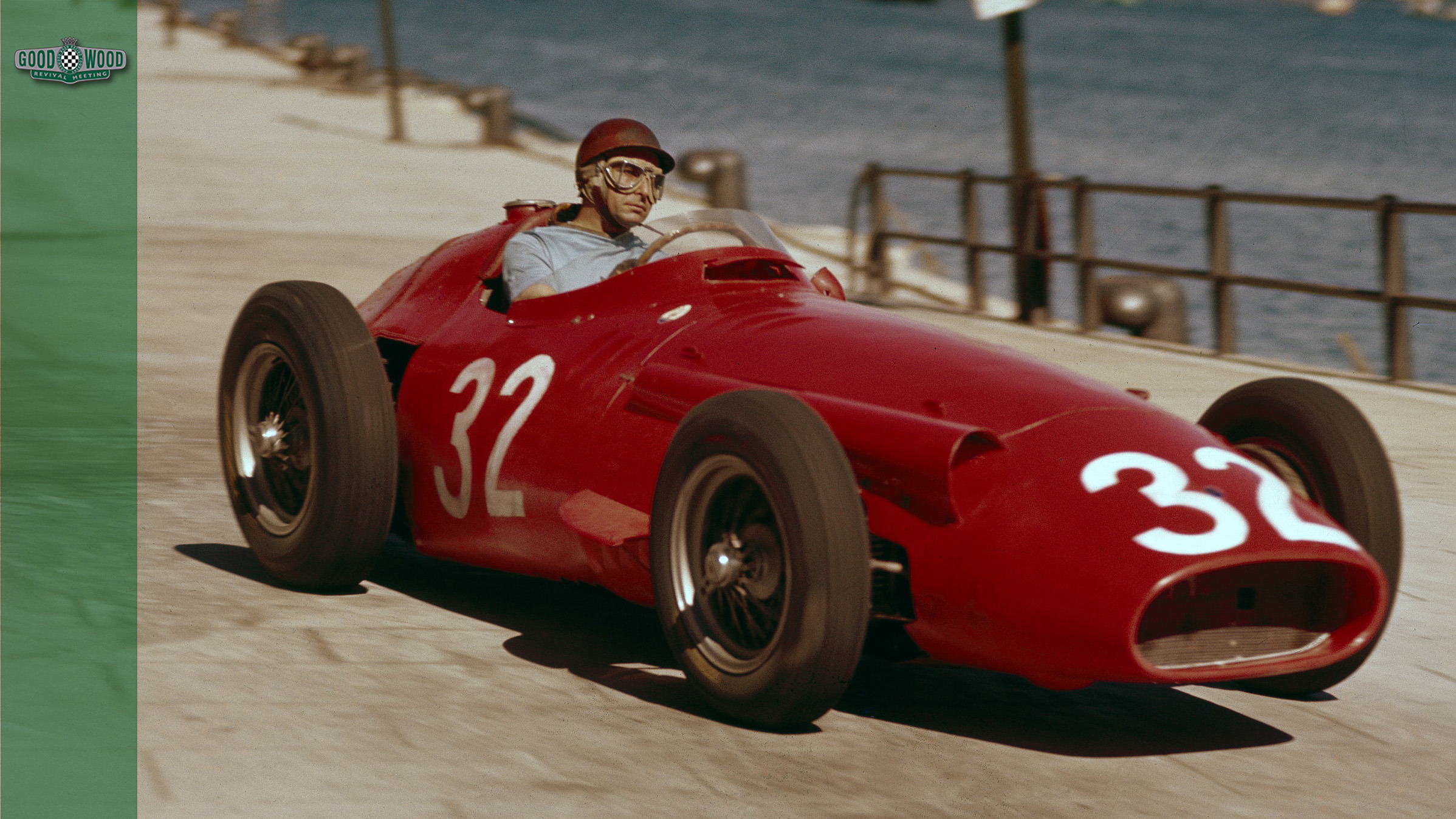
The greatest Formula 1 drive of them all? Juan Manuel Fangio at the Nürburgring in 1957 will forever be up there as the benchmark. Even the great man himself admitted it was his day of days as he stepped up to and perhaps beyond his own soaring limit to score his 24th and final World Championship Grand Prix win in a glorious Maserati 250F.
As we look forward to celebrating Maserati at the Goodwood Revival, 100 years on from the its maiden success at the 1926 Targa Florio, let’s look back at the performance that marked the high watermark of the Trident’s glory era in F1.
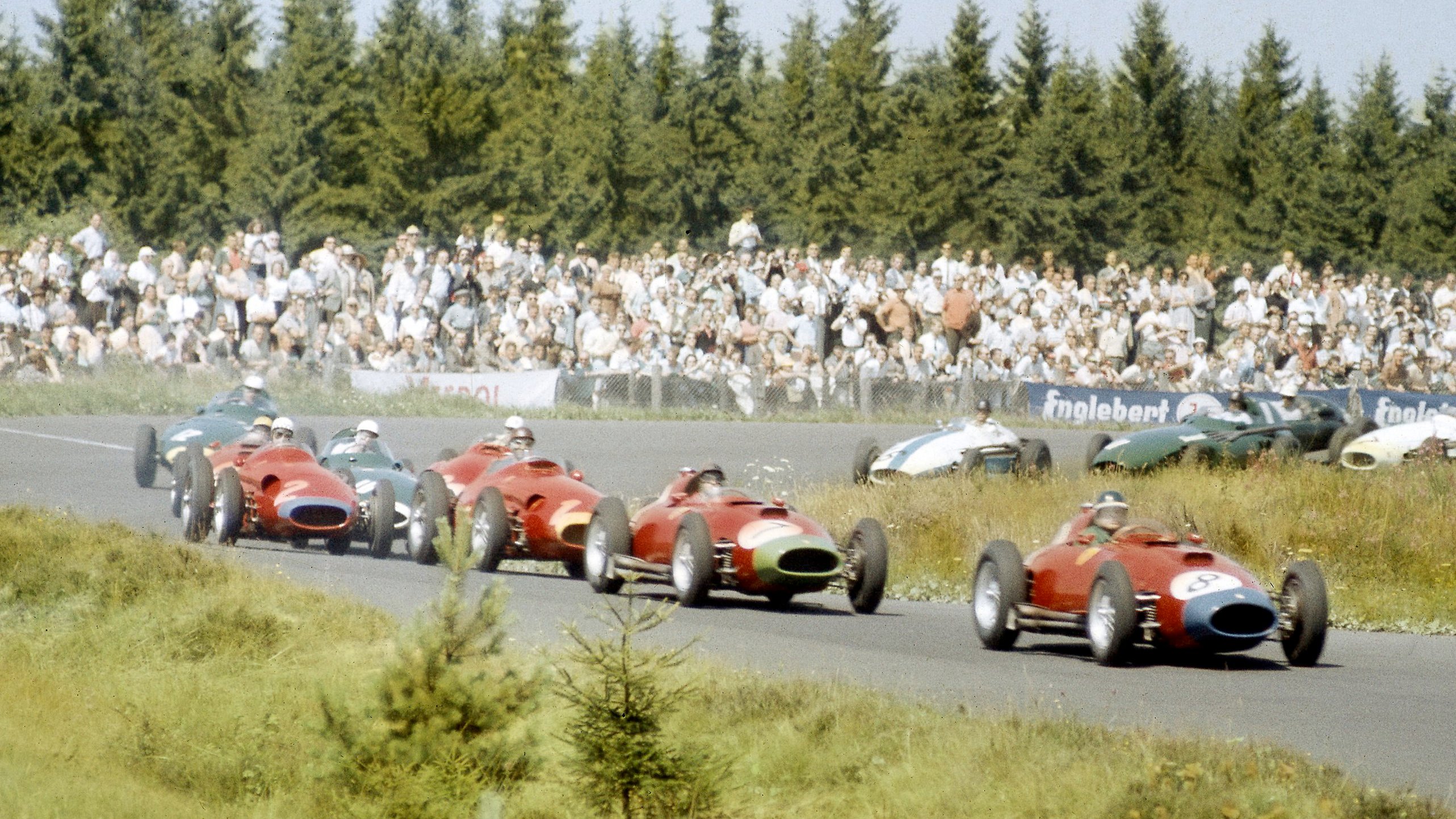
Fangio vs. the Nürburgring
The 1957 German Grand Prix not only made Fangio a five-time World Champion, it also crowned him the undisputed master of the 14-mile Nürburgring.
The Argentine had first won the German Grand Prix in 1954, aboard a Mercedes W196. The race was cancelled in 1955 in the wake of the Le Mans disaster which killed more than 80 spectators, but upon its return to the F1 calendar in 1956, Fangio won again, this time in a Lancia-Ferrari D50. Now he did it again in a Maserati — a hat-trick in three different makes of car, at the toughest, most feared race track of them all.
Fangio vs. Ferrari
The opposition on 4th August 1957 boiled down to two Ferraris driven by those best of ‘Mon Ami Mates’, Peter Collins and Mike Hawthorn. Just two weeks prior, Stirling Moss and Tony Brooks had shared victory for Vanwall at the British Grand Prix. But flat and relatively smooth Aintree was an entirely different proposition to the winding circuit in the Eifel mountains.
In Germany, the pace-setting British cars were rendered into also-rans by shock absorber and suspension balance bothers over the incessant undulations. Moss trailed home a distant fifth as Fangio, Collins and Hawthorn fought for the win.
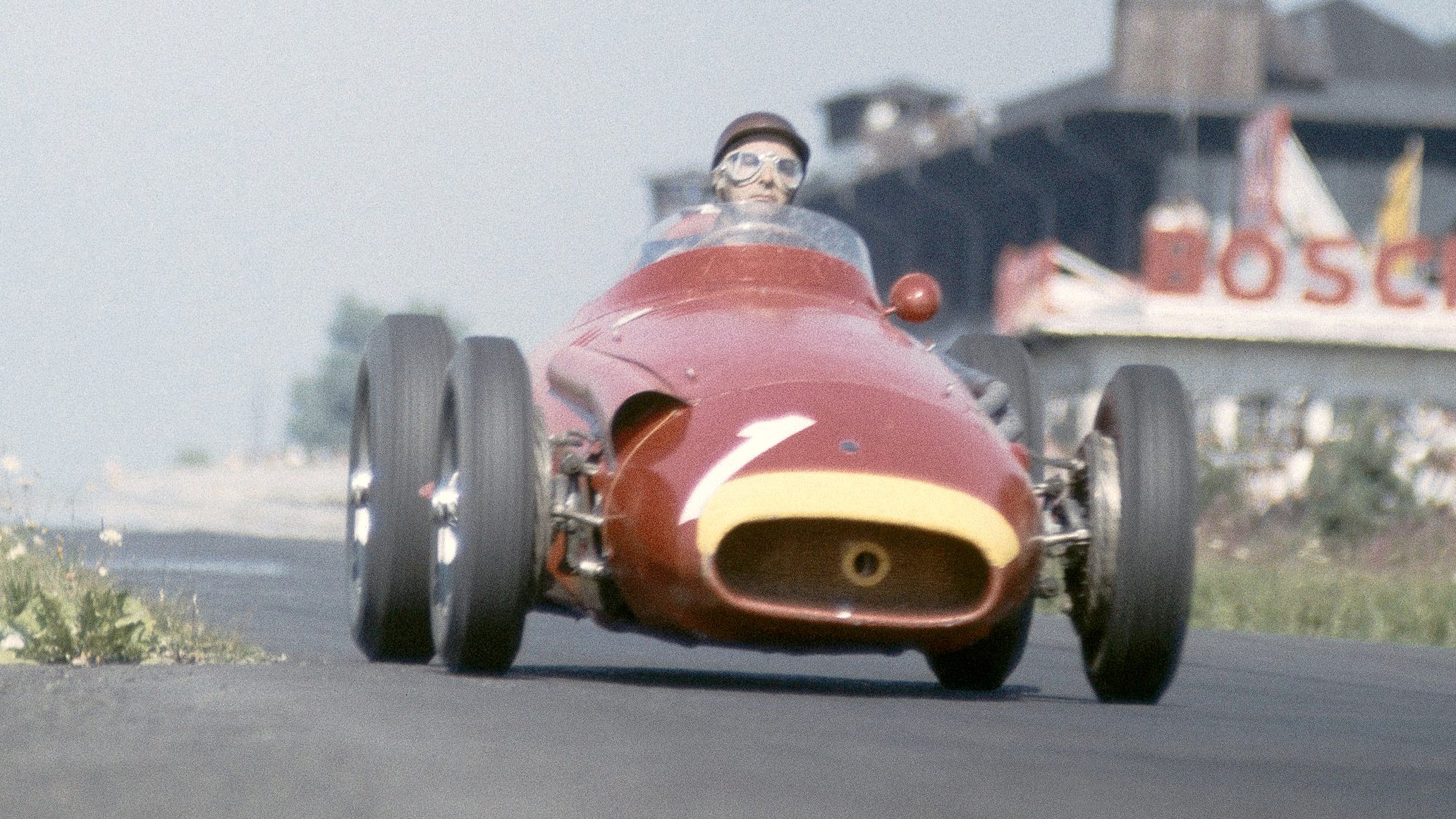
Juan Manuel Fangio races his Maserati 250F at the Nürburgring at the German Grand Prix, August 1957.
Image credit: Getty ImagesFangio was at one with his Maserati that weekend. He took pole position at an average of 90mph in a time of 9:25.6 and looked thoroughly composed through practice. As a crowd of an estimated 200,000 assembled for the 13:15 start, the stage was set for battle between the Maestro in his Maserati and the two blond Brits in their Ferraris.
It was Collins who led the early stages, but Fangio soon settled into his rhythm and by lap three had opened up a five-second advantage out front. By half-distance the gap was close to half a minute, but then Fangio took a tactical pitstop — something that was far from common in the 1950s. Concerned his soft Pirelli tyres wouldn’t go the distance, he’d planned a sprint on half tanks, then a fuel and tyre change.
He came in on lap 12. Even by the standards of the day it was a slow stop, lasting close to a minute. When he rejoined a 28sec advantage had turned into a deficit of 52sec. Now the chase and comeback began.
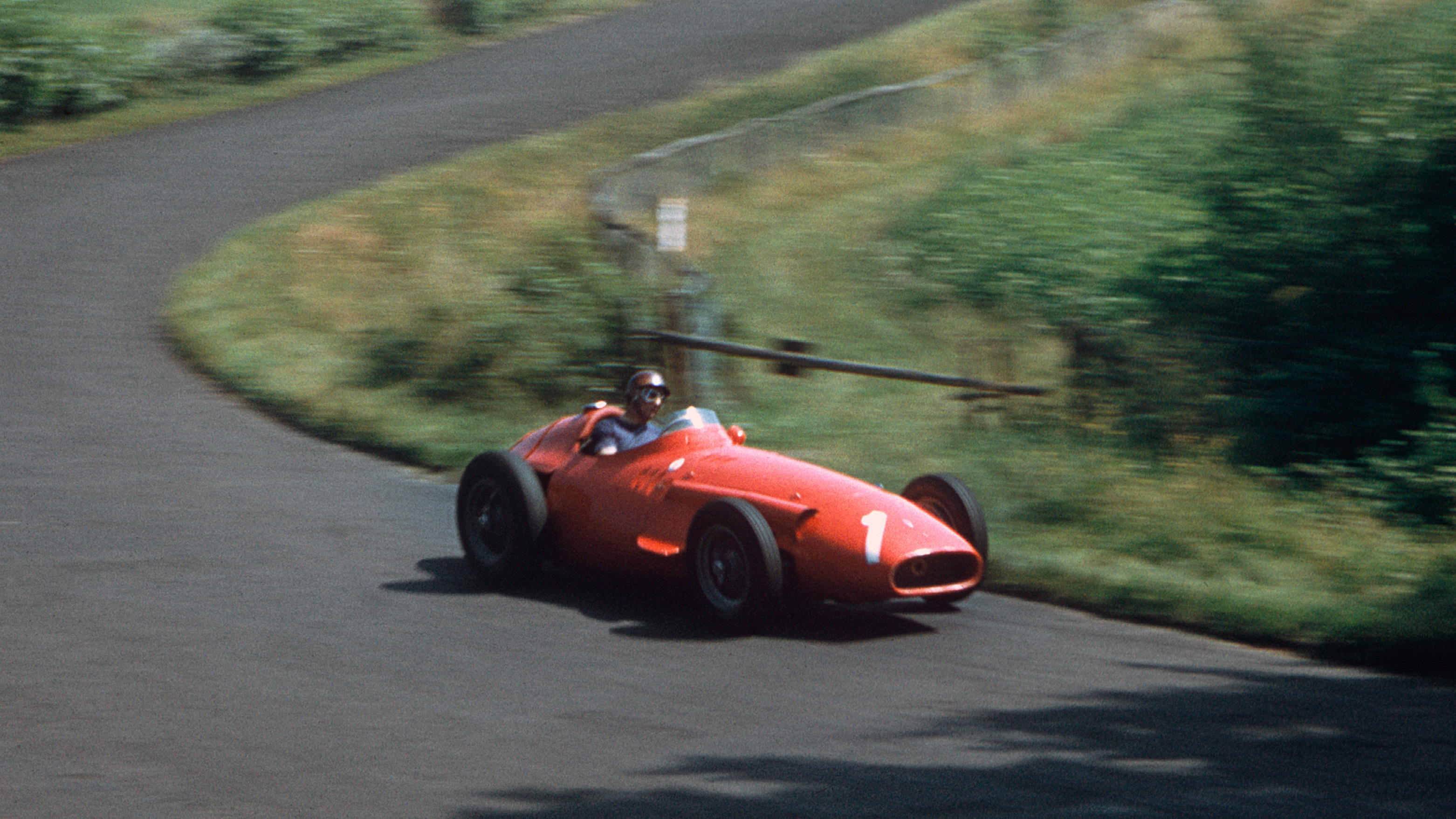
Fangio undertook one of the most impressive comebacks to win his fourth and final race of his triumphant 1957 campaign.
Image credit: Getty ImagesFerrari’s false sense of security
But not immediately. Denis Jenkinson’s period report in Motor Sport suggests it took some time for Fangio to begin making inroads to the Ferraris on fresh tyres and a full fuel load. But in Fangio’s autobiography, his business manager and collaborator in the book claims there was a ruse to convince Ferrari it could relax, to make them think the Maserati was no threat to Hawthorn and Collins finishing 1-2.
“Before Juan took off again, I leaned over and spoke to him,” relates Marcello Giambertone about the pitstop. “‘Listen… Can you take it a bit easy for two laps and not go flat out until [famed Maserati mechanic Guerino] Bertocchi gives you a go-ahead signal?’ The old racing fox Juan caught on and was about to smile. I tightened my grip on his arm and whispered, ‘Don’t smile. Look serious. Shake your head. You’re being watched…’ Fangio played his part marvellously and behind his goggles his eyes sparkled with joy.”
Giambertone claims Ferrari showed a ‘slow’ board to Hawthorn and Collins as proof the ruse worked, and then Fangio began to push. On such a long lap, he was able to take slabs of time out of the Ferraris before they could know and warn the Brits that the Argentine was coming for them.
On lap 21 of 22, Fangio was on them, as Jenks relates in Motor Sport. “Round the Sudkerve he was grinning contentedly at the two young boys and as Collins went into the left-handed Nordkerve Fangio went by him on the inside. Then came the most shattering announcement of the whole race: Fangio has just lapped in 9min 17.4 sec!
"An unbelievable record but obviously true for he had gained 11sec on Hawthorn in 14 miles. Before reaching the lowest point of the course, at Breidscheid, Hawthorn had been overtaken and with a lap and a half to go Fangio had made up for his pitstop.”
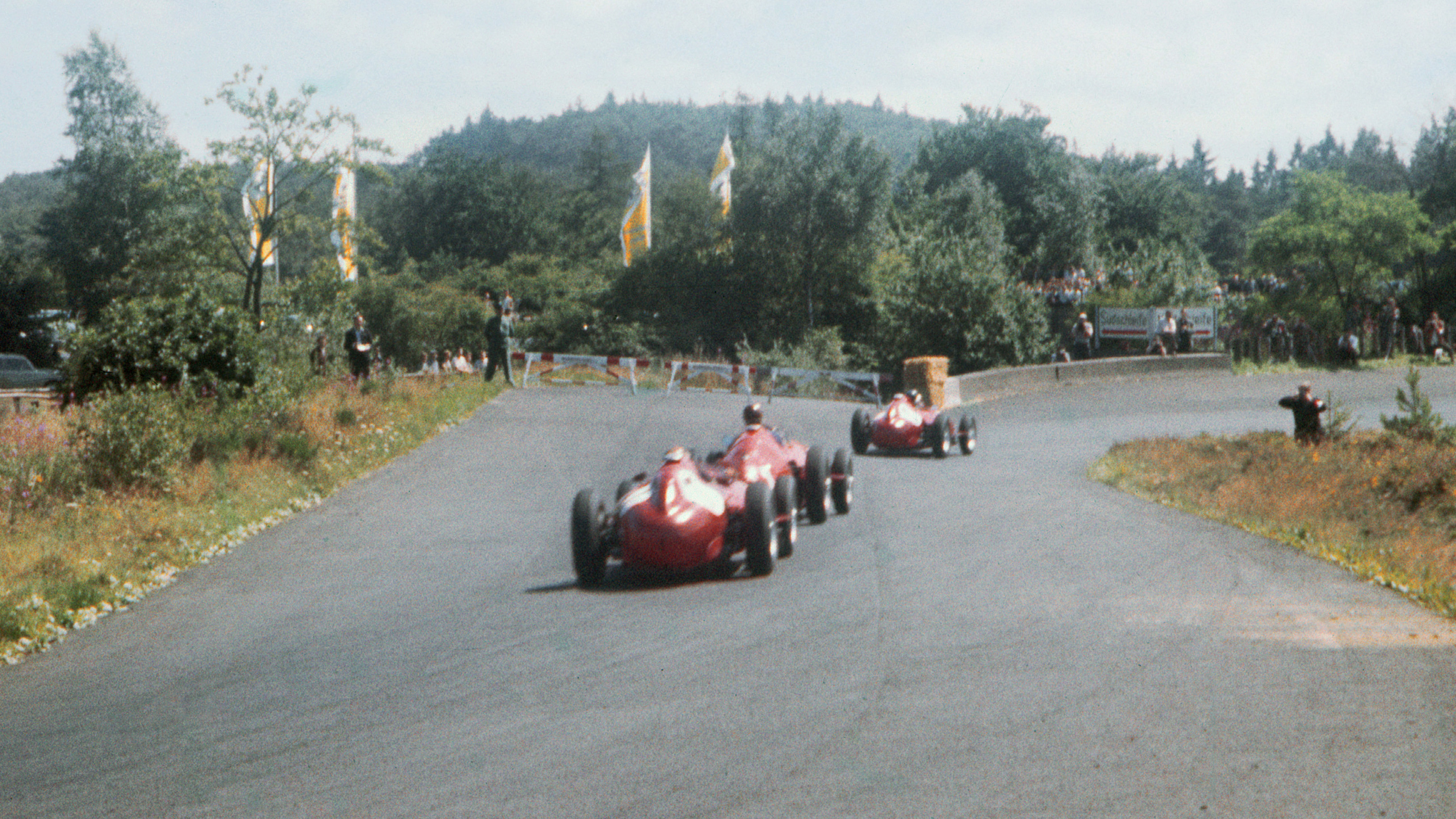
Fangio sandwiched between the Lancia-Ferrari D50s of Mike Hawthorn and Peter Collins during the 1957 German Grand Prix.
Image credit: Getty ImagesAs Jenks also relates, Hawthorn gave everything to respond and chased Fangio hard over the final miles but came up 3.6secs short. What a charge, what a finish, what a performance. The new lap record, Jenks quotes, on an admittedly resurfaced Nürburgring, was a full 24secs faster than the mark he’d left in 1956 in the Lancia-Ferrari, but even 11secs faster than his own pole position time in the Maserati.
Day of days
More than 20 years later, when Nigel Roebuck interviewed his idol in London, Fangio gave some indication just what the 1957 German Grand Prix had taken out of him.
“I loved that Maserati,” he said. “It wasn’t very powerful, but it was beautifully balanced — I felt I could do anything with it. Even now, sitting here with you all these years later, when I think of that race I can feel fear. The Nürburgring was always my favourite circuit — I loved it, all of it, and I think that day I conquered it, but on another day it might have conquered me, who knows?
“Afterwards I knew what I had done, the chances I had taken — I believe that day I took myself and my car to the limit, and perhaps a little bit more. I had never driven like that before, and I knew I never would again.”
The last great drive
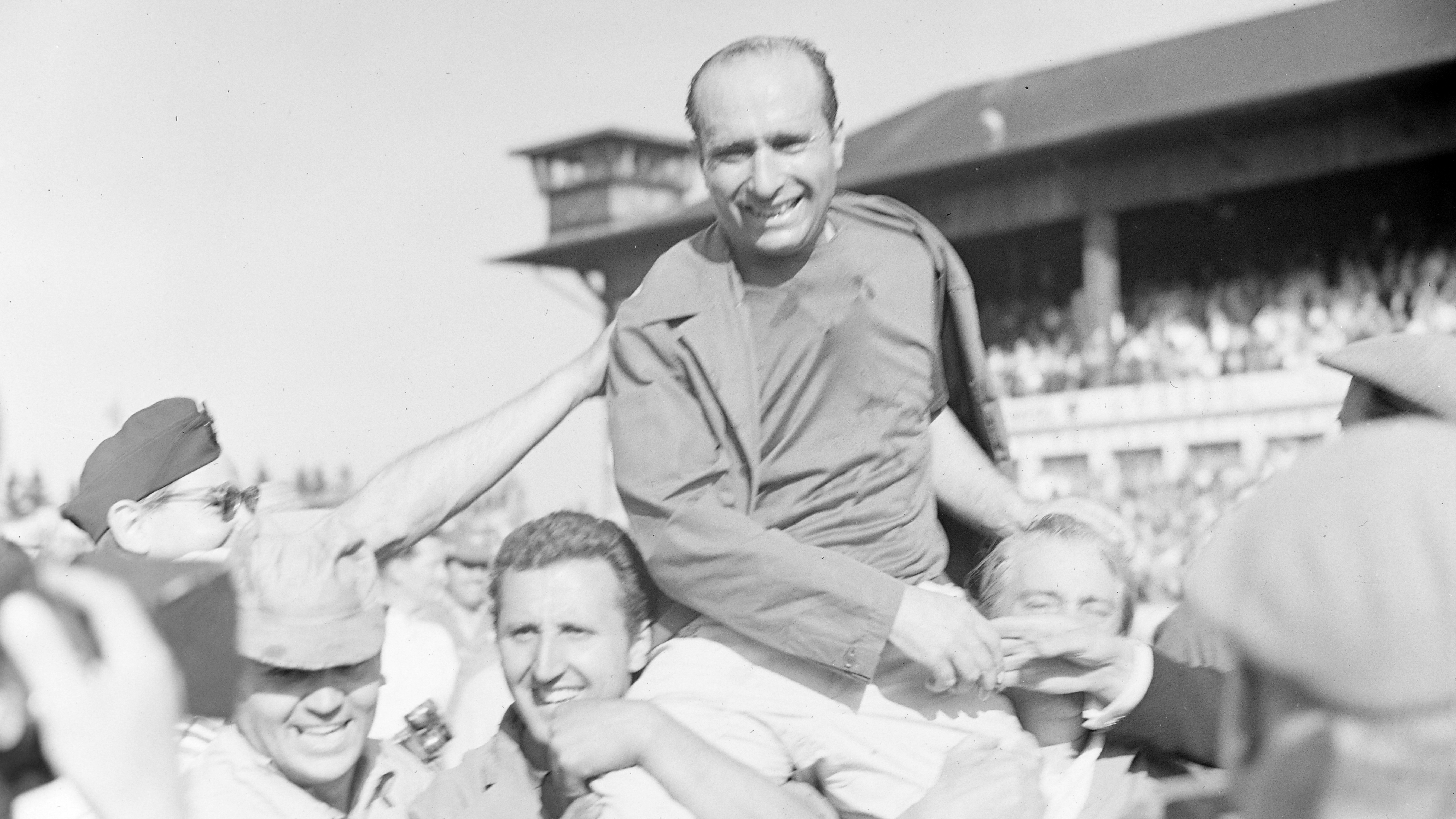
Beaten by Moss at Pescara later that month, Fangio knew he’d reached his zenith and that, at the age of 46, his time at racing’s pinnacle was nearly up. The following year he’d retire mid-season to enjoy the rest of his life as F1’s most revered elder statesman.
“1957. What a year!” he’d reflect in his autobiography. “A year when I was at the peak of my form and lived with the cars I drove. An intense and strenuous year, scarcely dimmed by a feeling that I would certainly never again see such a brilliant season.”
It’s also probably true that F1 as a whole would never see a better drive than Fangio’s at the ’Ring in ’57. It still resonates today as the greatest example of beyond-the-limit heroics by F1’s Maestro of the 1950s.
Tickets for the 2026 Goodwood Revival are now on sale. If you’re not already part of the GRRC, you can sign up to the Fellowship today and save ten per cent on your 2026 tickets and grandstand passes, as well as enjoying a whole host of other on-event perks.
Main image courtesy of Getty Images.
formula 1
f1
revival
Nurburgring
Juan Manuel Fangio
maserati
Maserati 250F
Maserati Celebration
Subscribe to Goodwood Road & Racing
Thank you, you’re now subscribed

How many hay bales are used at FOS?
For the last two years, 5,800 bales have been recylced into the biomass energy centre to be used for energy generation