

Driving the Lavant Cup’s most beautiful Ferrari | Frankel’s Insight
 Andrew Frankel
I cannot imagine a more beautiful or indeed more valuable grid at the 2026 Goodwood Revival than that of the Lavant Cup — this year run exclusively for 1950s Maseratis and Ferraris.
From Maserati there will be A6GCSs and 300Ss, a 200S perhaps and maybe even a monster 450S to really keep its driver on their toes. The list of possible Ferraris is positively dizzying, from a 166MM at the very start of the decade to the fabled Testa Rossa at the other, with the 250MM, 375 Plus, 335S, 340 Mexico, 500 Mondial, 121LM and the 750 Monza in between and plenty more besides.
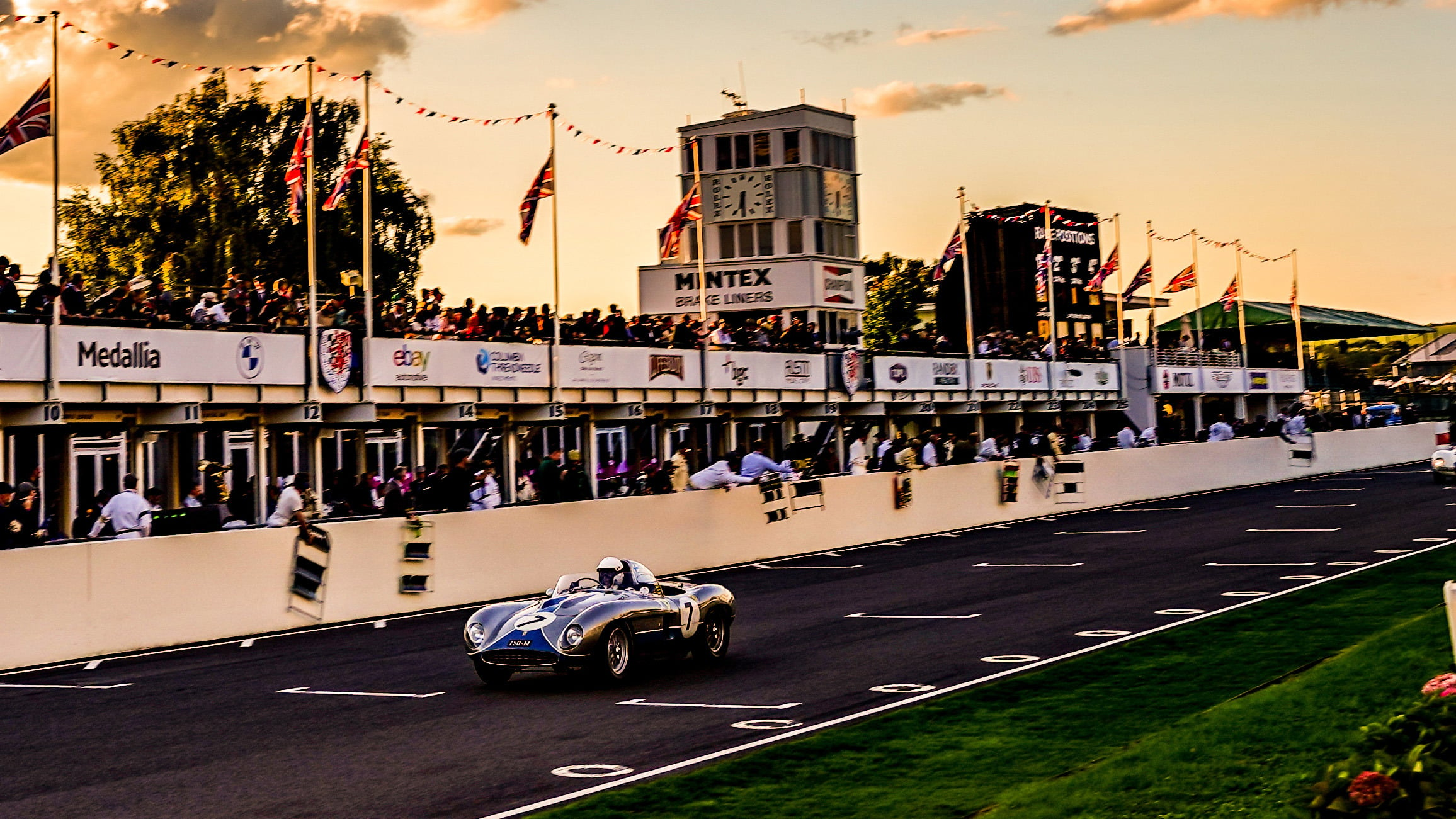
But it is the last named I’d like to dwell on for the next few hundred words, and for several reasons. It is one of the most achingly beautiful Ferraris of all time; it is even today somewhat under-rated; it is technically interesting, particularly by the somewhat conservative standards of Ferraris of that era. And I used to race one, never with greater pride than at Goodwood.
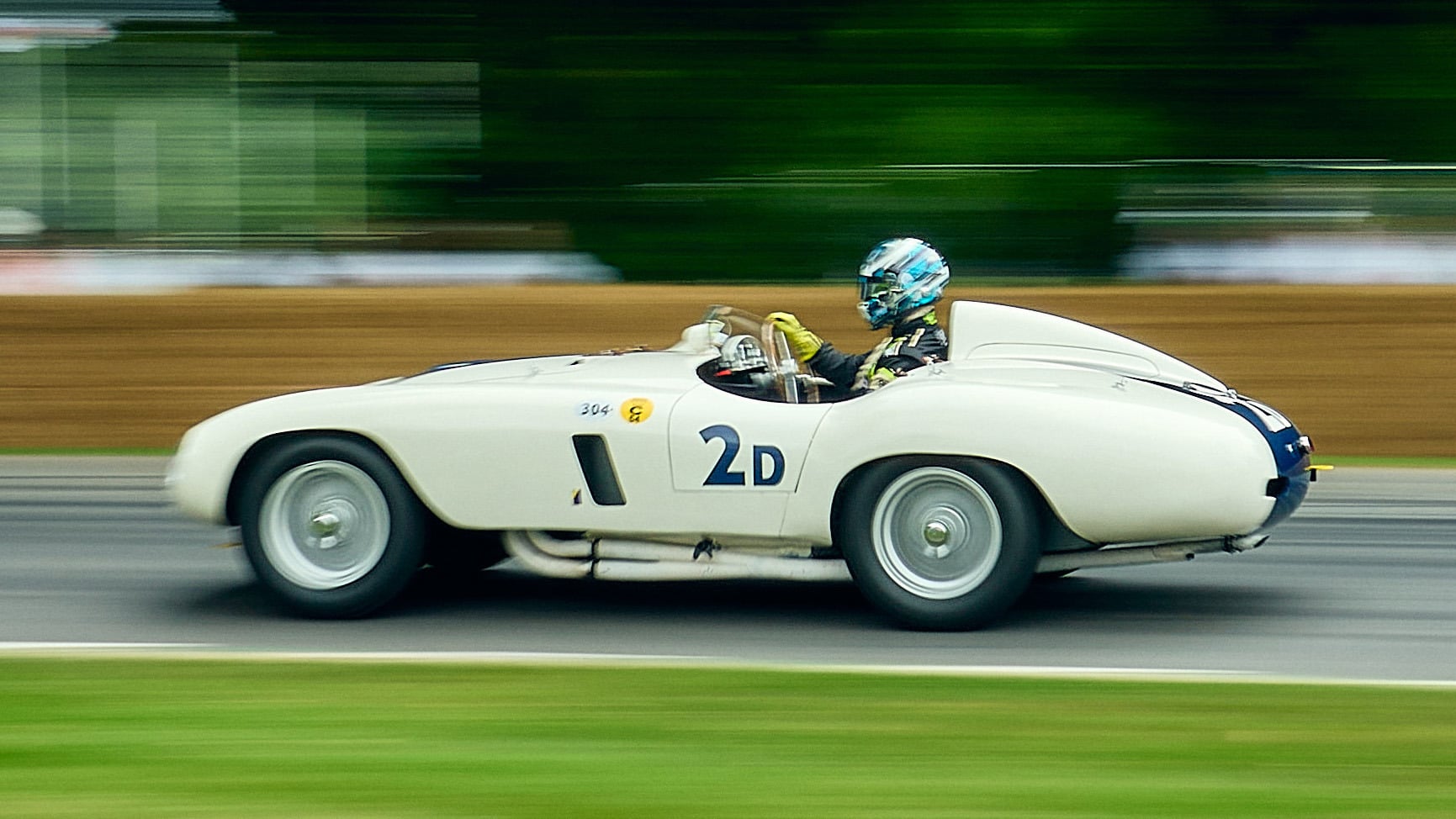
The 750 Monza was one of those weird fishes: a four-cylinder Ferrari. Its body was designed by none other than Dino Ferrari and was hand hammered into shape by Scaglietti. And while some early cars had four speed gearboxes, and some very late examples experimental disc brakes, almost all the 30-something cars that got built had five gear ratios and large drums at each corner.
But back to that engine. Ferrari it seemed was hedging his bets, preferring the power of his V12s for the long distance, high speed races like the Carrera Panamericana. For tighter tracks he opted for something altogether simpler, like the TT course at Dundrod which it won in 1954 in the capable hands of Mike Hawthorn and Maurice Trintignant, though it had also taken victory on its debut at the Supercortemaggiore race at Monza earlier in the year.
The engine was the work of the very great Aurelio Lampredi, who designed a 3.0-litre, four-cylinder motor with twin overhead camshafts fed by monstrous 58mm twin choke side draft Webers. It was shorter, stiffer, lighter and able to be mounted further back in the chassis than Giacchino Colombo’s similar capacity but very different single cam V12.
But the engine did come with two distinct but related problems, one very evident then, the other far more so these days. The first was that the four-cylinder design limited power to around 264PS (194kW) whereas its nemesis, the straight-eight Mercedes-Benz 300 SLR, had 304PS (224kW) from the same capacity.
The second was that it left essentially zero scope for tuning, so whilst almost all engines of that period now produce substantially more power than they did when new, when I was racing the Monza well over half a century later, 264PS was all it had then. It was limited also by its drum brakes, which meant we had no chance at all against Jaguar D-types with their bigger, far more powerful engines and disc brakes.
But I’m not sure I really cared that much. Even in a world populated by D-types, Aston Martin DB3Ss and the like, the Monza was always different — and not because it had a smaller engine, less power or fewer cylinders. It was because to drive it made all its rivals look like complete pussycats.
I raced the Monza at Goodwood, Silverstone, Le Mans, Spa, Dijon and probably a few other places, too, and while I’d not say it was like going into battle with your car, because that would be to imply it was trying to kill you and you it, it always left the indelible impression that unless you did everything the way it wanted it to be done, it would find an expensive and painful way of rewarding your discourtesy.
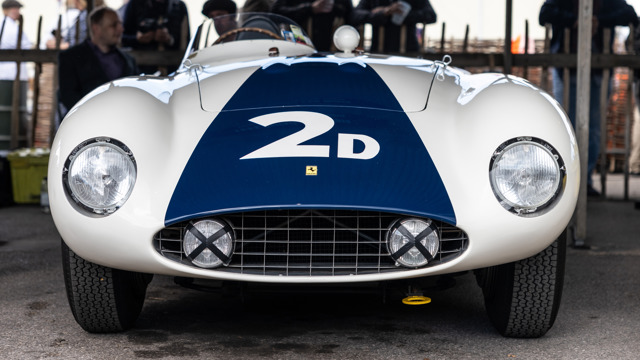
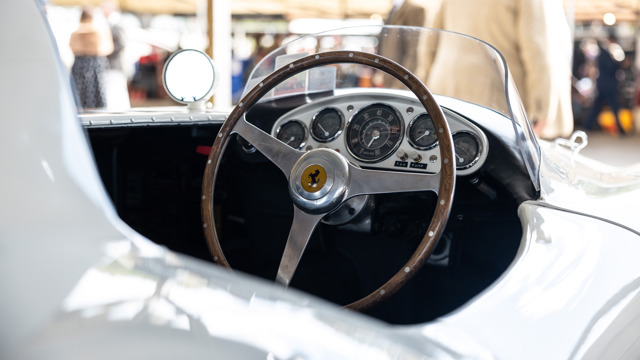
In my experience of that generation of car, the DB3S has far and away the sweetest handling, and would accept any driving style from clean and smooth to ragged and dramatic with equal equanimity. Not so the Monza. You drove it the way it demanded to be driven.
You had to drive to its strengths, which derived from the torque of the engine and traction provided by its De Dion rear axle, rear mounted gearbox and limited slip differential. It’d come out of slow corners like an artillery shell, always held up by what it was following, only to watch the advantage disappear on the straight. I was once talking to one lucky chap who owned both a 750 Monza and a later V12 Testa Rossa, and he was convinced that around a tight, slow circuit like Monaco the four-cylinder car would have been quicker.
In faster corners it was a handful, but an incredible, wonderful challenge and that feeling, on the rare moments it came, that I was actually driving it quite well, is among the best I’ve had in over 30 years of racing old cars.
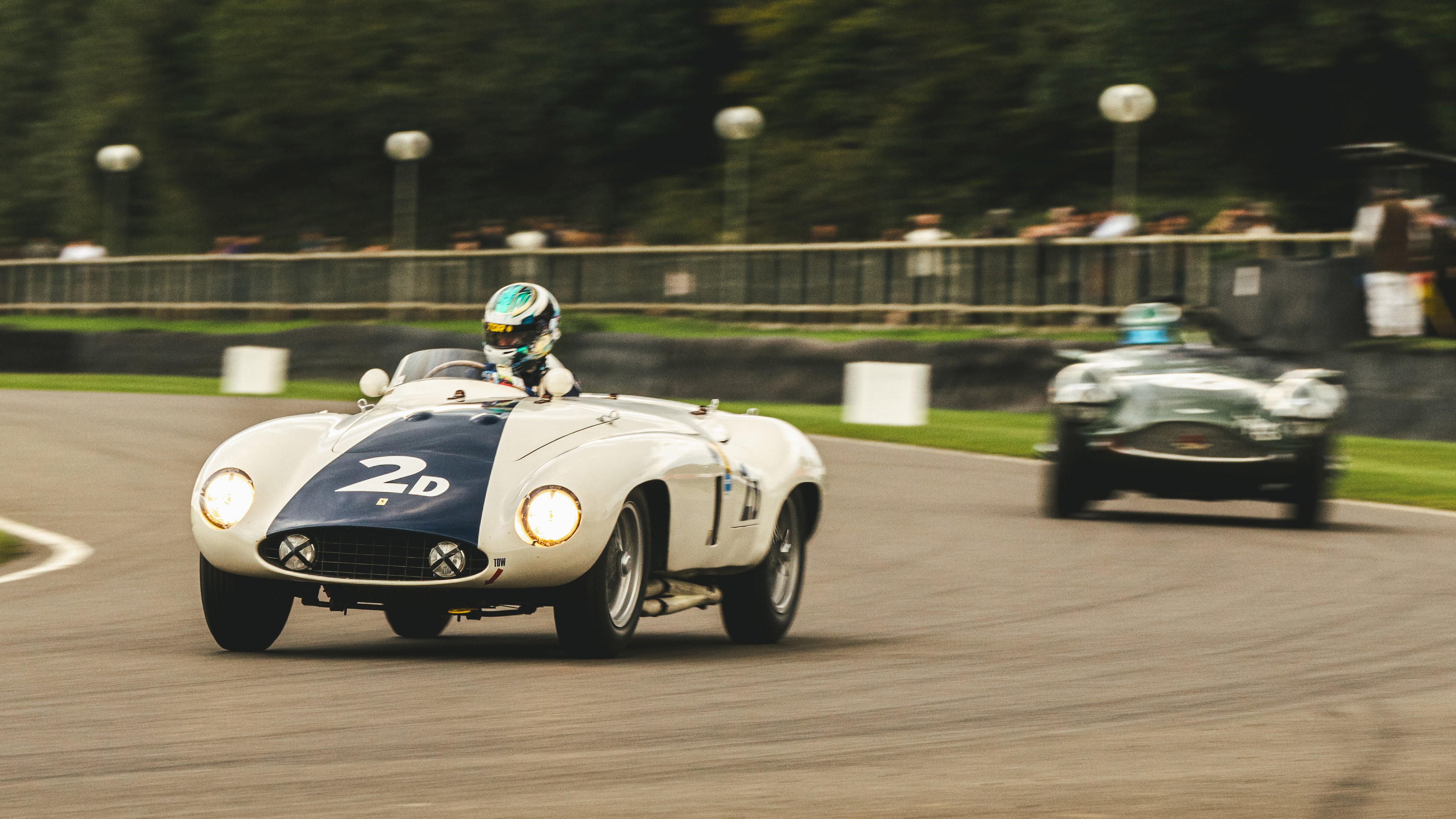
The best came at Dijon when we’d qualified on a dry track in our usual midfield position. But race day was cool and wet and the D-types couldn’t use all their power, and the Monza’s actually very good drums did not fade.
I started the one hour, two driver race down in something like 14th position, and when I came in to hand over to the owner, I was leading. And I’d had a fabulous scrap with a beautifully driven DB3S piloted by Gregor Fisken along the way, also revelling in the more level playing field the conditions had provided.
Next time out was at Silverstone and I thought I’d really got the hang of it, got ever so slightly cocky and ended up facing back the way I’d come, but thankfully with damage restricted to pride alone. I think it was Gary Pearson who’d said to me ‘don’t mess with a Monza!’ and I never did again.
Tickets for the 2026 Goodwood Revival are now on sale, with Saturday and 3-Day admission now limited and Friday and Sunday tickets selling fast. Book now to save before the final price rise.
If you’re not already part of the GRRC, you can sign up to the Fellowship today and save ten per cent on your 2026 tickets and grandstand passes, as well as enjoying a whole host of other on-event perks.
Photography by Michal Pospisil and Toby Whales.
revival
revival 2026
event coverage
lavant cup
Lavant Cup feature
frankel's insight
ferrari
750 Monza

Subscribe to Goodwood Road & Racing
Thank you, you’re now subscribed

How many hay bales are used at FOS?
For the last two years, 5,800 bales have been recylced into the biomass energy centre to be used for energy generation