

Astronomers detect galactic eruption equal to ten quintillion hydrogen bombs
Scientists have identified a colossal stream of super-heated gas erupting from a nearby galaxy, powered by a turbulent jet launched from a supermassive black hole.
The discovery was made using data from NASA’s James Webb Space Telescope, which can peer through thick dust clouds that obscure such activity from traditional optical telescopes. The observations reveal vast clouds of extremely hot plasma stretching for at least three kiloparsecs (around 10,000 light-years) from either side of the host galaxy.
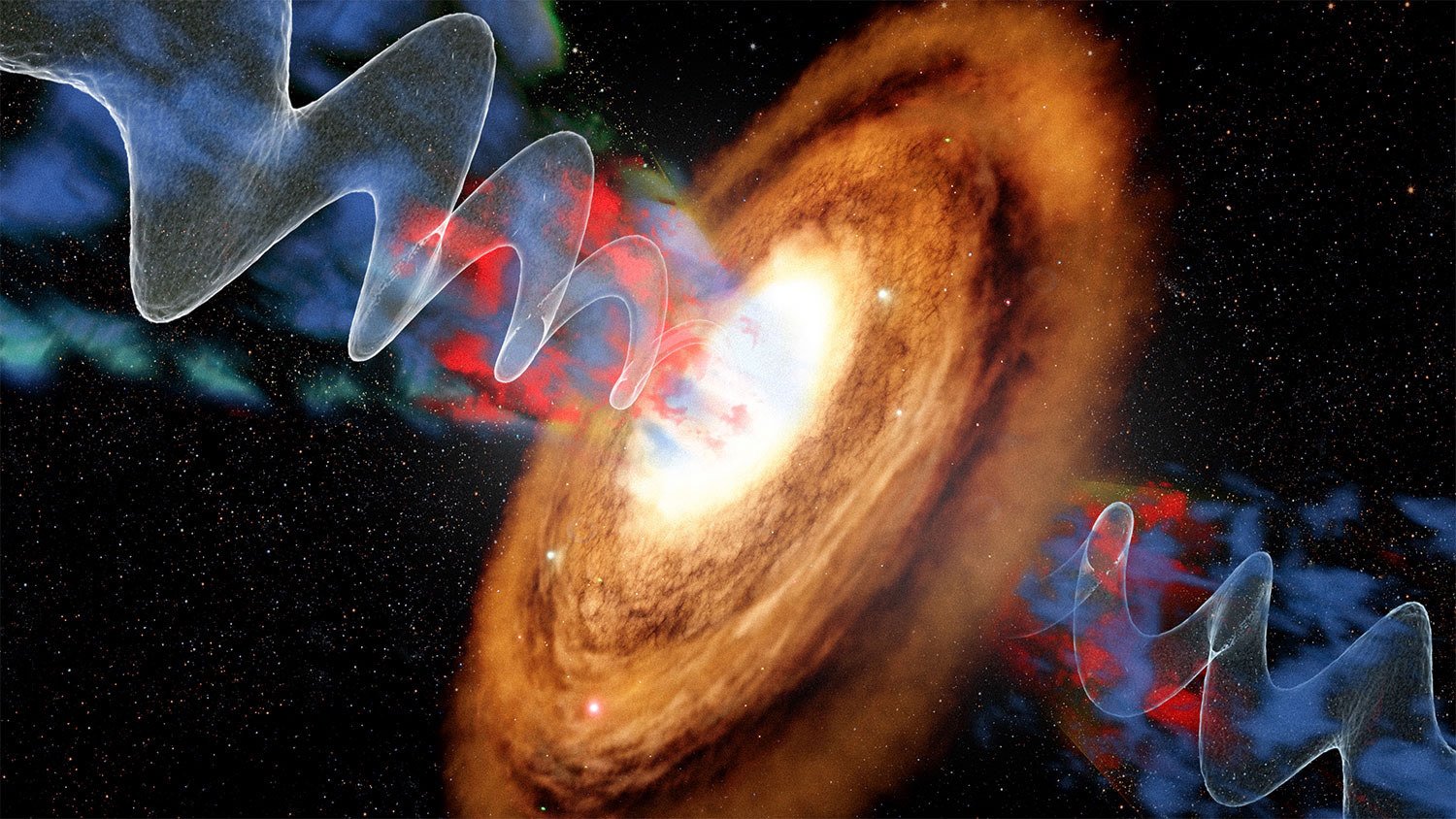
Astronomers from the University of California describe the structure as two elongated, glowing nebulae driven by intense activity near the galaxy’s central black hole. In the journal Science, lead author Justin Kader explains the scale of the phenomenon: “In other galaxies, this type of highly energised gas is almost always confined to several tens of parsecs from a galaxy’s black hole, and our discovery exceeds what is typically seen by a factor of 30 or more.”
The jets themselves are thought to form when gas falling toward the supermassive black hole reaches extreme temperatures and interacts with powerful magnetic fields. Equipped with Webb’s infrared sensitivity, astronomers could see the super-heated coronal gas, named for its similarity to the high-temperature plasma found in the Sun’s outer atmosphere, flowing outward well beyond the galaxy’s own disk. According to the researchers, the outflowing coronal gas carries an amount of energy equivalent to the detonation of ten quintillion hydrogen bombs every second.
Beyond the spectacle, this jet has profound consequences for the galaxy itself. As the super-heated gas is driven outward, it strips the galaxy of the cold material it needs to form new stars. The team estimates that the host galaxy in question is losing gas at a rate that could remove the equivalent of 19 solar masses each year, effectively starving the galaxy of the raw ingredients for further star formation.
Scientists say discoveries like this are transforming our understanding of how galaxies and their central black holes interact. Massive jets and coronal gas emissions had been thought to be largely confined to older, more massive elliptical galaxies. Finding them in a relatively nearby disk galaxy offers new insights into the co-evolution of black holes and galaxies across the universe.
If space exploration and supermassive black holes pique your interest, they are also central to FOS Future Lab presented by Randox, with astronaut Sir Tim Peake as an ambassador and previous exhibitors including space scientists from the University of Sussex, among the world’s leaders in analysing James Webb Space Telescope data. Tickets for 2026 Festival of Speed presented by Mastercard are on sale now.

Randox is a global leader in diagnostics, revolutionising patient outcomes through innovative technologies, including its patented biochip technology. This pioneering diagnostic platform allows for the simultaneous detection of multiple biomarkers from a single sample, delivering faster, more accurate, and comprehensive results. Operating in over 145 countries, Randox develops advanced laboratory instruments, high-quality reagents, and innovative testing solutions to improve global healthcare.
Randox Health brings this cutting-edge technology directly to individuals, offering bespoke, preventative health testing programs. With world-class laboratories and personalised health insights, Randox Health enables early detection of a wide range of conditions, helping individuals take control of their health.
Together, Randox and Randox Health are redefining diagnostics and preventative healthcare. For more information, visit www.randox.com and www.randoxhealth.com.
Image courtesy of W. M. Keck Observatory/Adam Makarenko
festival of speed
fos
event coverage
future lab
fos future lab




Subscribe to Goodwood Road & Racing
Thank you, you’re now subscribed

How many hay bales are used at FOS?
For the last two years, 5,800 bales have been recylced into the biomass energy centre to be used for energy generation