

Why is Britain building computers colder than deep space?
Somewhere in Oxfordshire, a computer chip the size of a fingernail sits close to ten millikelvin in temperature — one hundredth of a degree above absolute zero. The cold matters; quantum effects are fragile, and heat shakes them apart. Chill the chip that far and it performs calculations no classical computer can match.
Calculations like simulating a new drug molecule atom by atom; designing a battery material that doesn't yet exist; cracking the encryption today's banks rely on. This is a quantum computer, and for the first time, it is nearly here.
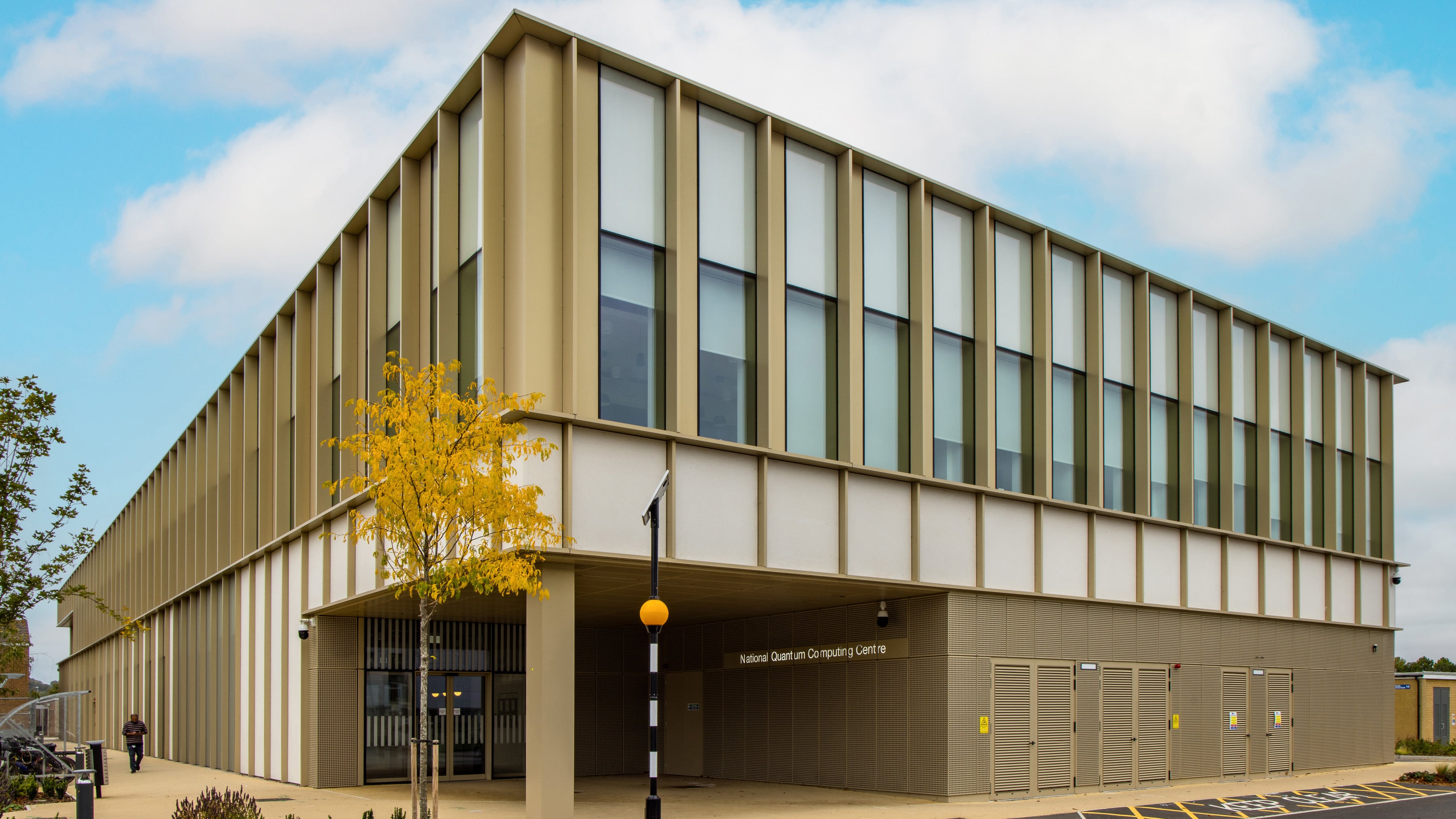
Britain's stake in that race is the National Quantum Computing Centre. Founded in 2020, its job is to build the science and ready the country for what comes next. And at the 2026 Festival of Speed presented by Mastercard, the work goes public as part of FOS Future Lab presented by Randox.
What ‘quantum’ actually means?
Daisy Shearer is NQCC's quantum computing outreach and education lead, and has spent considerable time persuading children, parents and the occasional dinner party guest that quantum is not, in fact, code for ‘we don't really know’.
"Quantum is all about the things that we see at the really tiny scale of life. And actually, everything around us in the world is quantum mechanical. It's just that we're too big and noisy to see those effects," says Shearer. It sounds a bit like The Force in Star Wars, but we're the wrong size to notice it.

Where a regular computer thinks in ones and zeros — the binary running every screen you've ever looked at — a quantum computer thinks in qubits. A qubit is a one and a zero at the same time, until you measure it. Shearer explains with a coin.
"Rather than having to use heads or tails, one or zero, we can now flip our coin into the air. It's not heads, it's not tails, it's something else. It's kind of a combination of the two."
Many of those mid-air coins, linked together, make up the essence of a quantum computer, and it’s spectacularly good at solving problems classical computers can't keep up with.
Not acceptable in the 80s
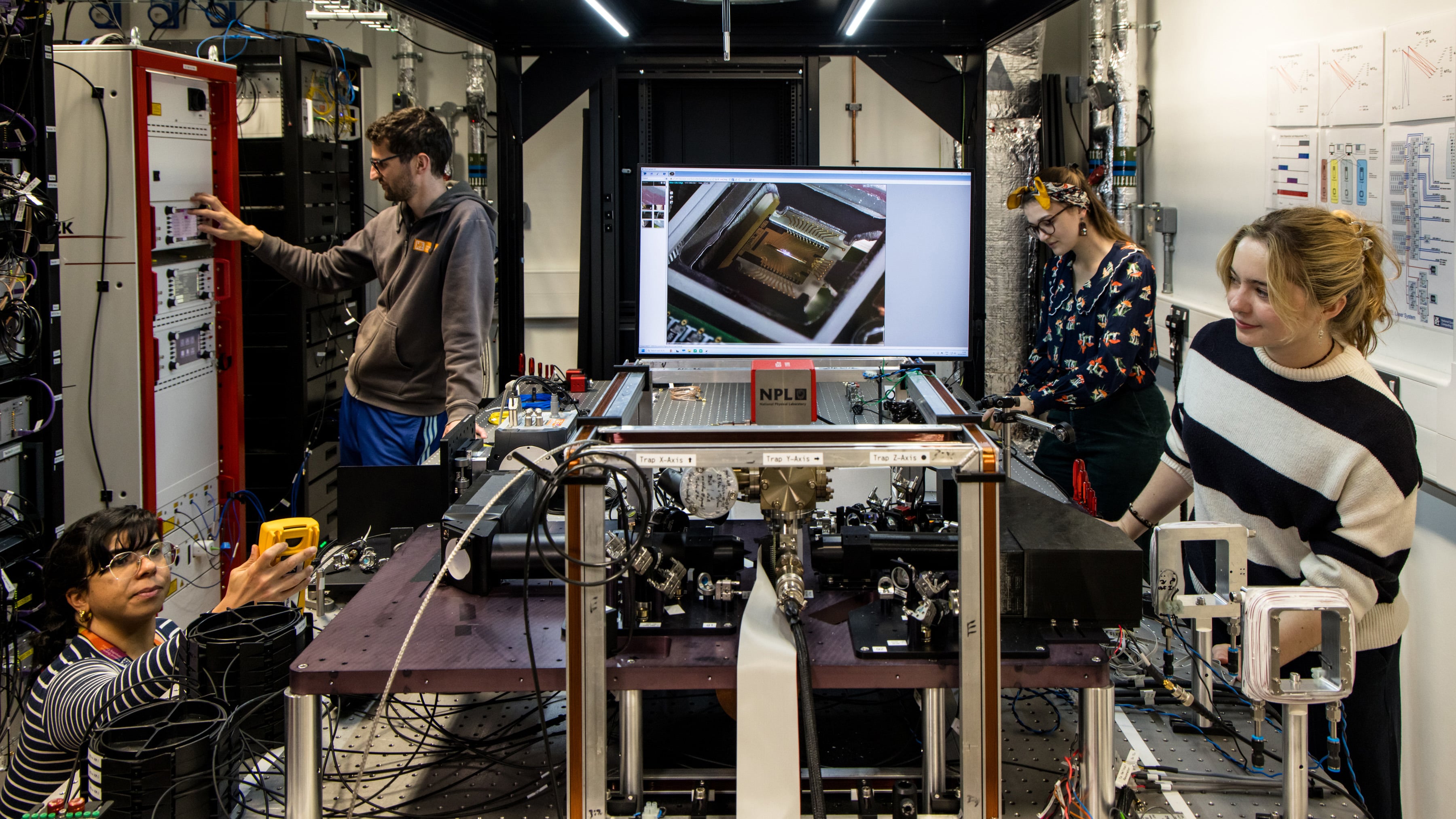
Professor Gerard Milburn is one of the NQCC's quantum fellows and has been in this field longer than most. "When I started in quantum computing back in the late 1980s," he says, "it was very much a fringe area of quantum physics.” Today, the NQCC has three different qubit technologies running in three different labs — three serious bets on how to actually build the thing.
The first traps charged atoms in a vacuum chamber and addresses them with laser light. The second uses superconducting circuits cooled to close to ten millikelvin, the only conditions a qubit will tolerate. The third route, neutral atom quantum computing, uses laser light to hold and shuffle uncharged atoms in three-dimensional grids.
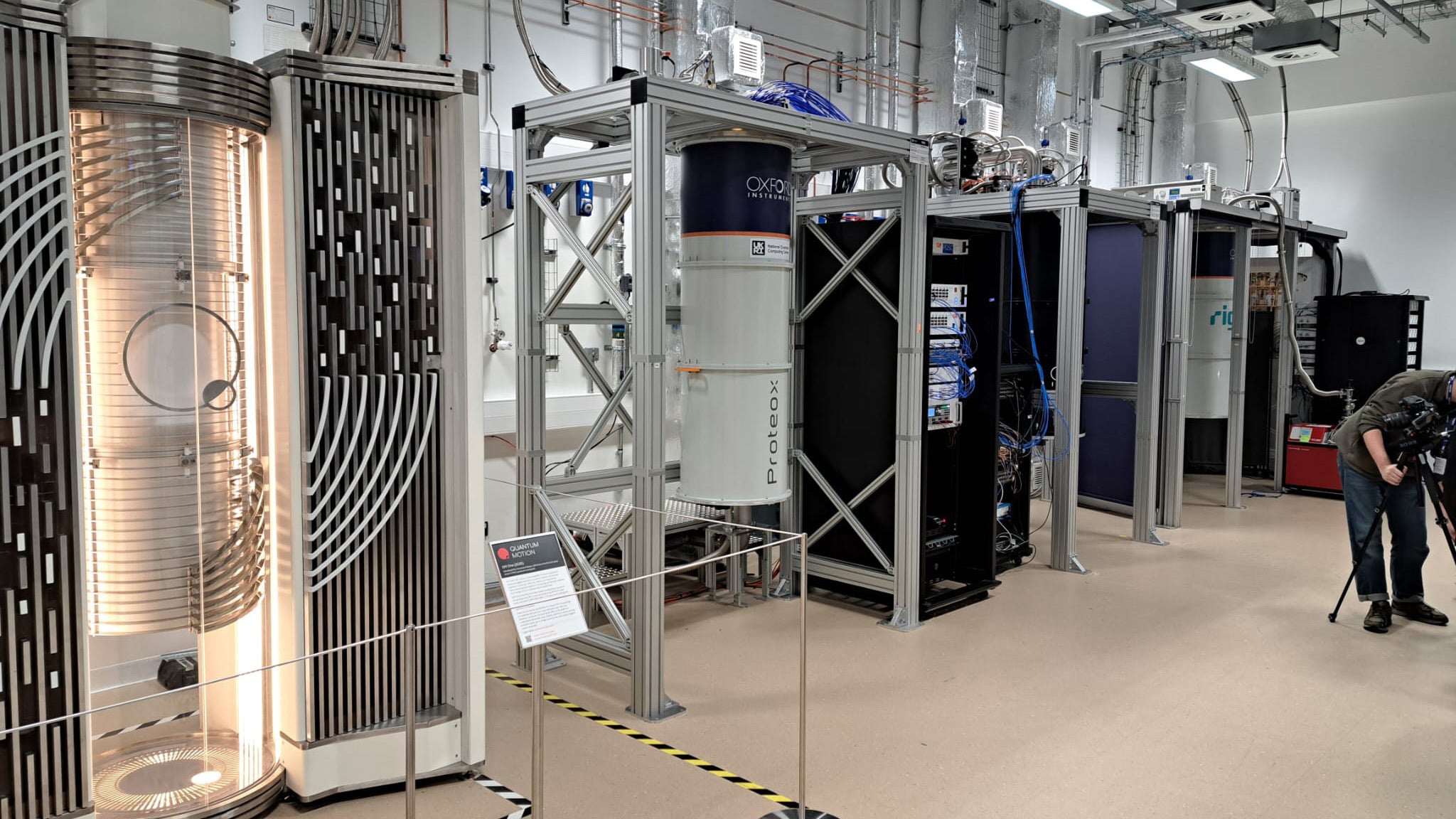
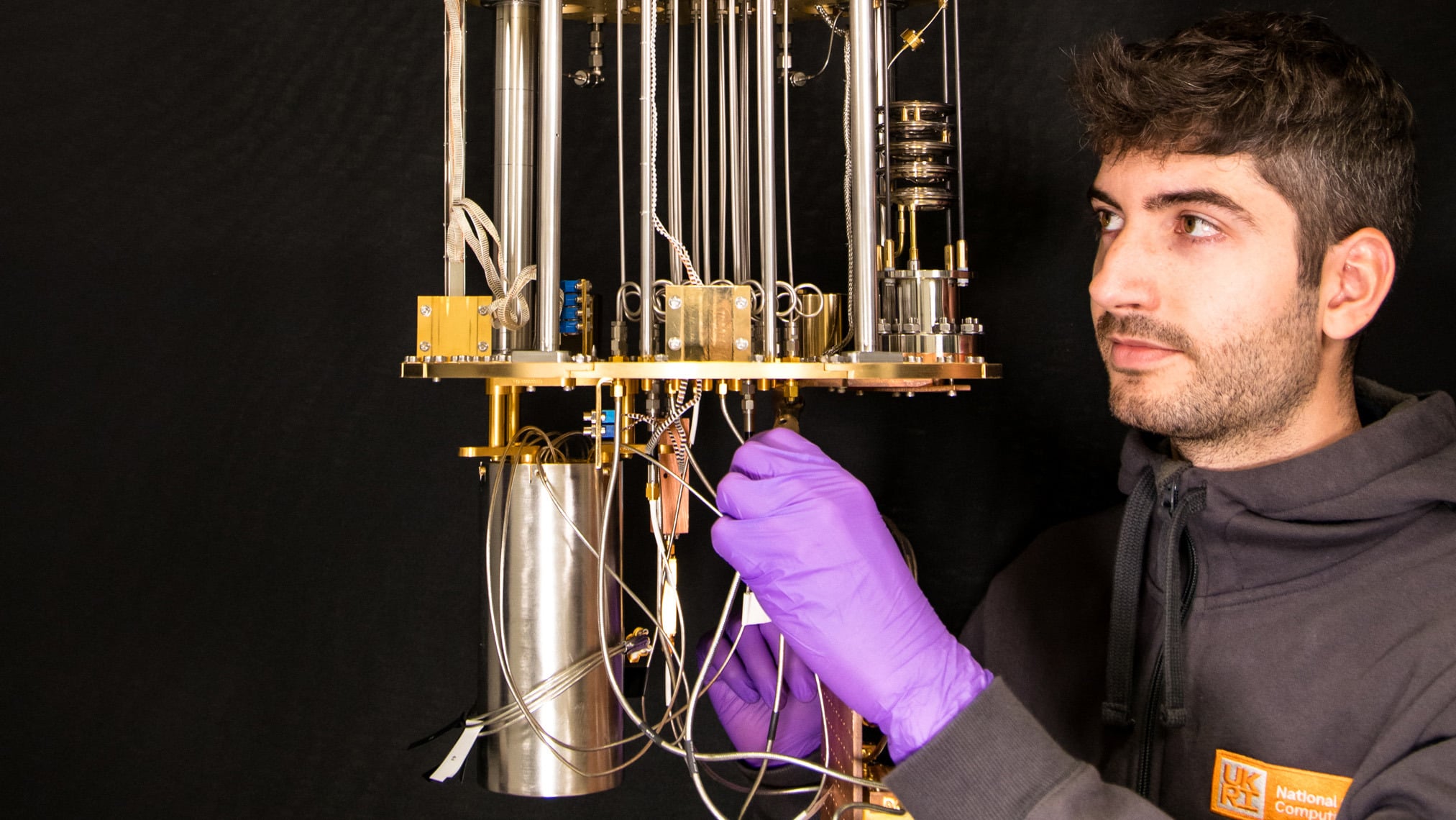
A processor built from atoms would take some beating, and most quantum computers look nothing like a laptop. Think more like an inverted gold-plated wedding cake suspended from the ceiling, and visitors to the FOS Future Lab will see exactly that.
The bit doing the actual computing sits at the bottom and is the size of a fingernail. Everything above it is plumbing — a cascade of cooling stages colder than deep space. A working quantum computer is, in physical form, mostly a fridge.
No, it isn't AI
It’s easy to hear ‘quantum computing’ and assume it’s AI. Or that it's a faster AI. Or that AI will probably eat it. It is none of those things.
"The conjunction of machine learning more broadly and quantum computing is extremely fortunate," Milburn says. "By having access to really good quantum data for classical machine learning, we can develop really good protocols for learning how the world works."
Translated: AI and quantum are not rivals, they are collaborators. AI learns patterns from data we already have; quantum computers solve a different class of problem — one where the underlying mathematics is itself quantum, like simulating a molecule or modelling a new material. Quantum will help generate data classical AI cannot reach, and then classical AI can help interpret it.
When this actually arrives
"Today, to be on the verge of full fault tolerance over the next five to ten years is incredibly exciting," says Milburn. "The opportunities for new scientific discovery are enormous." Fault tolerance is the threshold the entire industry is aiming for: the point at which a quantum computation can be trusted to give the right answer.
The impact is expected to be felt first in healthcare and pharmaceuticals, financial services, energy, optimisation and logistics. All sectors where the hardest problems involve very large numbers of variables, simulating at scale, or finding a single answer in an enormous haystack of possibilities.
The NQCC, meanwhile, has working agreements with several leading tech partners, giving the UK's academic researchers access to quantum computing resources over the cloud.
Coming to Goodwood
The headline piece on the NQCC FOS Future Lab stand is Quantum Jungle, an interactive installation by interactive artist Robin Baumgarten. Springs, sensors and LEDs running on Schrödinger's equation — the equation that describes how quantum particles actually behave — make those quantum behaviours visible to the naked eye.
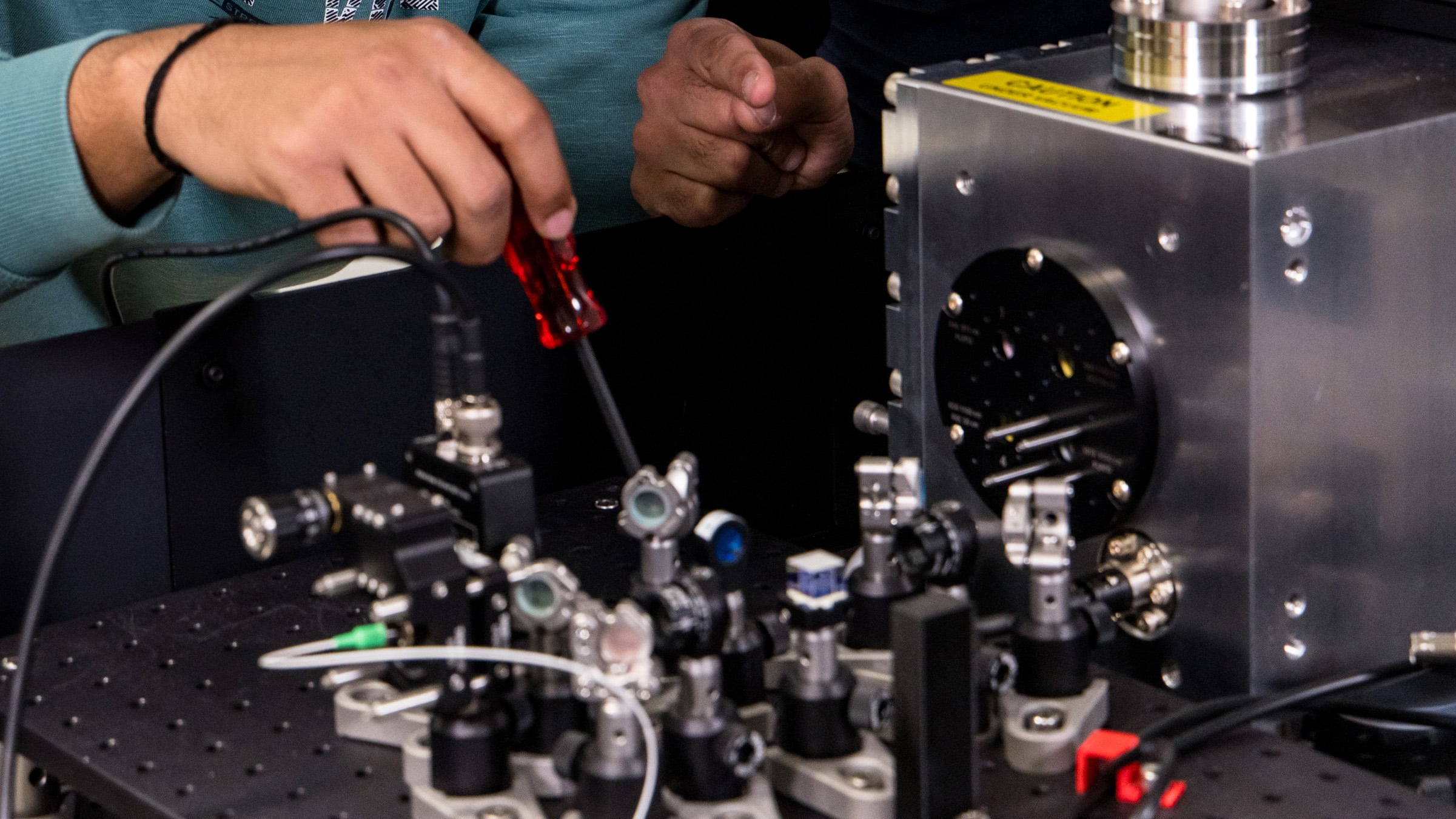
Then come the hands-on demonstrations, designed by Daisy Shearer and her team. This includes an interferometer using lasers to illustrate a key building block of a quantum computer, alongside superconducting circuits and real quantum chips.
"It tells them that this technology is happening now," Shearer says of the demos. "And that's what excites me — the fact that we can help these young people in shaping the future of quantum, and for societal benefit."
Randox is a global leader in diagnostics, revolutionising patient outcomes through innovative technologies, including its patented biochip technology. This pioneering diagnostic platform allows for the simultaneous detection of multiple biomarkers from a single sample, delivering faster, more accurate, and comprehensive results. Operating in over 145 countries, Randox develops advanced laboratory instruments, high-quality reagents, and innovative testing solutions to improve global healthcare.
Randox Health brings this cutting-edge technology directly to individuals, offering bespoke, preventative health testing programs. With world-class laboratories and personalised health insights, Randox Health enables early detection of a wide range of conditions, helping individuals take control of their health.
Together, Randox and Randox Health are redefining diagnostics and preventative healthcare. For more information, visit www.randox.com and www.randoxhealth.com.
Tickets for the Festival of Speed are limited. Only Thursday admission remains but hospitality packages for all four days are available. Missed out on a ticket for Friday or Saturday? Find out how you can access our sold-out days with one of our new packages.
If you’re not already part of the GRRC, joining the Fellowship means you can save ten per cent on your 2026 tickets and grandstand passes, as well as enjoy a whole host of other on-event perks.
festival of speed
fos
fos 2026
event coverage
future lab
fos future lab
NQCC
unseen worlds


Subscribe to Goodwood Road & Racing
Thank you, you’re now subscribed

How many hay bales are used at FOS?
For the last two years, 5,800 bales have been recylced into the biomass energy centre to be used for energy generation