The Maserati that conquered the Indy 500 – twice
Italian racing cars winning the Indianapolis 500? It happens all the time in the modern era thanks to the Dallara spec formula.
Scroll back deeper into the Great Race’s history through the 20th century, however, and you’ll notice just a couple of victories for Italian cars at the Brickyard — and they happened to land consecutively. For a singular make, model and chassis, too.
Maserati has something precious over Alfa Romeo and Ferrari as the only one of Italy’s three ‘grandee’ marques to have conquered the Indy 500. The Trident’s twin victories in 1939 and ’40 stand proud in the Indy records for other reasons too, foreshadowing the 1960s rear-engined revolution by more than 20 years as an example of European Grand Prix know-how beating the Americans at their own game.
Those wins are not forgotten either, as we’ll highlight at the Goodwood Revival this year during celebrations Maserati that will take centre stage at the event, alongside our wider theme of La Dolce Vita. So, scroll back with us as we recall not only a great Maserati, but one of the most impressive, successful and prolific racing cars that ever graced the Brickyard.
A Shaw thing
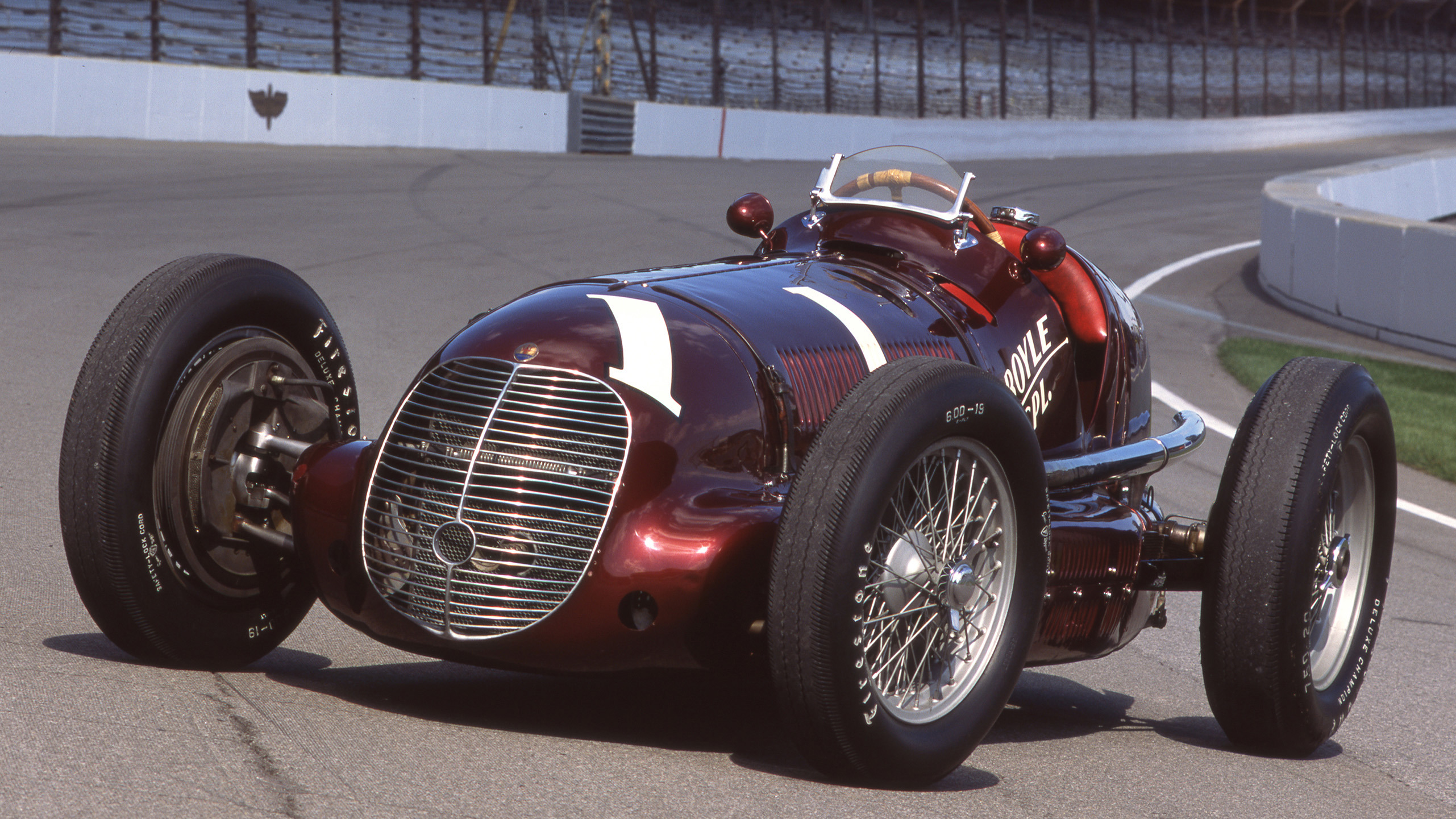
The machine in question is the Boyle Special, a Maserati 8CTF Grand Prix car, chassis 3032, imported direct from the factory in Bologna and driven to twin victories by a certified legend of the Indy 500, Wilbur Shaw.
The dashing Indiana-born racer had already won the 500 in an Offenhauser-powered car bearing his own name in 1937, when he witnessed the potential of exotica from the European Grand Prix scene while racing at the Vanderbilt Cup in Long Island.
That spurred him to approach a Chicago-based businessman, friend and racing enthusiast with a proposition. Shaw declared to Irishman Michael Joseph ‘Mike’ Boyle: “If I had a car like that, I’d win the next 500-mile race in it.”
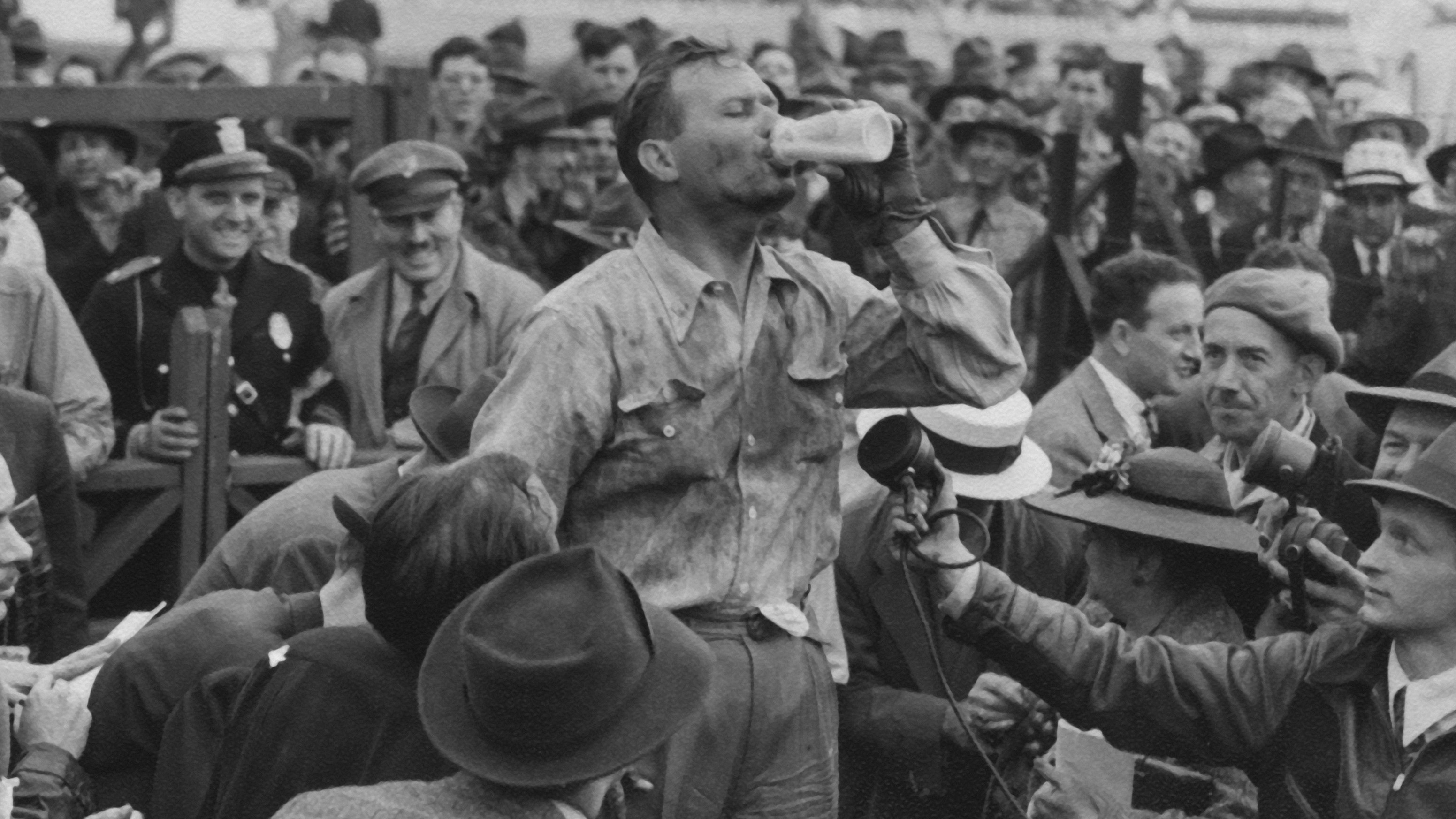
Wilbur Shaw celebrates after winning the 1940 Indy 500, the first driver to achieve back-to-back victories at the Brickyard.
Image credit: Getty ImagesThe Boyle Special
The project got off to something of a false start when Maserati sent over one of its 6CM ‘Voiturettes’ – far too small to shine at the 2.5-mile Indianapolis Motor Speedway. But for 1939, Boyle’s team manager Harry W ‘Cotton’ Henning travelled direct to Bologna and returned with what’s said to be one of only three 8CTFs. This was more like it.
Written to the new Grand Prix regulations under Maserati’s new Orsi Group ownership, the 8CTF might have been a Mercedes and Auto Union beater — had it proven more reliable on the European circuits. Built on a steel-section ladder frame chassis, it was powered by a 3-litre twin supercharged straight-eight, with cylinders in two blocks of four cast in a monoblock. The moniker ‘8CTF’ stands for eight cylinders ‘Testa Fissa’, meaning ‘fixed head’.
But the trip back to the States did not go well. The car, said to have cost Boyle what was then a hefty $15,000, was shipped with straight water in the cooling system, which then froze during the Atlantic crossing and split the cylinder blocks. The adept Henning rebuilt the engine in its entirety from Boyle’s Gent Street race shop. Fitted with larger wheels and Firestone tyres, it was all ready and set for the Month of May.
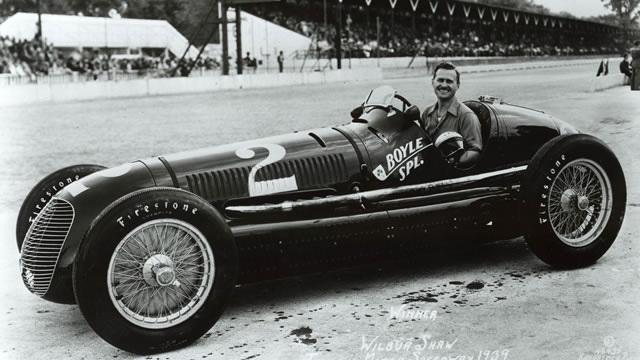
Shaw sat in the Maserati 8CTF at the 1939 Indy 500.
Image credit: IndyCarThe first landmark victory
The Maserati wasn’t as powerful as the best of its American rivals, but its pair of Roots blowers gave it decent acceleration out of the turns, and modern torsion bar independent front suspension made the set-up easier to tune. Then there were the huge 16-inch magnesium drum brakes. Most IndyCars of the period were fitted with production brakes and drivers barely used them.
But Shaw adapted his technique to use the Maserati’s stopping power as he cut through traffic in the short chutes and turns. Having qualified third, he led a total of 51 laps to beat Louis Meyer’s Stevens-Winfield and Jimmy Snyder’s Adams-Spark to make good on his pledge to Mike Boyle.
A hallowed history
A year later, the same driver and chassis returned and repeated the feat, making Shaw the second to achieve three Indy wins and the first to score two consecutively. Among his prizes, including a respectable cash purse and a car, was apparently a refrigerator!
A Boyle Special hat-trick looked on the cards in 1941, only for a wheel to break and send Shaw crashing into the wall. Yet still this great Maserati existing under a different name was not yet done, despite the United States’ delayed entry into World War II curtailing the Indy 500 from 1942.
In peacetime, Shaw stepped up as a key figure to reestablish the abandoned Indianapolis Motor Speedway, working with Tony Hulman as president of the venue from 1945. Meanwhile, the Boyle Special was on the grid for the first post-WWII Indy 500 in 1946, this time in the hands of Ted Horn, who took the car to a third-place finish.

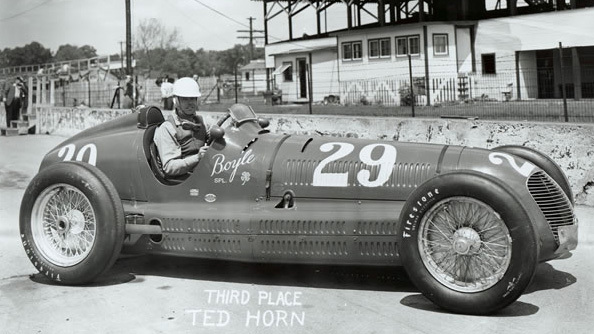
Ted Horn finished third in the 1946 Indy 500 in the Boyle Special.
Image credit: IndyCarHorn was third again in 1947, with chassis 3032 now renamed the Bennett Brothers Special. The combo finished fourth the following year, too.
Ten years after its maiden victory, in 1949, the car was finally entered as a Maserati for the first time, but was reduced to a bit-part in the hands of Johnny McDowell. Yet still it wasn’t done. In 1950, a promising young sprint car driver by the name of Bill Vukovich used the Maserati to pass his rookie test at a track he would soon come to dominate.
Shaw served as IMS president until 1954, when he was tragically killed in a plane crash. As for chassis 3032, it was loving restored to its amaranth-coloured Boyle Special splendour to be preserved in the Indianapolis Speedway Museum.
An all-round masterpiece
Think of great Maserati Grand Prix monopostos and the glorious 250F most obviously springs to mind, especially given the weight of association with both Juan Manuel Fangio and Stirling Moss. Then there’s the 4CLT, which made such an impression at Goodwood in the early years of Formula 1 and conquered the 1949 British Grand Prix.
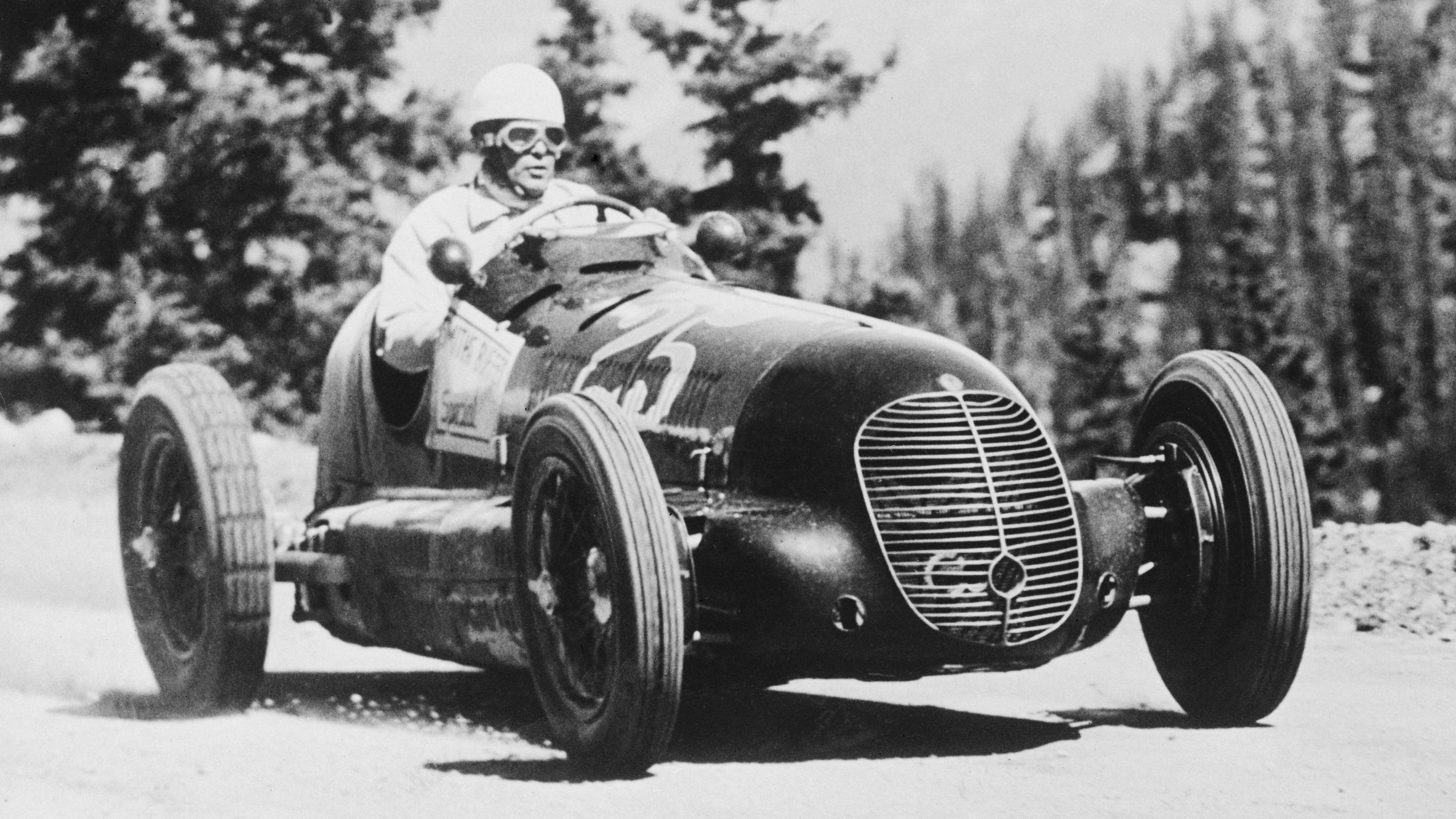
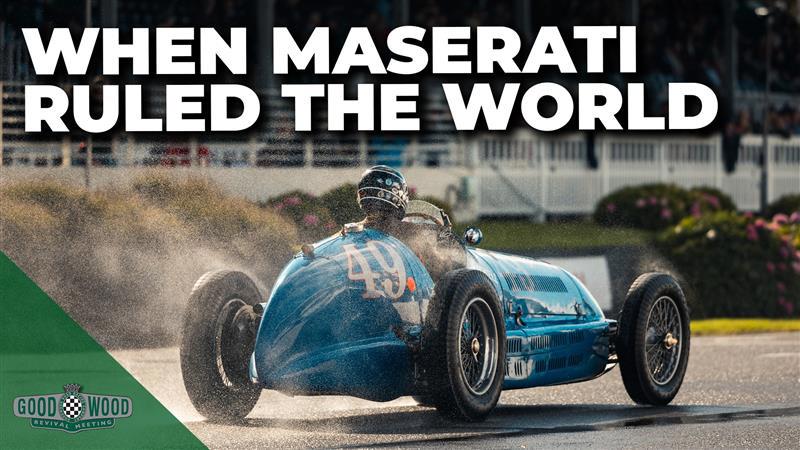
The Maserati 8CTF took Louis Unser to consecutive wins at Pikes Peak in 1946 and '47.
Image credit: Getty ImagesBut the 8CTF deserves its share of the Trident limelight, and not just because of 3032’s astonishing record at the Indy 500. Consider the prototype sister, 3030, which also raced at Indy but then showed off an unlikely turn of speed as a mountain dirt racer…
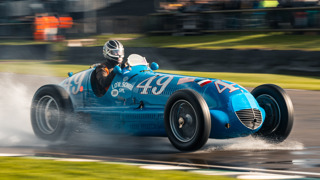
Yes, here was a Grand Prix car that conquered the mighty Pikes Peak climb, not once but twice, in the hands of Louis Unser in 1946 and ’47. The blue beast, part of the cherished Rev Institute collection, was a popular visitor to the Goodwood Revival in 2014 when it finished third in the Goodwood Trophy driven by Andy Willis.
It took an Atlantic crossing to discover the Maserati 8CTF’s best strengths. But that Stars ’n Stripes legacy just makes it an all-round, all-time classic.
Tickets for the 2026 Goodwood Revival are now on sale. If you’re not already part of the GRRC, you can sign up to the Fellowship today and save ten per cent on your 2026 tickets and grandstand passes, as well as enjoying a whole host of other on-event perks.
Images courtesy of Getty Images.
race
historic
maserati
8CTF
indycar
Wilbur Shaw
Maserati Celebration