

The photographer revealing the secrets of Oxford’s Harry Potter ceiling
The University of Oxford’s Bodleian Library has been receiving books and manuscripts for more than 400 years, but only in the last three years has it begun investigating their hidden secrets. That work falls largely to John Barrett, studio manager and senior photographer at the Bodleian's Weston Library, and technical lead on ARCHiOx, the library's 3D digitisation project run with Madrid-based Factum Foundation.
Together they record medieval manuscripts, 18th-century printing plates and the stunning ceiling of the university’s famous Divinity School at resolutions previously impossible, and they’ll also both be present at FOS Future Lab presented by Randox to reveal never-before-seen mysteries.
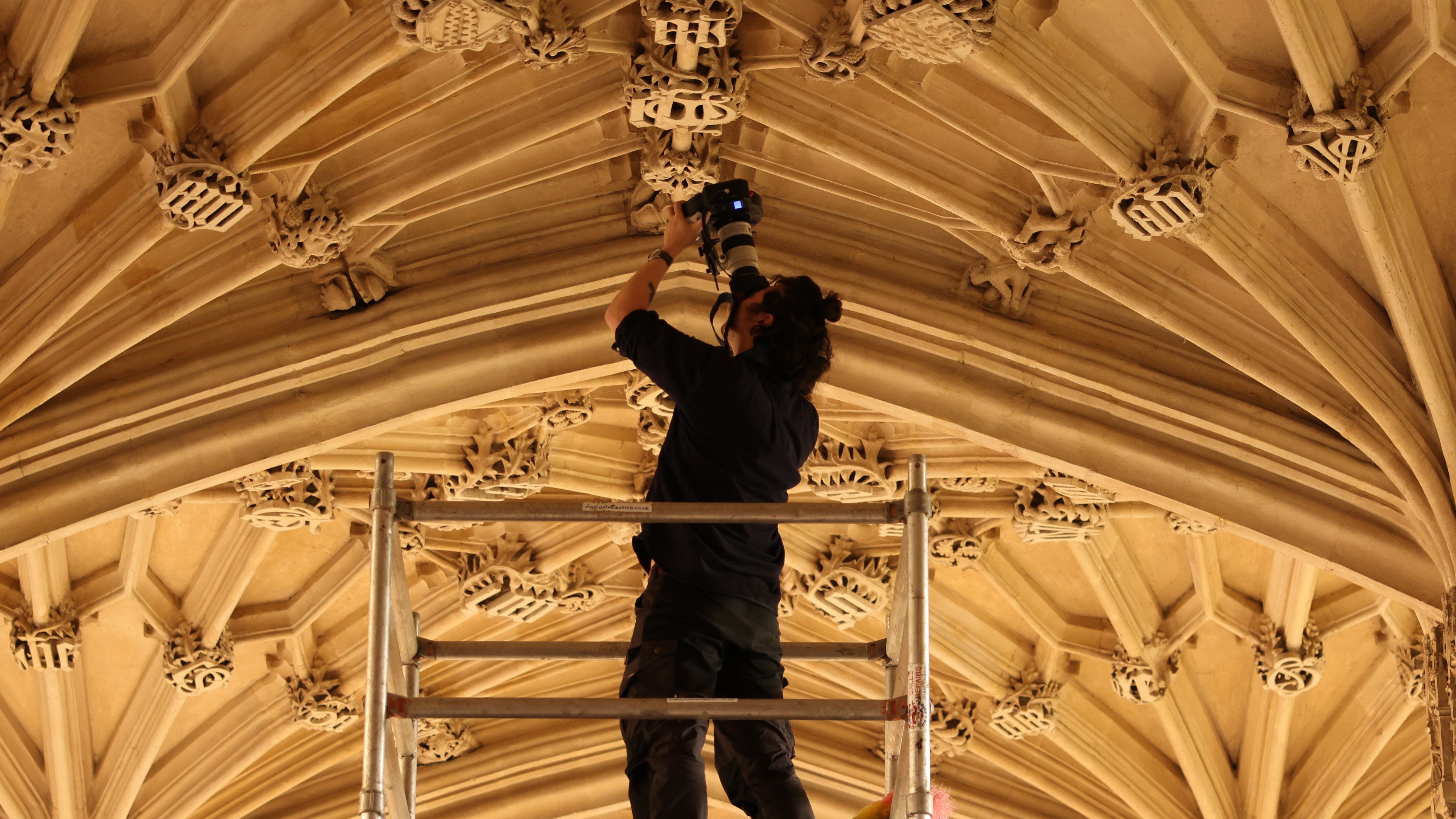
Most visitors walk into the Divinity School and think of Harry Potter; it doubled as the Hogwarts infirmary and played host to the Goblet of Fire dance lesson scene with Professor McGonagall. The floor above featured as the Hogwarts Library, which is fitting given Barrett’s role is a bit like looking in the restricted section for anything out of the ordinary.
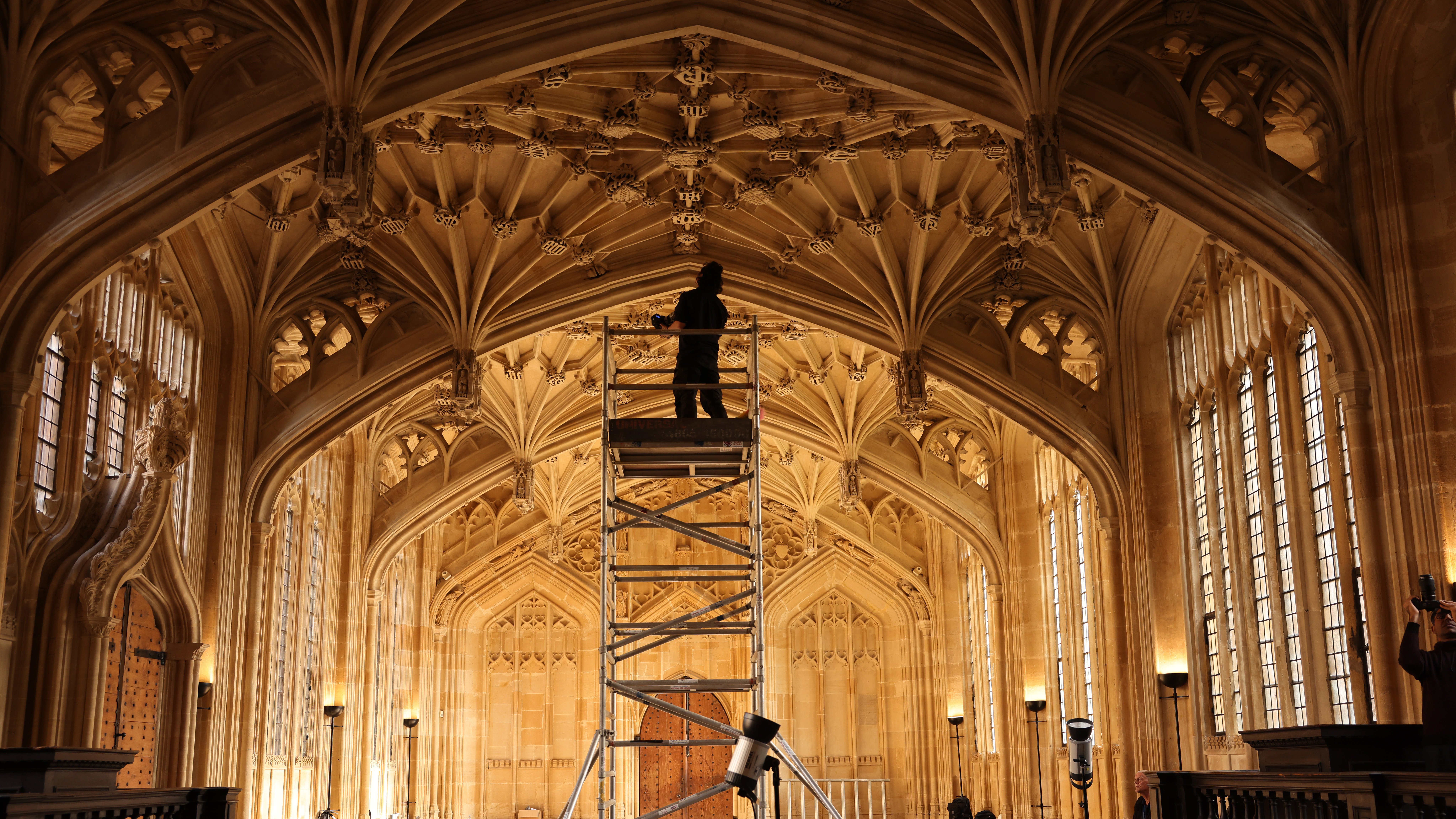
Look up at the Divinity School ceiling, and can you find 455 15th-century carved bosses, none of which any living person had properly seen until ARCHiOx put cameras up to the ceiling.
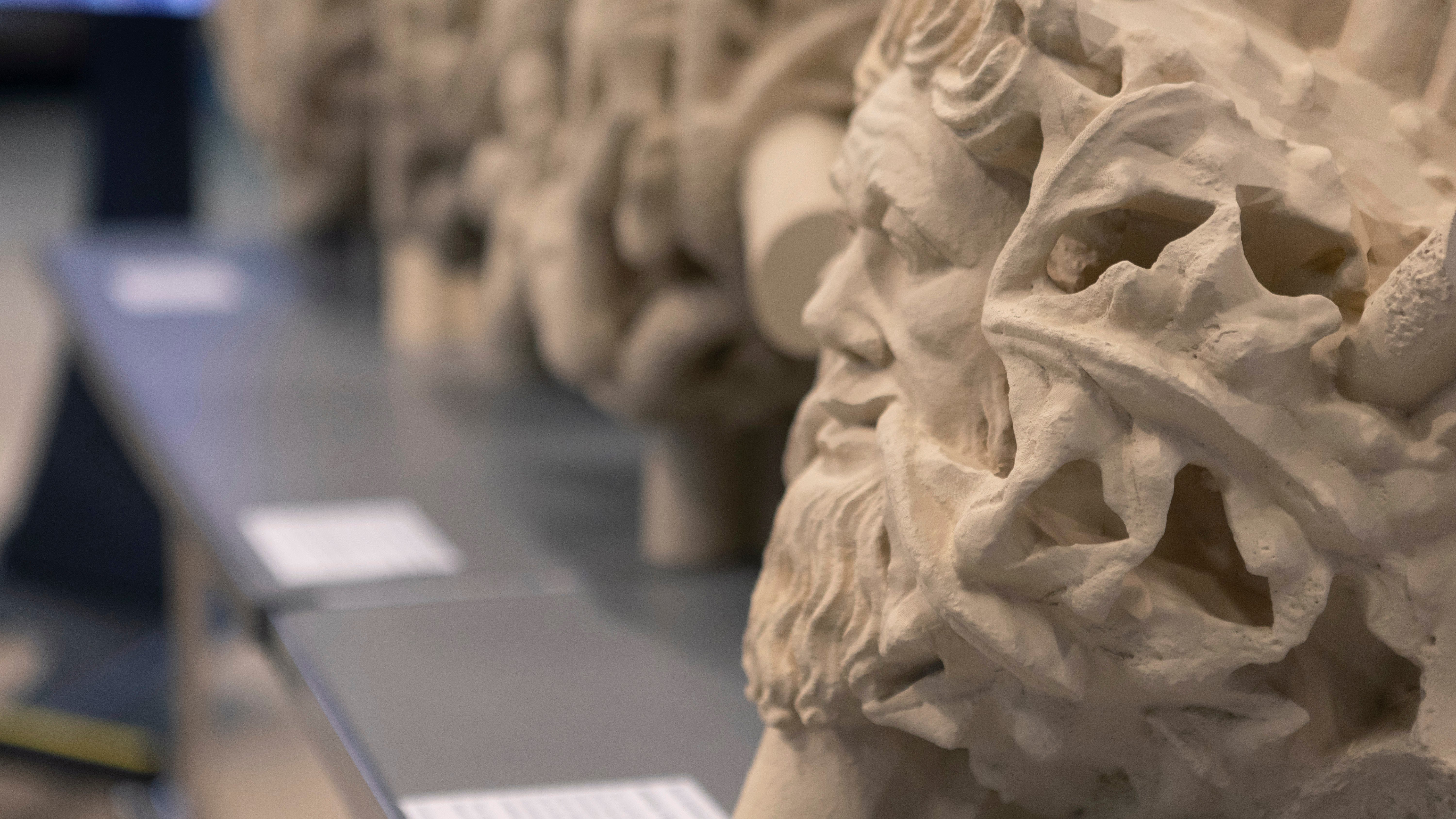
Factum Foundation and ARCHiOx will exhibit together at the Goodwood Festival of Speed presented by Mastercard, which will mark the first time the Divinity School ceiling project will have been shown in public. The stand will include live demonstrations of its scanner technology and three individual ceiling bosses, cast at full size, for visitors to touch.
Alongside the ARCHiOx display, Factum Foundation will unveil an interactive digital journey into one of the best-preserved Greek burial complexes in the Mediterranean, currently hidden ten metres beneath the streets of Naples’ Rione Sanità.
The Ipogeo dei Cristallini dates to the late 4th and 3rd centuries BCE and preserves extraordinary examples of Hellenistic painting, polychrome sculpture and funerary architecture. Visitors will be able to descend virtually into this remarkable underground world to explore its richly coloured tombs and sculpted chambers in unprecedented detail.
We caught up with Barrett ahead of the Festival of Speed to find out more.
How did you find your way into manuscript imaging?
I started at the Bodleian in 2005, and my background was in photography, not manuscripts or history, though you pick those up as you go. The 3D project came along in 2022 when we partnered with Factum. They proposed trialling a new piece of technology for recording the 3D surface of books, manuscripts and artworks. I've been at it since.
Most people associate 3D scanning with lasers. The Bodleian's system, Selene, doesn't use one. Why?
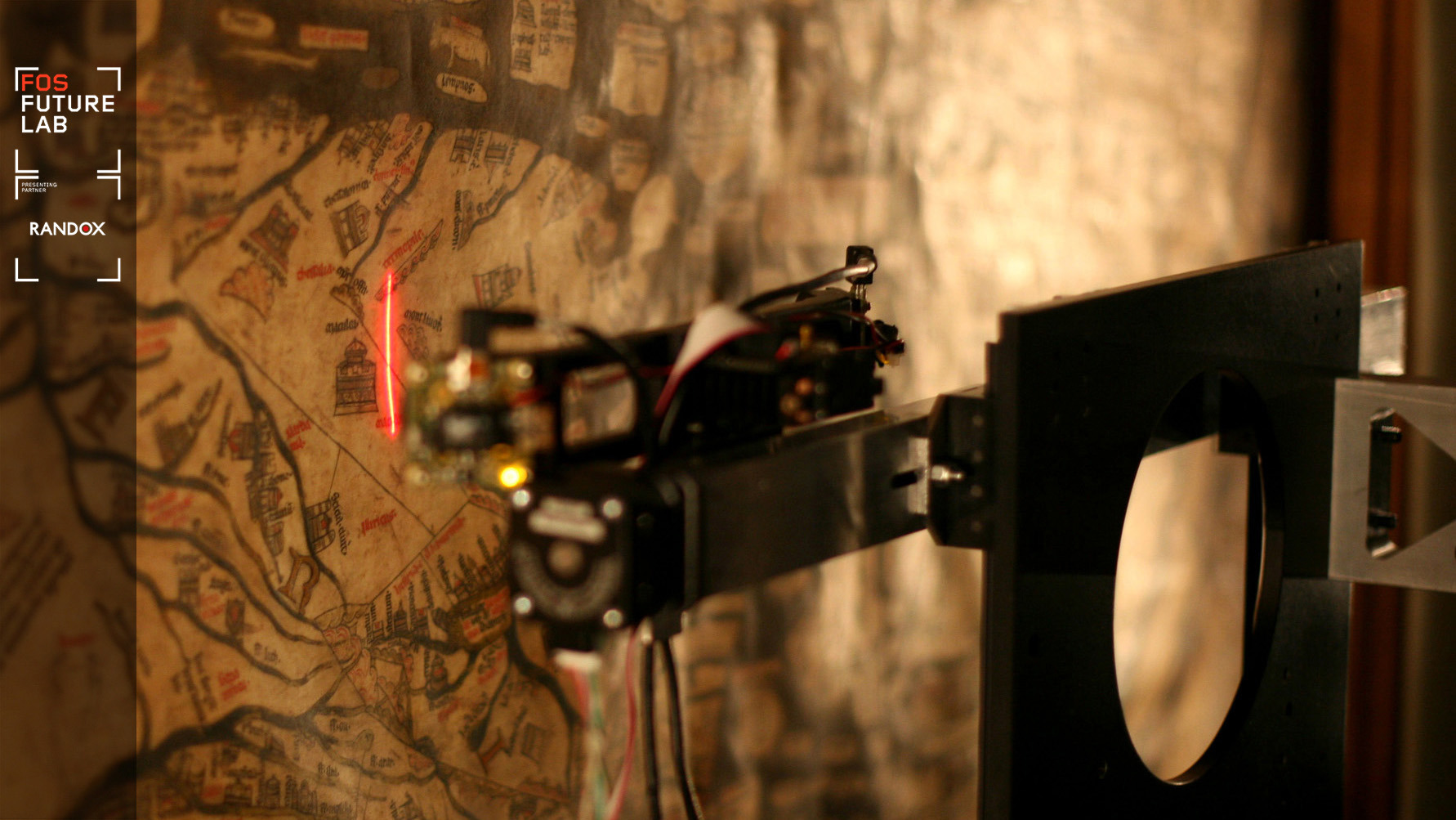
It's light-based, not laser-based. The principle is called photometric stereo, and NASA originally developed it to work out how deep the craters on the Moon are by examining how shadows fall across the surface depending on where the sun is. At the right scale, working out the depth of a lunar crater and the depth of a stylus mark on a medieval manuscript turn out to use the same physics. The machine is named after Selene, the Greek goddess of the moon.
How does it work?
We take four images of the same surface, lit from four different directions, and from the way the shadows fall we calculate the topography at every pixel. Up to four million pixels per square inch.
What can it see that ordinary photography can't?
Surfaces nobody has looked at in centuries. My favourite find is on the reverse of an 18th-century copper printing plate, where we think William Blake may have left his first self-portrait — a doodle of a face about the size of my fingernail. He was apprenticed to a master engraver called James Basire and went out to Westminster Abbey to draw the tombs of kings and queens.
What else?
We're also finding stylus incisions in medieval manuscripts that the naked eye can't see, like planning marks, annotations and compass points used to lay out illustrations. The page looks completely blank until you light it the right way.

Most Divinity School visitors are there for Harry Potter. What are they missing?
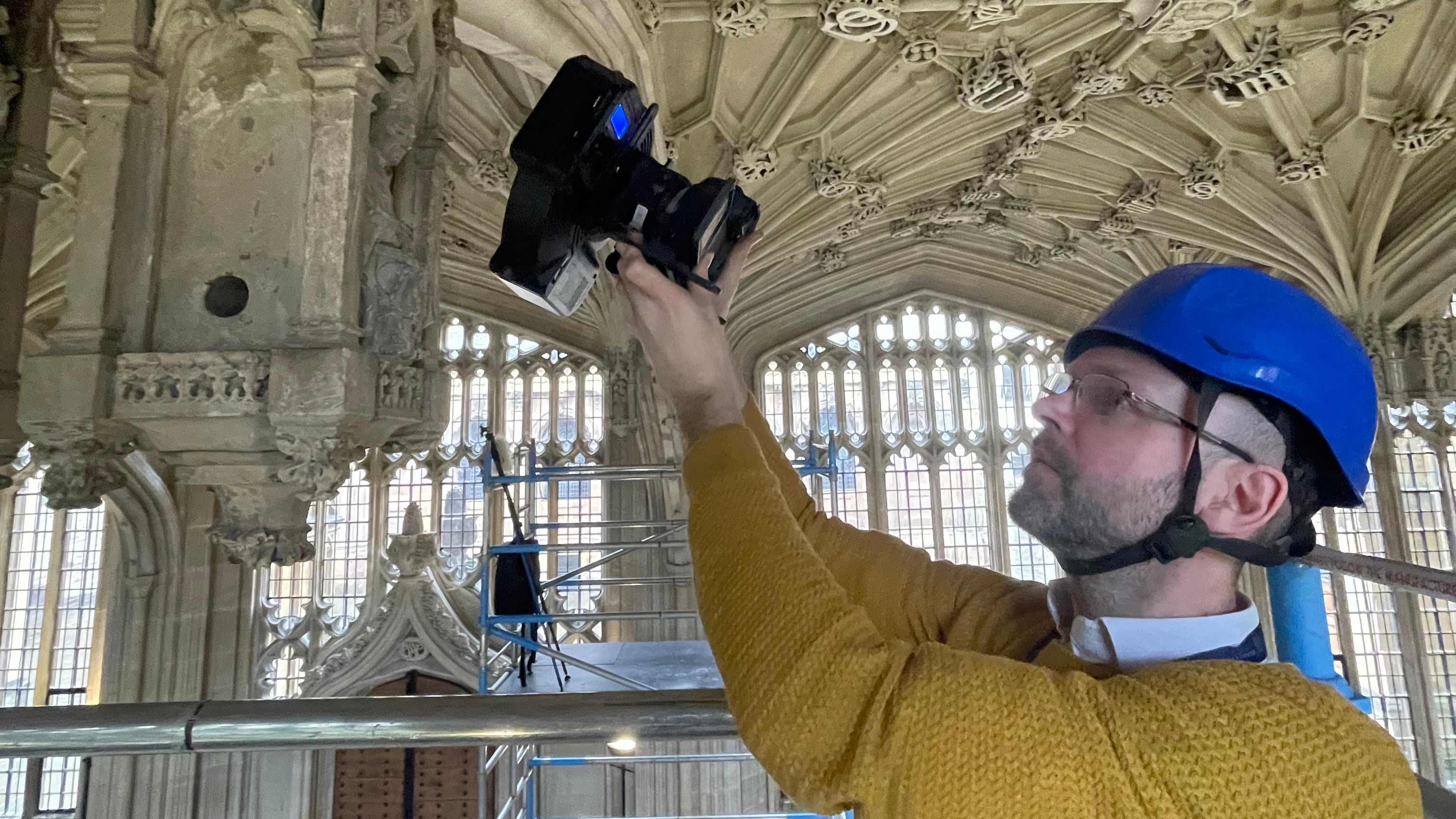
It's an extraordinary space. Everyone notices the ceiling, but what's hard to appreciate is that there are 455 individual carvings up there, around eight metres above your head. We went up in 2024 with photogrammetry rigs, taking up to 2,000 images per carving, to record them in detail nobody's been able to see before.
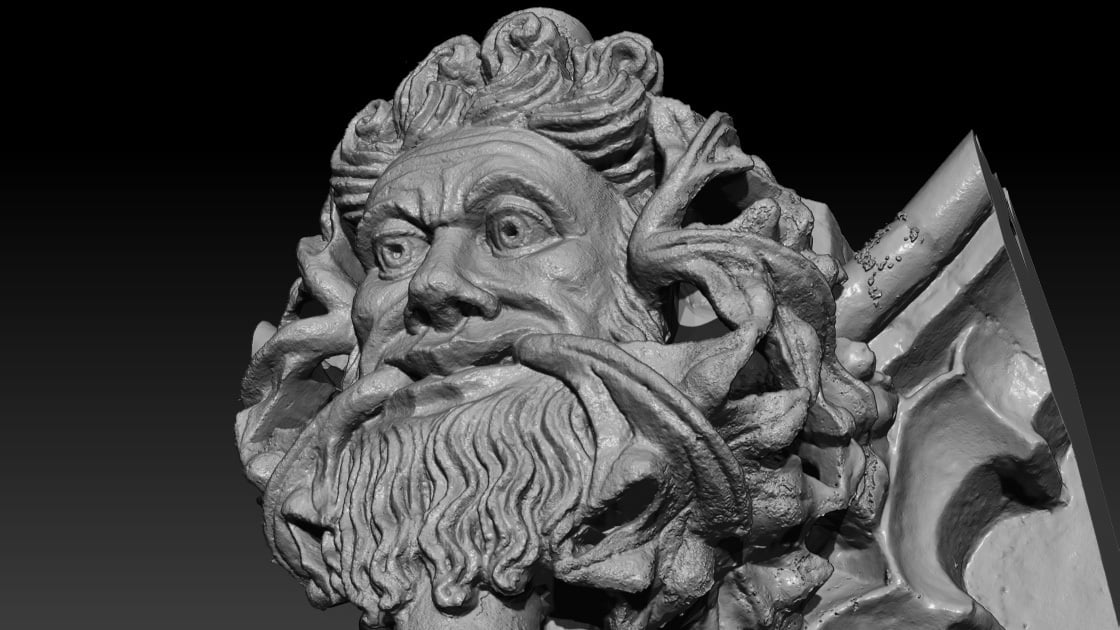
Take the Eagle and Child boss — probably one of the last on the ceiling to be carved. It's covered in details you can't appreciate from the ground, like the angry expression on the child's face. A boss catalogued for years as a "grazing pony" turns out to have tusks and may actually be a wild boar.
We've found wooden wedges holding parts of the ceiling together, with no idea who put them there or when. The only people who had ever really seen these carvings up close were the masons who made them in the 1400s.
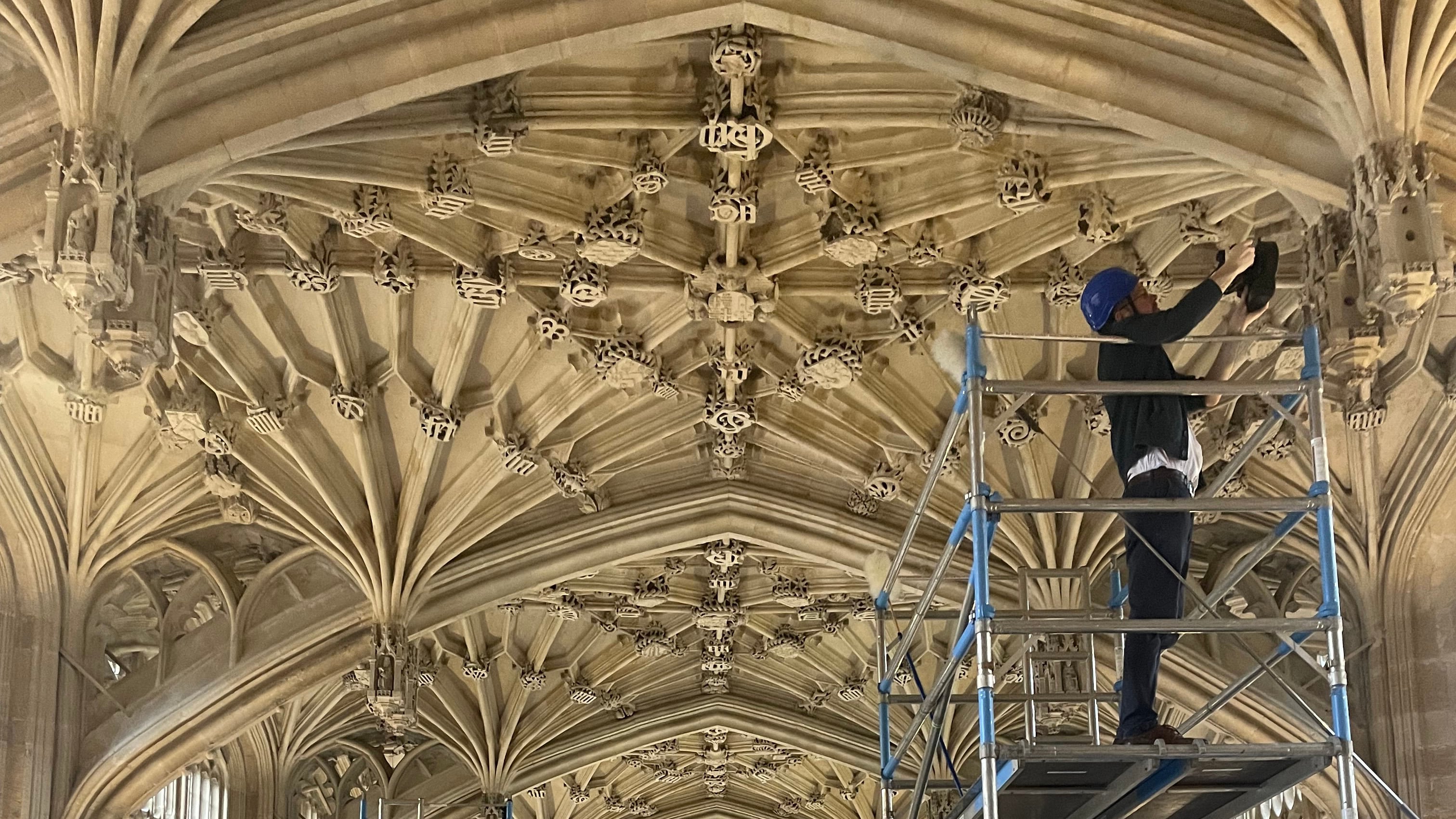
Just last week, I invited researcher Dr Duncan Taylor in to look at the most recent recordings. He was amazed at the level of detail in the new digital models — we can travel through the recesses, even examine the tool marks in the hollow voids behind the figures and the foliage. One of the most important carvings sits close to Edward IV's central boss. It depicts the Trinity. Dr Taylor immediately noticed the stigmata in Christ's hands, feet and side. Details a few millimetres across never documented before.
The Factum Foundation makes exact replicas. Are they somehow lesser than the original?
We should be honest about what we're showing. The bronze horses on St Mark's Basilica in Venice are not original. The carved heads around the Sheldonian Theatre were installed in 1972, but most tourists assume they're contemporary with the building. A facsimile isn't a forgery. We make reproductions that look identical, label them clearly and let visitors do things they can't with the original, like get close, change the lighting and touch them.
What should younger generations wanting in on this be studying?
My route in was photography. I started in 2D imaging, which morphed into 3D, which has been really good fun. A bit of art history wouldn't hurt. Physics would be a really good starting point; it underpins the way photometric stereo works and all forms of photography, photogrammetry as well. In terms of my colleagues at Factum, we've got cartographers, we've got artists. It's really multidisciplinary — all sorts of amazing people. If you wanted to be a curator or work in a reading room, you'd certainly want to study literature and history.
What can visitors expect to see at FOS Future Lab?
We always invite people to touch the facsimiles — that's where you get an appreciation for the skill of these stonemasons who made them. I hope visitors can see that this is possible now, using current technology, and how it could be applied to other spaces.
Where does this technology go in the next decade?
It'll get a lot easier. We're not far off video photogrammetry, where you wave a camera around an object and get a high-resolution 3D model almost instantly. At the moment, we process thousands of images per carving on gaming-grade GPUs. That's going to get much faster.
Why is this work important?
If you think about terrible disasters like the Notre Dame fire, this is really important — to safeguard our cultural heritage and record it as best we possibly can with the technology available. It's reassuring. Every time we digitise a manuscript, every time we record a space, we know we've got a record of it.
Randox is a global leader in diagnostics, revolutionising patient outcomes through innovative technologies, including its patented biochip technology. This pioneering diagnostic platform allows for the simultaneous detection of multiple biomarkers from a single sample, delivering faster, more accurate, and comprehensive results. Operating in over 145 countries, Randox develops advanced laboratory instruments, high-quality reagents, and innovative testing solutions to improve global healthcare.
Randox Health brings this cutting-edge technology directly to individuals, offering bespoke, preventative health testing programs. With world-class laboratories and personalised health insights, Randox Health enables early detection of a wide range of conditions, helping individuals take control of their health.
Together, Randox and Randox Health are redefining diagnostics and preventative healthcare. For more information, visit www.randox.com and www.randoxhealth.com.
Tickets for the Festival of Speed are limited. Only Thursday admission remains but hospitality packages for all four days are available. If you’re not already part of the GRRC, joining the Fellowship means you can save ten per cent on your 2026 tickets and grandstand passes, as well as enjoy a whole host of other on-event perks.
festival of speed
fos
fos 2026
event coverage
future lab
fos future lab
factum foundation
unseen worlds

Subscribe to Goodwood Road & Racing
Thank you, you’re now subscribed

How many hay bales are used at FOS?
For the last two years, 5,800 bales have been recylced into the biomass energy centre to be used for energy generation