

Inside Parnelli Jones’ record-breaking Indy 500 winner
Where Formula 1 circuits have changed almost beyond recognition over the past 60 years, with larger run-off areas, revised corner profiles and so on, the Indianapolis Motor Speedway is fundamentally the same track now as it was in 1961: a 2.5-mile long oval where commitment and courage is rewarded.
Though we’re in no doubt today’s drivers are as brave as they come, there was undoubtedly a different flavour of mental fortitude required to pilot a car like this, the Watson-Offenhauser 'Agajanian Willard Battery Special'.
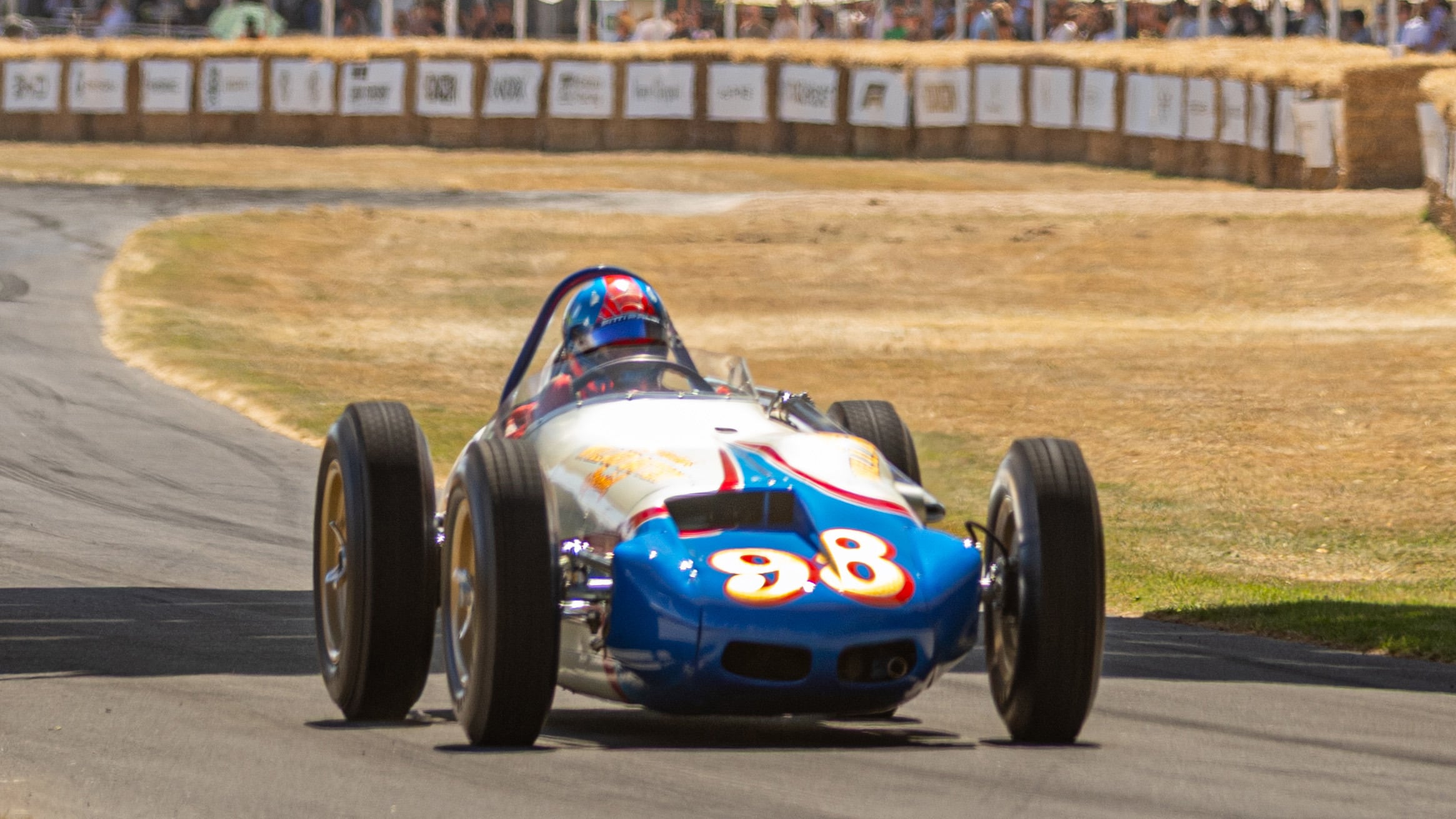
This very car was driven to victory at the 1963 Indianapolis 500 by the late Parnelli Jones, a racer through and through and the first man to achieve a 150mph-plus qualifying lap at Indy in 1962 — in this very car. In fact, the Agajanian Willard Battery Special, or “Ol' Calhoun” as it’s often referred to as, was raced at the Indy 500 in 1960 by Lloyd Ruby, and then in 1961, ‘62, ‘63 and ‘64 with Jones on the tiller.
With Goodwood heading to the USA from 2027 with the launch of the GRRC of America, we sat down with Jason Vansickle, Vice President Curation and Education at the Indianapolis Motor Speedway Museum, where “Ol’ Calhoun” resides, to learn more about the car, its origins and its success.
“This is an A.J. Watson-built roadster,” Vansickle told us. A.J. Watson was one of the pivotal chief mechanics and car builders in the mid-20th century, a legend when it comes to the Indianapolis Motor Speedway.
“The roadsters at Indianapolis,” Vansickle continued, “really debuted in 1952 with car builder Frank Kurtis and driver Bill Vukovich. So the teams, car owners and drivers quickly switched from having upright ‘offys’ — dirt cars that were running the 500 before, to these roadsters.”
Multiple people took to building the new roadster-style racers, but it was A.J. Watson who looked at a Kurtis, started making adjustments as he saw fit and in turn created the Watson chassis, who found a lot of success.
So, what of ‘Ol’ Calhoun’? As Vansickle explained, the Agajanian Willard Battery Special debuted in 1960, with J.C. Agajanian as the car owner and Lloyd Ruby as the driver. But really its legacy started in 1961 with Parnelli Jones in his rookie year.
“He led during the race [and] unfortunately ran into some issues that set him back, but still won co-rookie of the year with Bobby Marshman. Then 1962 is really when the records start happening.”
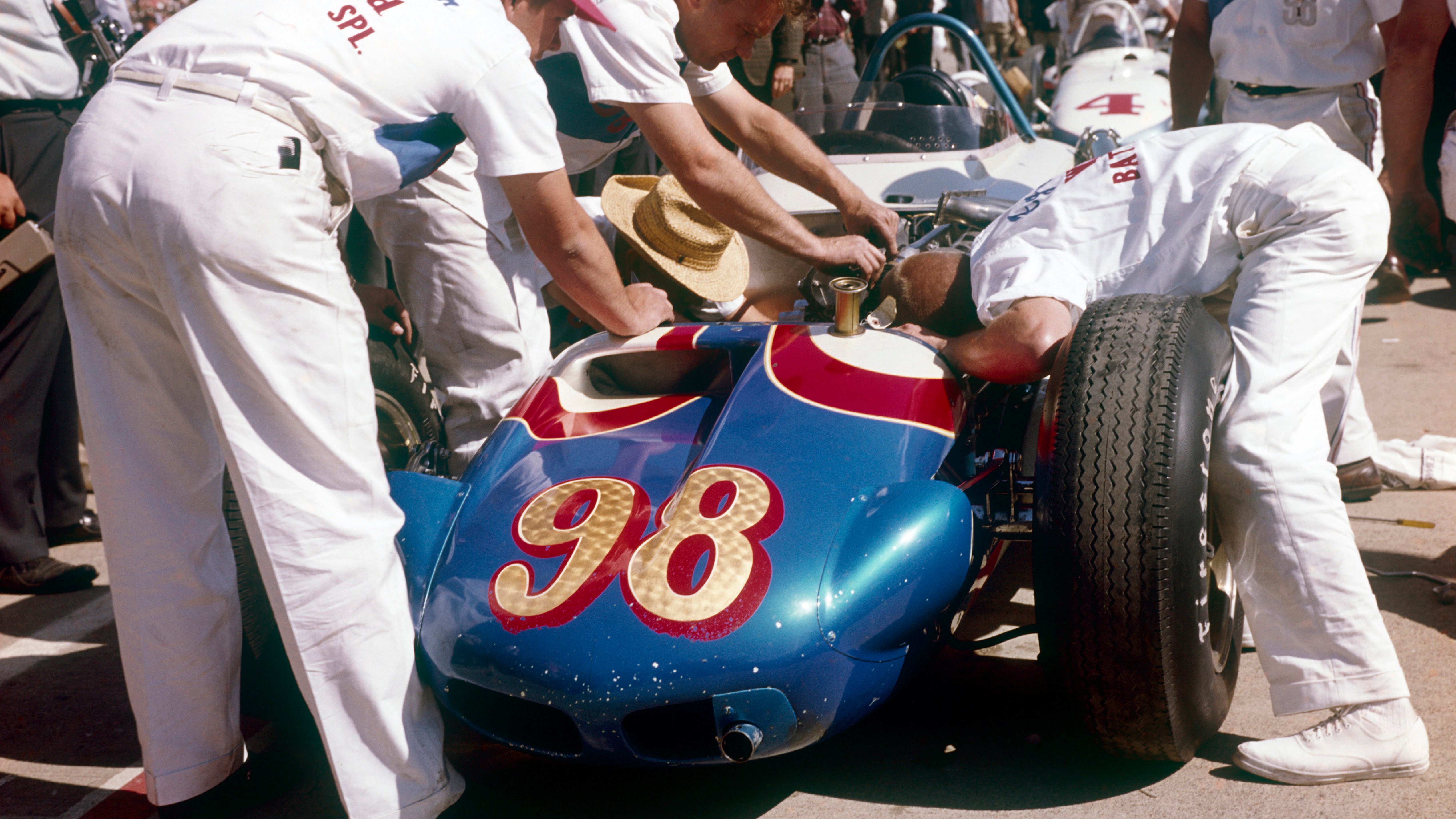
‘Ol’ Calhoun’ before its victory at the 1963 Indianapolis 500.
Image credit: Getty Images.The record Vansickle’s referring to is of course the 150mph qualifying run, a feat no other car, driver and team combination had been able to conquer up to that point. “That was a threshold people were anticipating, but Parnelli was the first one to break it.”
Sadly, luck wasn’t on Parnelli Jones’ side that day. Despite leading a lot of the race he encountered brake issues and finished in seventh position come the chequered flag. But returning in 1963, with a modified nose and exhaust on the car, Jones was able to hold off the legendary Jim Clark in his mid-engined Lotus 29 for his one and only Indy 500 victory.
Parnelli Jones and ‘Ol’ Calhoun’ returned again in 1964, but a fire during a pit stop put an end to his and the team’s ambitions of back-to-back wins. Following that, it was the newer mid-engined cars that began to take over. Even so, the Agajanian Willard Battery Special is an imposing creation.
It uses a 4.2-litre, four-cylinder, naturally-aspirated engine. “It has around 450 horsepower,” Vansickle reported. “When you look at the rear engined cars that they were competing with, especially this year [1963], the rear engined cars probably had about 100 and some horsepower less. But with the more modern layout, geometry and suspension, and being lighter, they could go through the corners quicker. But the roadsters had more top and speed at that point.”
How fast, we asked, given that the bodywork is so thin you’d worry about a feather tearing a hole in it. “I mean, they were doing probably about 130mph, the high 130s, in the corners,” Vansickle said. “But then obviously during the long five eighths of a mile straight away at Indianapolis, they really get the speed back up — they're probably doing north of 175mph before they have to lift and slow down for the corners.”
The tyres are tall and thin, the gearbox a two-speed unit (“you would just use the low gear to get out of the pits during the pit stops, and then really get into high”), the suspension torsion bar and the brakes hydraulic discs.
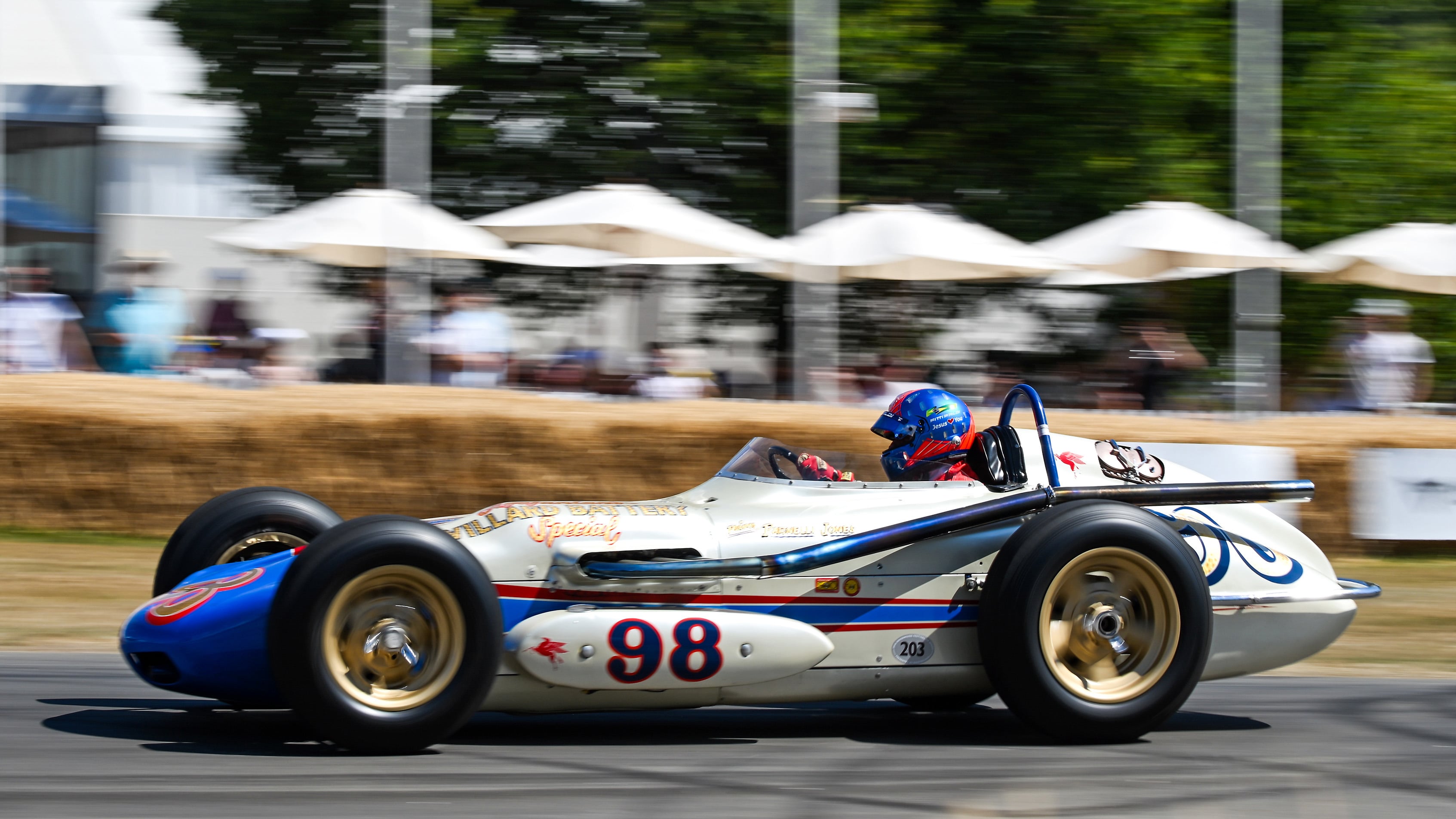
A common thread between this and modern Indy 500 racers is the ability of the driver to change the car’s balance from lap to lap, as Vansickle illustrated: “They have what you call a weightjacker. So, you can adjust in the car, the suspension to add more weight on the left front or the right rear to help with the handling over the duration of the run.” Very clever stuff.
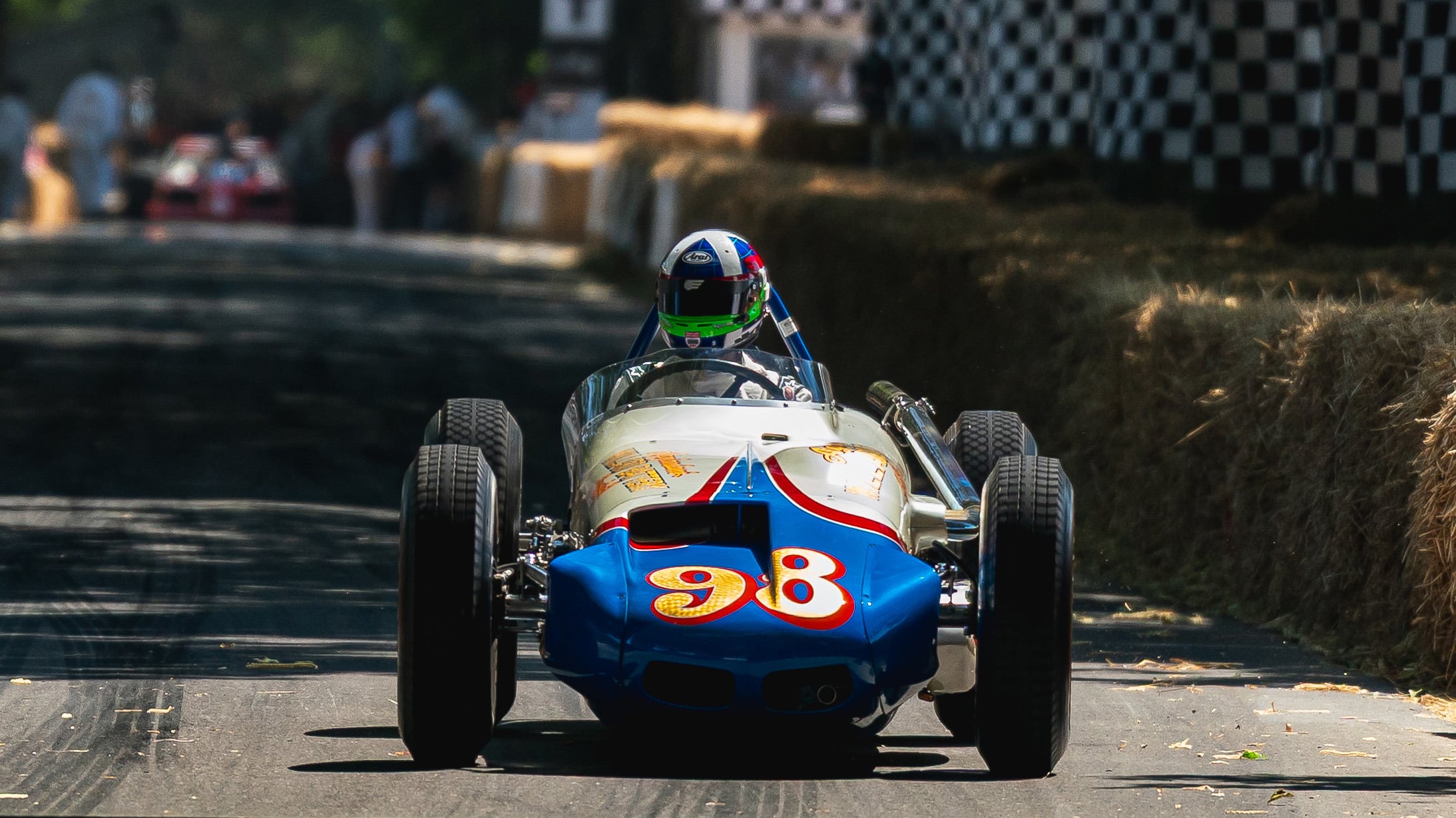
But the real curiosity is the position of the engine inside the engine bay. “Because it's an oval track and they just turned left,” Vansickle continued, “it's offset, which is another typical roadster hallmark.
“If you look inside the cockpit of it you can see the transmission, but you'll also see the driveshaft that runs to the driver's left. It’s encased in a torque tube, so it's not free spinning, but it's still right there. So if you have a failure, you know… It's there!”
Vansickle’s knowledge of the iconic Agajanian Willard Battery Special is incredible — there’s more than enough history in this one classic racer to create a large hardback book. But soaking in the details, it’s hard to imagine getting behind the wheel of such a car and pushing it to the very limit, let alone doing so for 200 laps of Indianapolis.
But despite its seriousness, its potential, there are little features to remind you humans really did get behind the wheel, and that other bright sparks put a class-leading car together with whatever they had available to them at the time. The interior is trimmed with leather, for example, and the instrument dials taken from former World War II aircraft.
But what about the nickname? “There's a couple of different stories,” according to Vansickle. “Parnelli and the team called it Calhoun, but a lot of people called it Ol’ Calhoun. But it is a football term — American football! The phrase, if you will, was ‘give the ball to old Calhoun’. So, for whatever reason, Parnelli dubbed the car Calhoun and the rest was history. And it's really, really stuck with it, people may not refer to it as its real name, the Agajanian Willard Battery Special, but they'll call it Calhoun.”
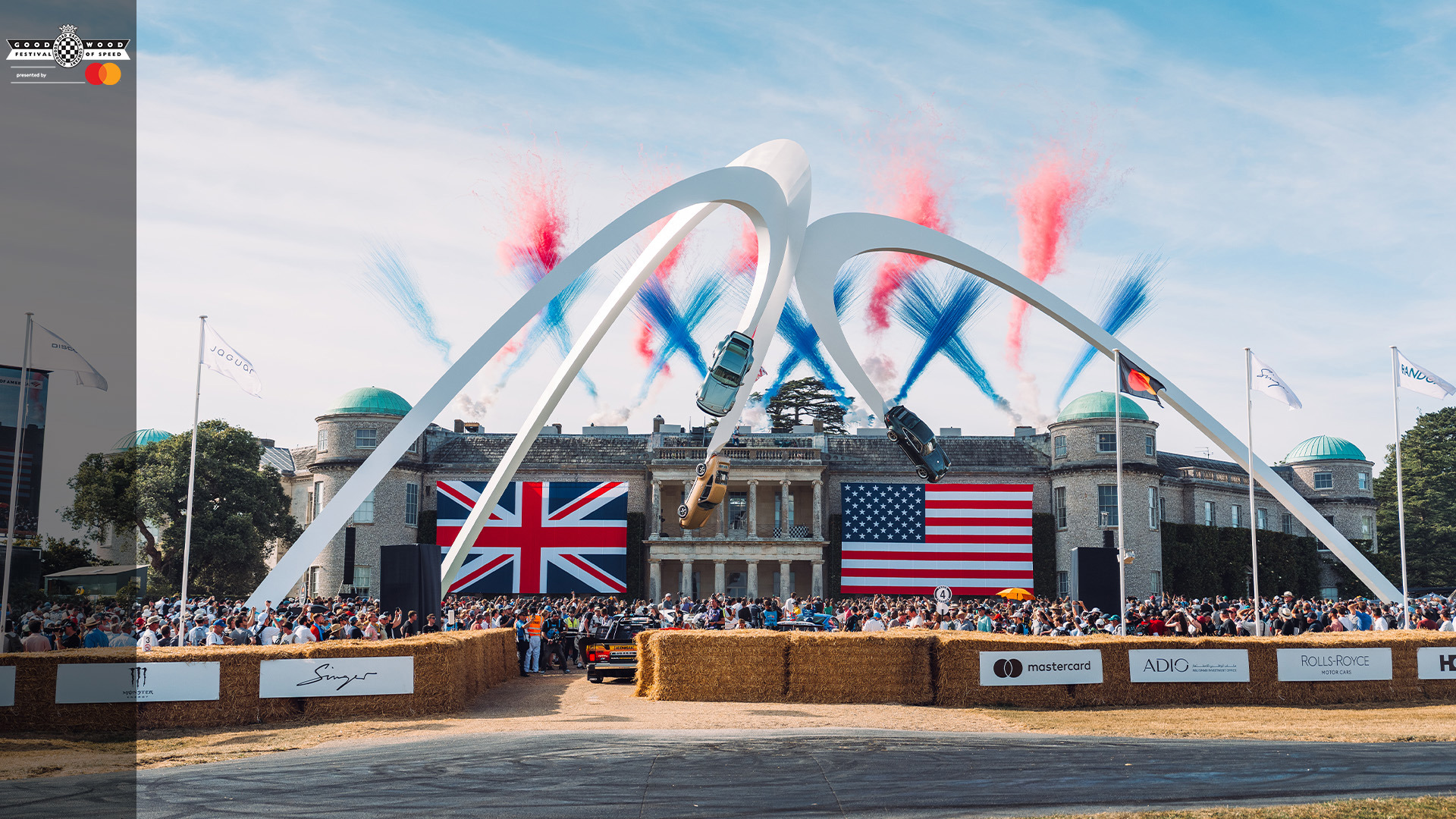
The curious thing about Goodwood, and events like the Festival of Speed presented by Mastercard, is that you can very quickly get used to seeing and hearing what are some of the rarest, most exotic and most valuable road and racing cars in the world.
You’ll wander past a Formula 1 car or two, hear a NASCAR ripping a burnout in the distance, and snap a picture of a 1963 Indy 500 winner that just so happens to be parked next to another immeasurably valuable machine without really thinking about it. Which is why looking at ‘Ol’ Calhoun’, getting to know a single car’s story a little better, is so exciting. With the arrival of the GRRC of America, no doubt we’ll have plenty more special stateside tales to tell in the years to come.
A special thanks to Jason Vansickle and the Indianapolis Motor Speedway Museum.
The 2027 Festival of Speed will take place on 15th-18th July 2027, sign up for ticket alerts to make sure you don't miss out. Tickets are available for GRRC Members and Fellows, you can join the Fellowship today.
Main image photography by Sam Milton.
festival of speed
fos
fos 2026
event coverage
Parnelli Jones
ol calhoun
Agajanian Willard Battery Special
Indianapolis 500
Subscribe to Goodwood Road & Racing
Thank you, you’re now subscribed

How many hay bales are used at FOS?
For the last two years, 5,800 bales have been recylced into the biomass energy centre to be used for energy generation