




























































The Fast Show
A new exhibition at the Dulwich Picture Gallery shines the spotlight on the Grosvenor School of Modern Art, a group of late-1920s artists whose creative mission was to capture and celebrate the speed of modern life
Words by Matthew Sturgis
Goodwood Magazine
goodwood newsletter
Goodwood news
horseracing
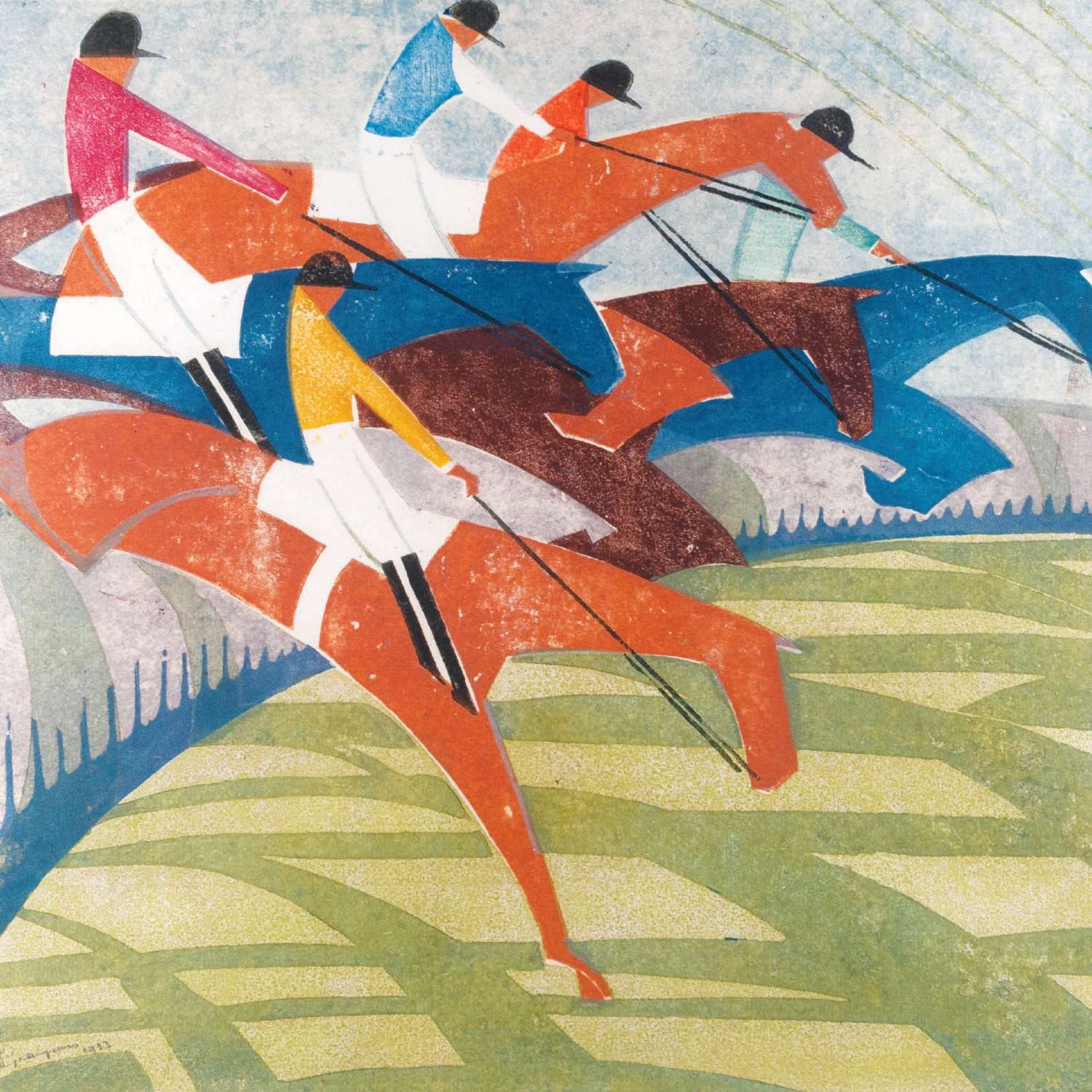
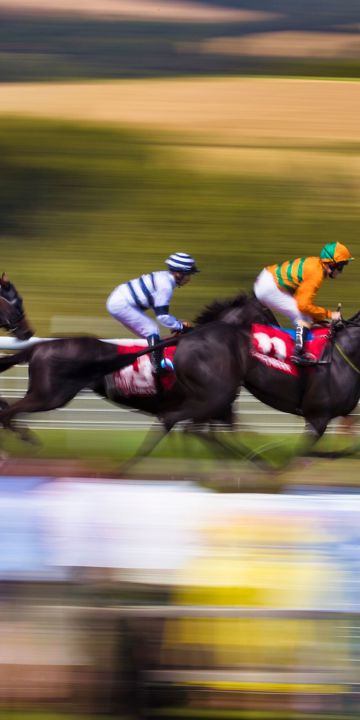
Cars, trains, planes, motorbikes, action movies, sports, pastimes, life itself: everything is getting faster. And faster. Speed, indeed, is the defining feature of the modern world, and it has been ever since the world started considering itself as “modern”. Back in 1925, the artist Claude Flight was already noting, “Time seems to pass so quickly nowadays. Everybody is in a hurry… this speeding up of life in general is one of the interesting and psychologically important features of today.”
While some lamented the acceleration, Flight was both intrigued and enthused by it. The desire to capture, and celebrate, the speed of modern life became his artistic mission – a mission that he shared with the artists he gathered together at the Grosvenor School of Modern Art in the late 1920s.
The boldly coloured prints created by the practitioners of the Grosvenor School are a remarkable achievement in the story of British Art: fresh, vital and utterly distinctive. After decades of neglect, they have gained a renewed recognition. They are now sought-after and collected; they achieve high prices at auction; and an exhibition this summer at the Dulwich Picture Gallery in South London will introduce the work to a new and wider public. Original and forward-looking though the work is, it owes a debt to what came before – to earlier artistic movements that had embraced the challenging energy of the Machine Age: the experiments of Wyndham Lewis and the Vorticists; the achievements of Italian Futurism. In 1912, Claude Flight, then a mature but eager art student, had met Filippo Marinetti when the founding figure of Futurismo visited London. Marinetti was particularly delighted by the London Underground system, and the way it hurtled along beneath the crowded streets. He could not understand why no British artist had taken it as a motif. It was an observation that resonated.
Even the horrific mechanised slaughter of the First World War – during which Flight served in France – did not destroy his sense of excitement in the potent dynamism of the modern world, although it did perhaps tinge it with a new sense of tension. And at the beginning of the 1920s, when his friend Iain Macnab set up a small private art-school in a run-down Pimlico townhouse, at 44 Warwick Square, Flight offered to establish a printmaking course in the basement, so that he could develop and communicate his vision.
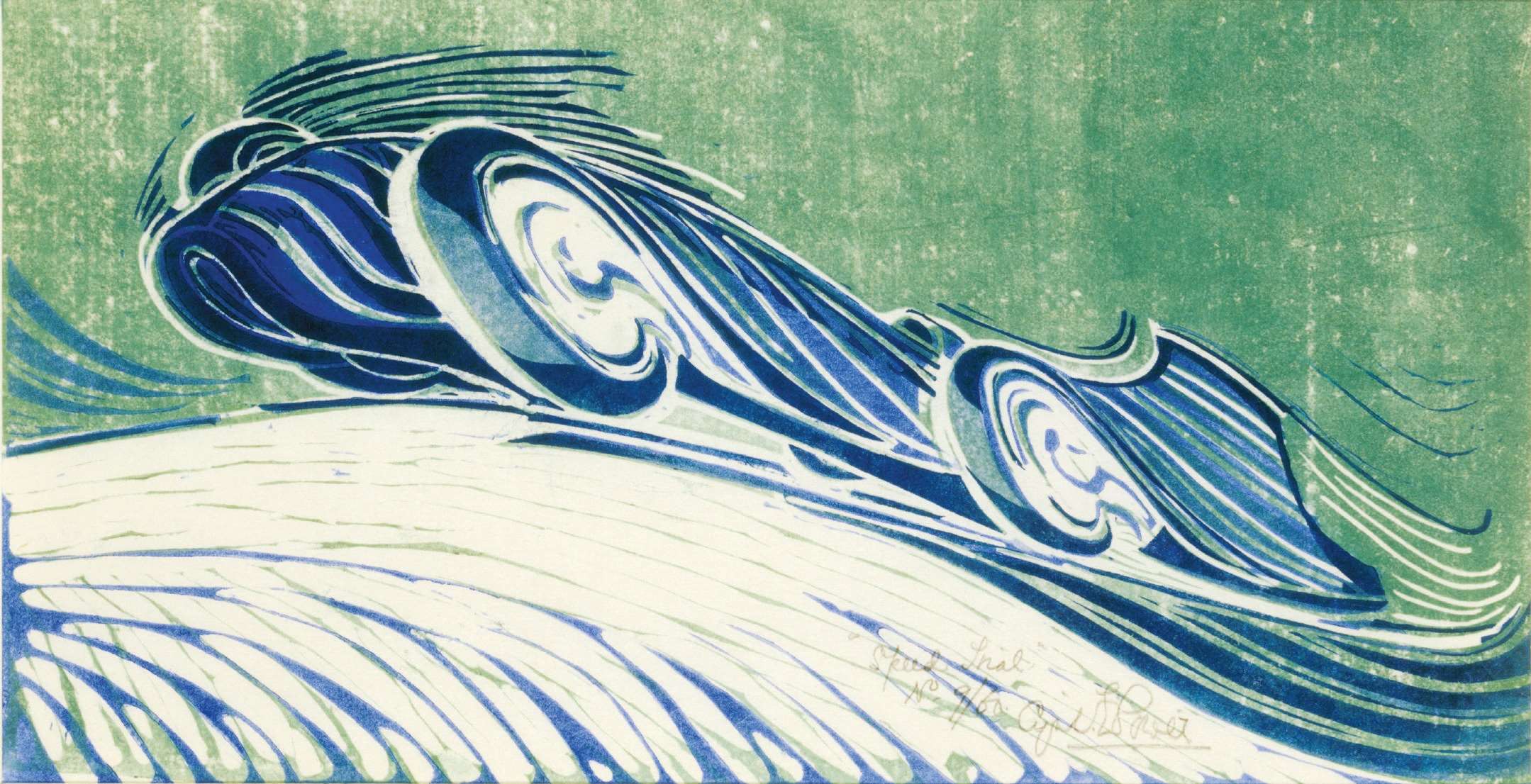
Flight had evolved a style of geometric volumes and curving lines, of bold flat colours and striking contrasts, that conveyed a sense of motion and force. And he chose to fix these images not in paint or sculpture but in the simple medium of the linocut. Then, as now, it was a medium more associated with primary school artclasses than with the endeavours of Fine Art. But Flight saw scope in its immediacy and in its modest form.
Flight evolved a style of curving lines, bold flat colours and striking contrasts that conveyed a sense of motion and force
The group that gathered for Flight’s classes was a small one. It included the school secretary, Sybil Andrews, and its architectural-drawing tutor, Cyril Power; there was a trio of Australian students (Ethel Spowers, Dorrit Black and Eveline Syme), and a young Swiss woman called Lill Tschudi. All, however, were enthused by his modernist vision – and by his innovative working methods.
Materials were simple, and – no less importantly – cheap. They used regular household linoleum as their base. Their gouging tools were fashioned from old umbrella struts. Flight’s technique demanded a clarifying simplicity of design, with the image being broken down into its main constituent colours, and separate linoblocks being cut for each colour. Areas of overprinting could produce intermediate shades. To preserve the freshness and energy of the image, Flight abandoned the traditional print procedure of overprinting the principle outlines of the design from a single, black “key block”.
Linocutting may have been crude in some ways, but what it lacked in precision and detail it made up for in boldness of form and fluidity of design. It had novelty too. It was not a medium freighted with a lengthy history and daunting artistic associations. These were all elements well-suited to conveying the energy and movement of a contemporary world that was undeniably novel, often fluid, nearly always bold.
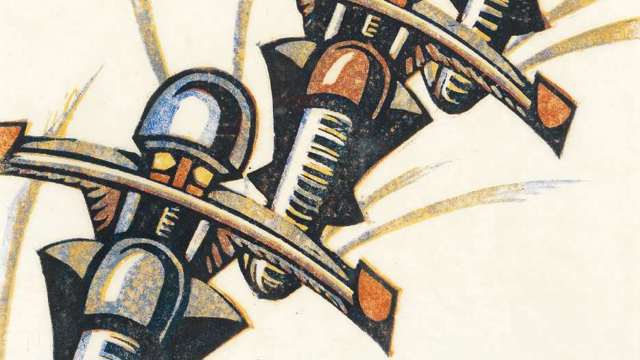
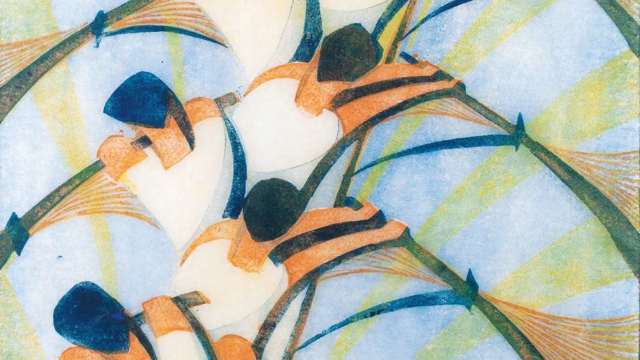
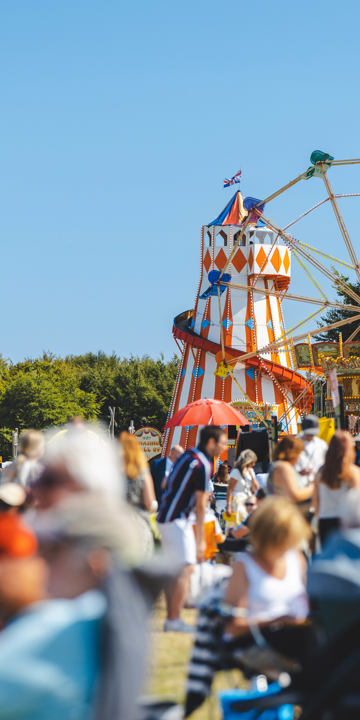
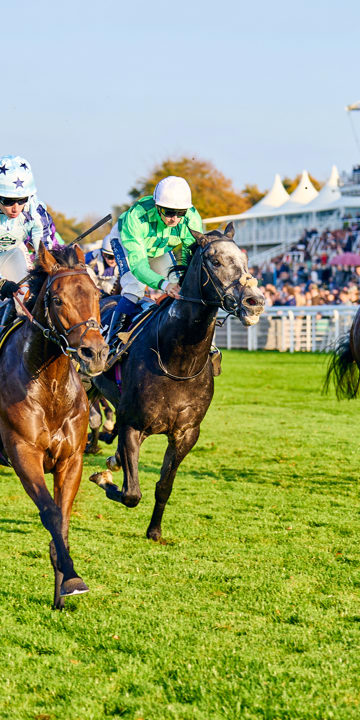
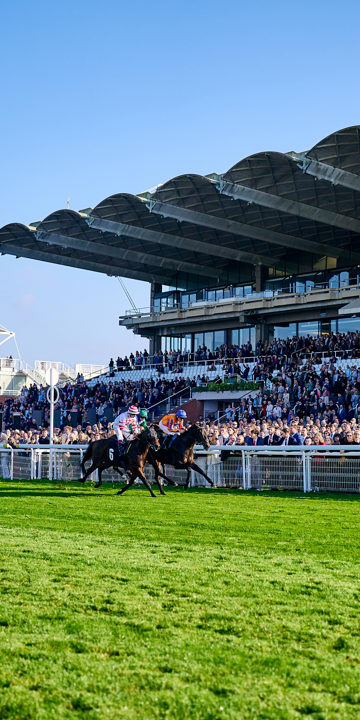
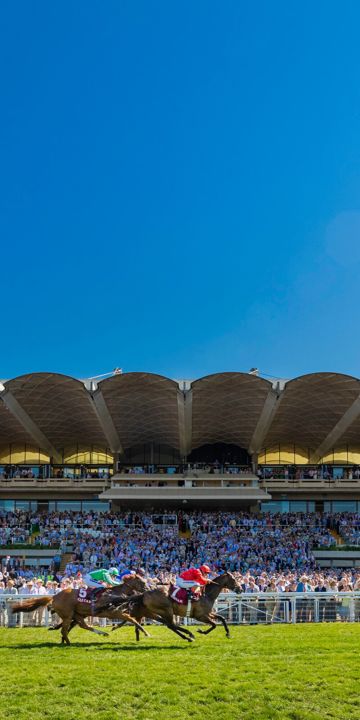
Cars, escalators, fairgrounds, factories, dance halls, restaurants, racetracks and rush hours: all the motifs of urban existence were taken up – along with, it has to be said, some scenes of rural life: from ploughing horses to village cricket. But the town always predominated.
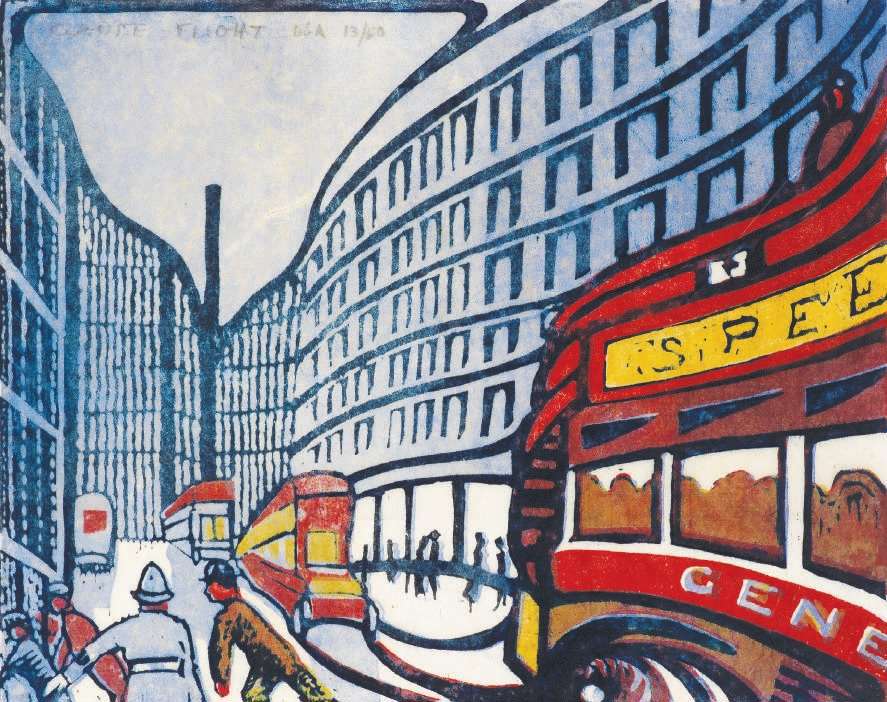
In his significantly titled 1922 print, Speed, Claude Flight had set the tone, showing the lines of the modern metropolis bending, if not buckling, against the rush of motor traffic. The first four letters of the title appear, emblazoned on the side of the passing double-decker bus in the foreground. His pupils responded to the call. Cyril Power, in The Tube Station (1925), took up that challenge laid down by Marinetti, producing a glorious symphony of curving forms to depict a red tube-train racing through the sudden brightness of the arcaded station into the blackness of the tunnel beyond.
Power and Sybil Andrews collaborated on a series of posters for London Underground depicting major sporting venues in and around London. And it was from studies done on this project that Andrews created her celebrated print Speedway (1934), showing three riders hurtling towards the viewer, faces obscured by helmet and goggles, streaks of dirt rising from their front wheels in a visual expression of speed. Lill Tschudi also relished the dynamism of sporting subjects, producing gracefully charged images of skiers and cyclists and sports cars racing on their way. Her striking 1933 print, Ice Hockey, less graceful but more charged, is a swirling vortex of clashing green-and-black forms.
Linocut may have been crude, but what it lacked in precision it made up for in boldness of form and fluidity of design
The minor dramas of daily life were not ignored. In A Gust of Wind (1931) Ethel Spowers created a memorable image of a black-clad figure on a crowded street losing hold of a sheaf of papers. The white pages swirl against a background of reds and greens, and blue umbrellas.
Flight valued linocut’s modest scale for its aesthetic as much as its commercial benefits. “People live in smaller rooms,” he reasoned, “and the pictures they buy must necessarily be smaller… Colour prints being necessarily small, look better in smaller rooms, and the colour-print being a simple colour scheme can be chosen to suit the colour scheme of the particular room to be decorated.”
There was also a social aspect to his choice of medium. It was art within the reach of “ordinary people”. At a time when a watercolour by even a young artist might cost between £5 and £20, a Grosvenor School linocut, done in an edition of 50, would sell for just two or three guineas. As Flight enthused, this was not far off the price “paid by the average man for his daily beer or his cinema ticket”.
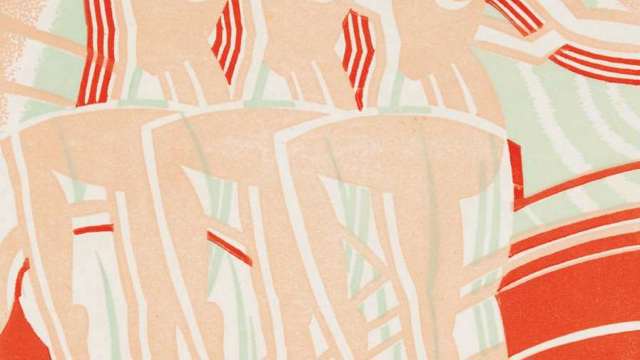
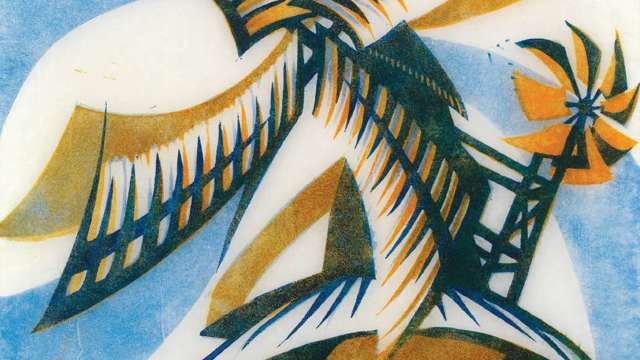
Things have moved on rather on this front. And although the price of beer has gone up since 1929, it has not kept pace with the price of Grosvenor School prints. Lucia Tro Santafe of Bonhams reports a healthy market, with works selling for tens of thousands of pounds. Whether the auction house’s upcoming June sale, which features Sybil Andrews’ Speedway and works by Cyril Power and Lill Tschudi, will break auction records, is yet to be seen. The current record is held by Ethel Spowers’ Gust of Wind, which fetched £114,500 in 2012 during a fierce period of competition between rival collectors.
The movement was sustained for about a decade, with exhibitions in London (at the Redfern Gallery) and in Canada, Australia, the US and China) before it began to lose ground to new artistic innovators during the 1940s. The group gradually broke up. Flight was disheartened when his studio was bombed in the Blitz. He died in 1955, largely forgotten. Power returned to his architectural practice in East Anglia. Andrews emigrated to Canada.
But the energy of the work remains. And its rediscovery has been one of the fascinating cultural features of recent times. It continues to speak with a compelling directness. The pace of life, too, shows no sign of slowing – and the work of the Grosvenor School of printmakers encourages us to embrace and enjoy that speed.
Cutting Edge: Modernist British Printmaking is at Dulwich Picture Gallery from 19 June to 8 September
This article was taken from the Summer 2019 edition of the Goodwood Magazine.
Goodwood Magazine
goodwood newsletter
Goodwood news
horseracing