
























































































Green and pleasant land
For the artist and poet William Blake, a three-year stay in the village of Felpham, just eight miles from Goodwood, was a source of inspiration for some of his best-known works, including what we now know as the hymn Jerusalem. But Blake’s rural idyll ended with a violent encounter and a potentially calamitous trial.
Words by Mark Crosby
goodwood magazine
estate newsletter
goodwood news
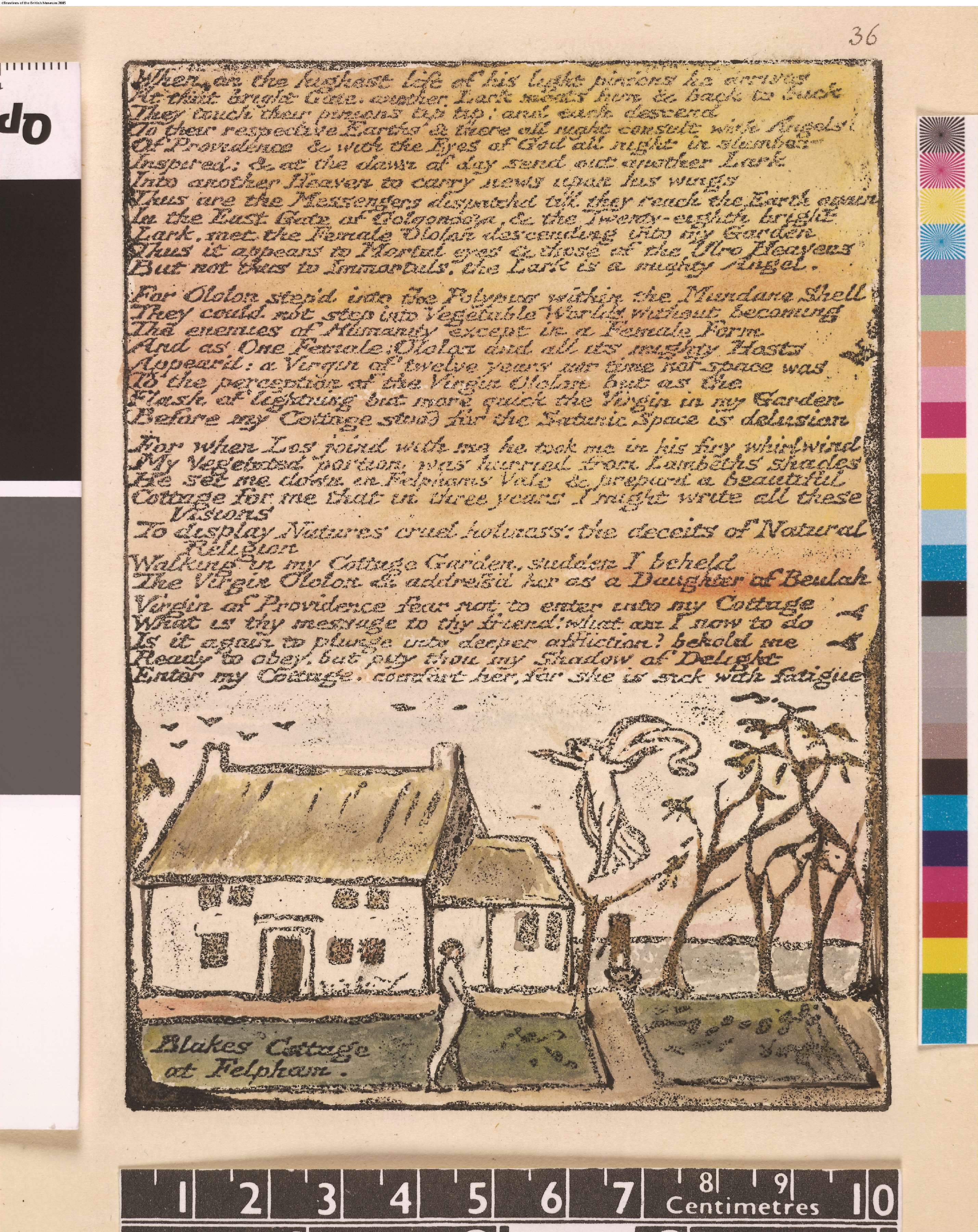
“Away to Sweet Felpham for Heaven is there”. So William Blake begins a poem composed in August 1800 and addressed to his Sussex patron, the poet and biographer William Hayley. London-born Blake spent three years living on the Sussex coast and this experience proved a wellspring of creative inspiration, helping him emerge from what he described as a “pit of melancholy”.
As the 18th century drew to a close, Blake’s talent as an engraver and artist had been ignored in London and his poetry dismissed as madness by contemporaries. He and his wife Catherine struggled financially, living as he said in 1799 “by a miracle”. The Blakes’ desperate economic circumstances were exacerbated by rampant inflation caused by a succession of poor harvests, which in turn prompted social unrest in London and nearby towns. With little prospect of work, in dire economic need, and with food riots on his doorstep, Blake accepted Hayley’s invitation to quit London for the first and only time in his life and move to Sussex. Writing to a friend on September 1, 1800, Blake includes a poem that expresses his sense of escape, characterising London as a “Dungeon dark […] Dropping with human gore”, while enthusiastically describing his soon-to-be new home: “See my cottage at Felpham in joy”.
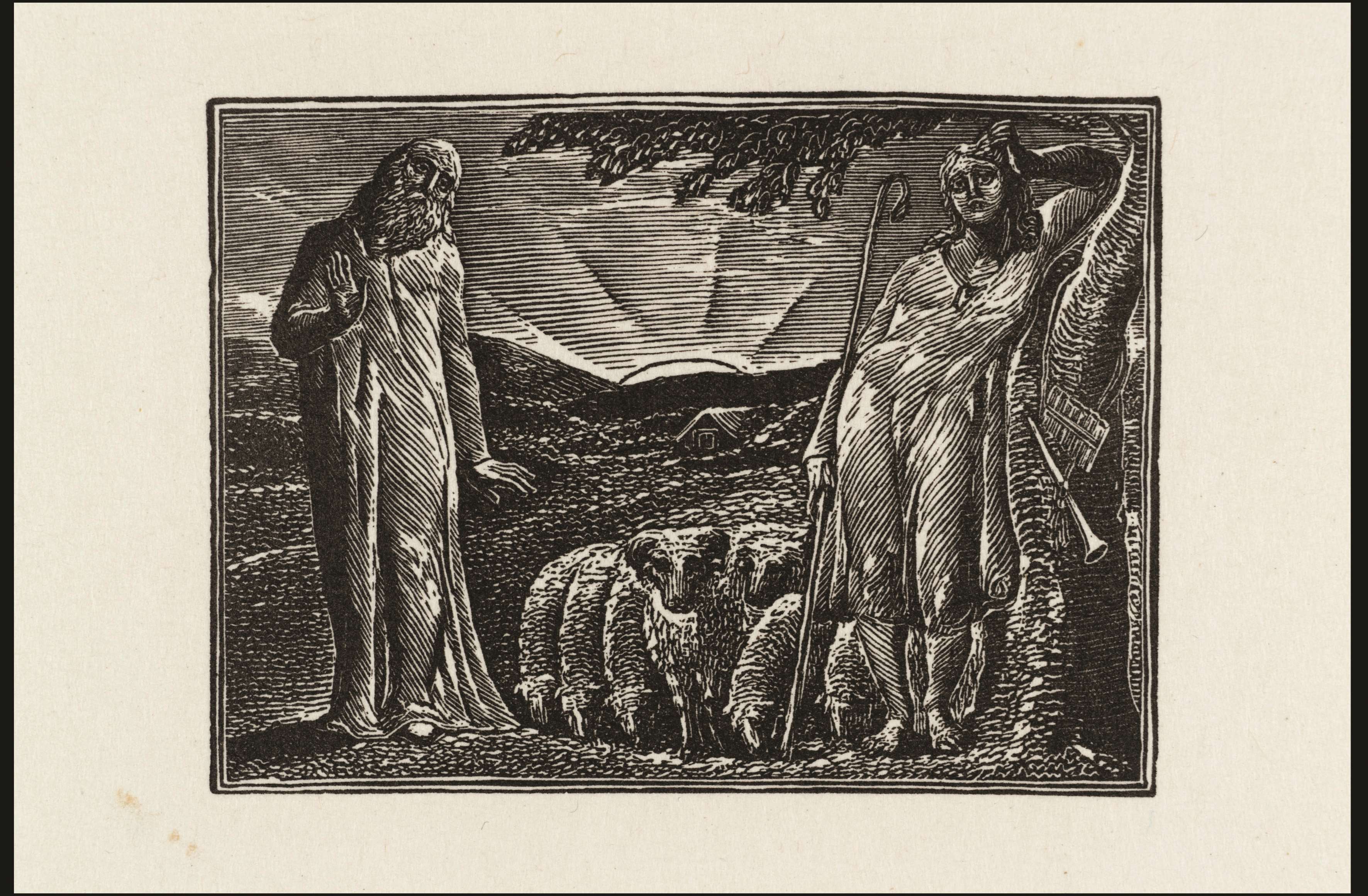
Blake's pastoral experience informed his later work, like this 1891 engraving, Thenot and Colinet
In late September 1800, the Blakes embarked on the 17-hour, 63-mile journey from London to Felpham by one of the thriceweekly passenger coaches, bringing with them “sixteen heavy boxes and portfolios full of prints”. The boxes included Blake’s star-wheel copperplate rolling press, which was assembled in the largest room of their new home, a six-room thatched cottage constructed from ship’s timbers.
The Blakes leased the cottage for an annual rent of 20 pounds from George Grinder, the landlord of the nearby Fox Inn. Blake was optimistic about his new home, describing it as “the sweetest spot on Earth”, and his future prospects, telling Hayley, “My fingers Emit sparks of fire with expectation of my future labours”. Blake also revealed to another friend that the move to the Sussex coast would enable him to become “independent. I can be a Poet, Painter & Musician as the Inspiration comes”.
During his time in Felpham, Blake worked on various engraving and painting commissions for Hayley and started composing two of the greatest and most complex works in British literature, the illuminated books Milton and Jerusalem. It is clear from Blake’s correspondence, poetry, and art, that the move to Sussex inspired his creative energies. In a letter to Hayley, Blake claims that the rural environment would be “propitious to the Arts” and described his new home as “a sweet place for Study. Because it is more spiritual than London”. Blake also saw his move to Sussex in a political context, drawing a connection between his new cottage and Revolutionary France. For Blake in 1800, the move presented an opportunity to renew the radicalism of his early illuminated books, works such as The Marriage of Heaven and Hell, which were produced in the highly charged atmosphere of the early 1790s, as revolutionary fervour spread across the channel and inspired a new generation of poets, including a young William Wordsworth.
The soldiers claimed that during the scuffle Blake had 'Damned the King of England – his Country and his subjects'
Since Blake’s rediscovery as a poet in the early 20th century, largely thanks to WB Yeats, he has been considered one of the Romantics, an anachronistic catch-all term for a cultural movement that, if not wholly rejecting the Enlightenment emphasis on reason over feelings, fervently celebrated the unfettered imagination. Unlike other prominent Romantic poets, whose work evinces a deep connection with nature and landscape, Blake’s early poetic and pictorial work mostly eschews nature. After his move to Sussex, however, we see a significant engagement with landscape. Pictorially, Blake tries his hand at landscape painting, including an unfinished watercolour (now in Tate Britain) of his cottage in Felpham surrounded by cornfields. In both Milton and Jerusalem, the English landscape is prominent both visually and poetically, perhaps most famously in the four-stanza poem that concludes the Preface to Milton, now more popularly known as the hymn Jerusalem, which begins: “And did those feet in ancient time/ Walk upon Englands mountains green”.
There is an apocryphal story that Blake composed this poem while gazing over the South Downs from a bay window in the Earl of March pub near Lavant. We do know that Blake, riding a pony called Bruno, often accompanied Hayley to Lavant to visit their friend Henrietta Poole. We also know that Blake, whose favourite tipple was porter, frequented the Fox Inn and drank small beer, but there is no extant documentary evidence that he visited the Earl of March pub. What we can say for certain is that Blake’s experiences in Sussex profoundly influenced the composition of Milton, which contains a number of autobiographical scenes that take place in Felpham. Work on the illuminated book itself didn’t begin, however, until 1804 when Blake had returned to London.
While Blake’s time in Sussex began positively, by 1802 he’d become annoyed at Hayley’s patronage, and his wife Catherine had suffered bouts of ill health that Blake blamed on the sea air and the cottage. By mid-1803, Blake decided to return to London, but before he and Catherine could leave Sussex, he had a potentially life-threatening encounter with the most powerful man in the county, Charles Lennox, the third Duke of Richmond, Commander-in-Chief of the Sussex Volunteer Corps, and Lord Lieutenant of Sussex.
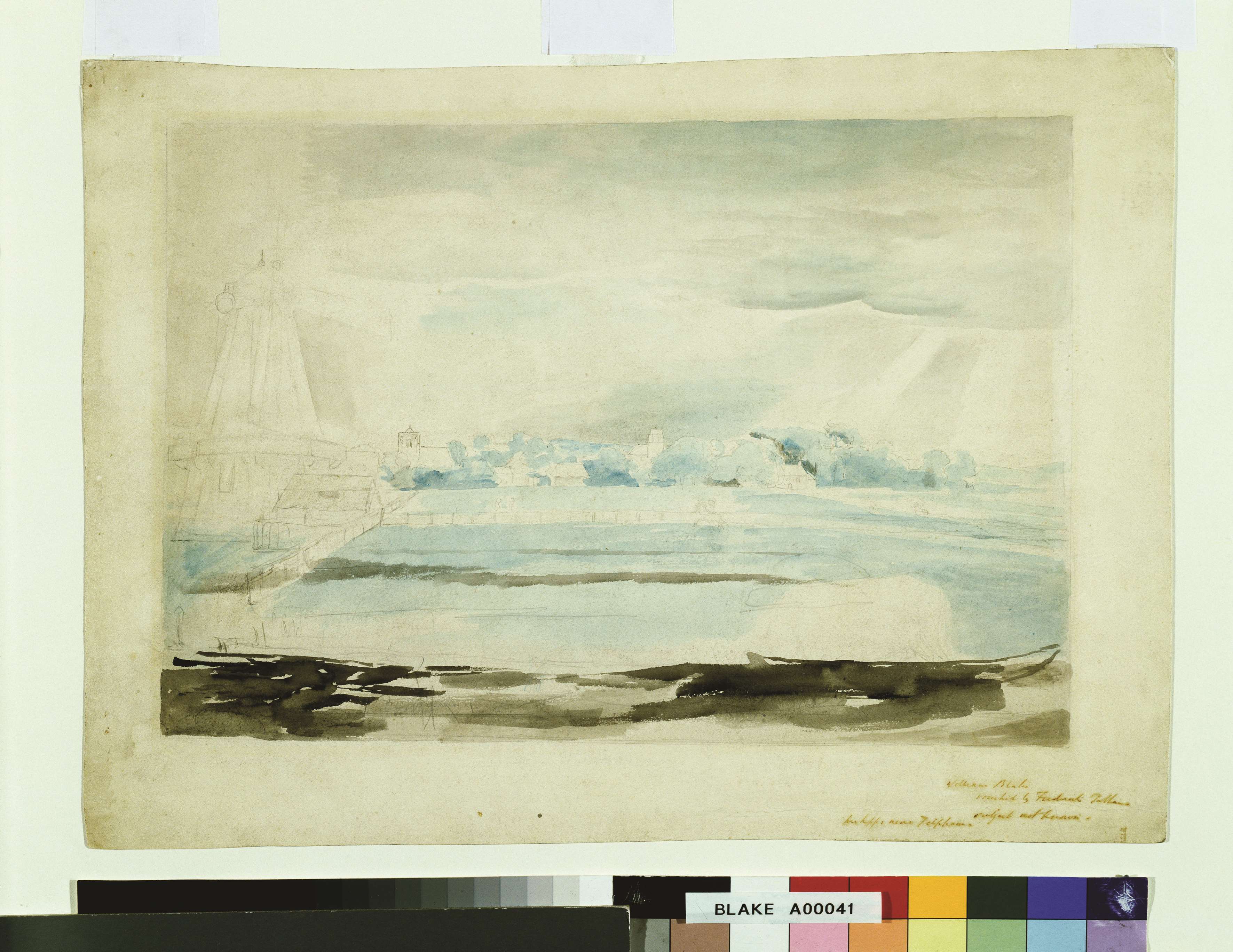
Landscape near Felpham, 1800, watercolour
On August 12, 1803, Private John Scolfield of the Royal Regiment of Dragoons entered Blake’s garden to speak to the local ostler who was working there. A brief fight ensued between the soldier and Blake that resulted in Scolfield and another soldier making an official complaint against Blake to the local Justice of the Peace. The soldiers claimed that during the scuffle Blake had “Damned the King of England – his Country and his subjects”. On 16 August, Blake was also called before the Justice and was entered into a warrant to appear at the Petworth Quarter Sessions. At these Sessions, presided over by Richmond, the Grand Jury found sufficient cause for Blake to stand trial for sedition at the Chichester Quarter Sessions in early 1804.
At four o’clock on a cold January afternoon, Blake stood before a bench of local Justices, headed by Richmond, and a jury of his peers, charged with seduction from allegiance and duty, seditious expressions, and assault. These were serious charges, particularly sedition – given the collapse of the Peace of Amiens and resumption of hostilities between Britain and Imperial France. In the summer of 1803, Bonaparte had amassed an army around Calais ready to invade southern England and French spies had been apprehended along the south coast, reconnoitering possible landing sites. In his role as Lord Lieutenant of Sussex, Richmond was responsible for organising the defence of the region against the threatened French invasion and had a history of suppressing disorder in the county. During Blake’s trial, Hayley noted that Richmond “was bitterly prejudiced against Blake; & had made some unwarrantable observations”. If the jury found Blake guilty he would have been sentenced there and then by Richmond.
During Blake’s trial, Hayley noted that Richmond “was bitterly prejudiced against Blake; & had made some unwarrantable observations”
Before the trial, Blake described the case against him as “a Fabricated Perjury”, which proved to be the case. Blake’s advocate called several witnesses to discredit the soldiers’ testimonies against Blake and under cross-examination the soldiers gave contradictory evidence. Hayley’s friend, the Chichester-based composer John Marsh, recorded in his journal that the soldiers did not agree “in their evidence & fail[ed] to make good their accusation”. All charges against Blake were dropped, with the
local newspaper reporting that the acquittal “so gratified the auditory, that the court was, in defiance of all decency, thrown into an uproar by their noisy exultations”. Whether Blake actually uttered seditious expressions on 12 August 1803 is unlikely based on the conflicting testimonies of the soldiers. In the privacy of his own manuscript notes, however, Blake’s view of monarchy is evident in statements such as “Every body hates a King”. If such writings had been presented during the trial, Blake would certainly have been imprisoned for at least three months, and in the context of the French invasion threat, with the Duke of Richmond as the presiding Justice, he may even have been transported to Botany Bay or worse.
Despite only spending three years in the county, Blake maintains a significant presence in Sussex to this day. The cottage he lived in still stands and was bought in 2015 by the Blake Society after a fundraising campaign endorsed by Philip Pullman, Stephen Fry, and Russell Brand. With the support of a National Lottery grant, the society set up a trust with goal of restoring it to its 18th-century condition, after which the Blake Cottage Trust plans to open the building to artists and scholars, host exhibitions, and house a replica of Blake’s star-wheel copperplate rolling press, with members of the public invited to take part in engraving and printing demonstrations. Blake’s time in Sussex has also inspired the Big Blake Project’s annual BlakeFest, a celebration of his visionary genius, comprising a diverse range of events including musical concerts, poetry readings, and art exhibits that take place in Bognor Regis and Felpham in the autumn. Both BlakeFest and the Blake Cottage Trust continue Blake’s creative legacy and, in their own ways, fulfil his 1800 declaration that Sussex is “propitious to the Arts”.
This article was taken from the Autumn 2019 edition of the Goodwood Magazine.
goodwood magazine
estate newsletter
goodwood news