

















































































Where The Wild Things Are
Rewilding, an ambitious form of conservation that isn’t just trying to preserve what’s left but restore what’s lost, is a controversial topic. But on a number of large British estates, it’s already happening. So will parts of the country once again echo to the howl of wolves?
Words by Patrick Barkham
Illustrations by Eri Griffin
Magazine

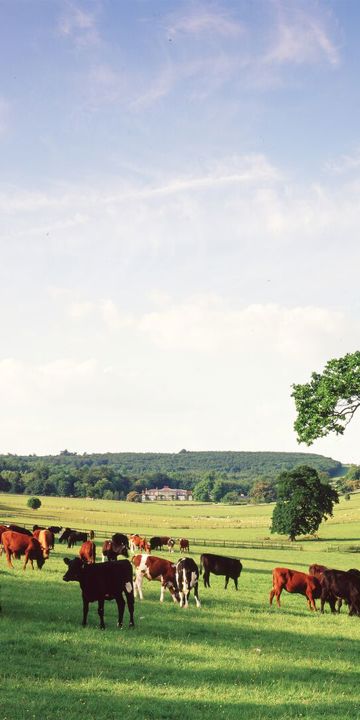
IF YOU TAKE A WALK BEYOND DIAL POST, the classic rolling countryside of the Sussex Weald gives way to something more surprising. A neatly hedged patchwork of wheat and pasture is replaced by overgrown fields filled with hummocks of bramble and scrubby hawthorn. Roaming free among thickets of sallow and wildflowers are ginger-coloured Tamworth pigs, English Longhorn cattle, red and fallow deer and Exmoor ponies. It’s an exotic scene, and it sounds different too: there’s a cacophony of birdsong, from the soft tur-turring of the endangered turtle dove to the extravagant riffs of rare nightingales.
This is the Knepp Castle Estate, which, over the last 18 years, has been transformed from conventional dairy and arable farm into a 1,400-hectare rewilding experiment. Knepp is filled with a wealth of nature, from little owls to purple emperor butterflies. But it provokes visceral reactions: some people are thrilled by the sight of nature running wild; others find the dereliction and weeds distressing. But what is rewilding? Why is it so controversial? And how could it change our much-loved countryside?
Rewilding was coined in America to describe an ambitious form of conservation that isn’t just trying to preserve what’s left but restore what’s lost. Rewilders want to return natural ecological processes to large areas of landscape – allowing species other than humans to shape the environment. This might mean removing fences so animals roam free, or removing drains to allow rivers to meander along their natural course. And, most eye-catchingly of all, rewilding usually means reviving megafauna: bringing back charismatic predators or key species – wolves, lynx, or beavers – possessed with the power to change a landscape.
In Britain, rewilding has been popularised by the environmentalist George Monbiot, whose 2013 book, Feral, is an eloquent call to rewild all aspects of life, including ourselves. But, as rewilding gains popularity, so it attracts criticism – and confusion. To which wild period should we return? As wild as 1800, 1066 or 10,000 years ago? Some advocates, such as Knepp’s owners, Sir Charles Burrell and Isabella Tree, prefer “wilding”, for we can never turn the countryside’s clock back to a precise moment. And how ancient or large should the megafauna be? Wild boar? Bears? Or even woolly mammoths? Is the influential predator known as Homo sapiens to be excluded from rewilded countryside?
A classic example of rewilding is in Yellowstone National Park, which is as big as England’s largest county, North Yorkshire. Yellowstone’s reintroduction of the grey wolf in 1995 caused a great chain of unanticipated consequences which benefitted other species and transformed this enormous wilderness. As wildlife biologist Doug Smith said: “It is like kicking a pebble down a mountain slope where conditions were just right that a falling pebble could trigger an avalanche of change.” In Yellowstone, the wolf’s return helped beavers bounce back: ecologists discovered that the wolves kept elk constantly moving throughout winter, preventing the elk from eating all the willow upon which the beavers depend. When the beavers returned to dam streams and create new pools, so too did otters, muskrats, reptiles, fish, birds and insects. Because wolves reduced coyote populations, and rabbits and mice increased, the red fox returned too, as did ravens, which fed on wolf kills.
When beavers returned to Yellowstone – and began to dam streams and create new pools – so too did otters, muskrats, reptiles, fish, birds and insects
Rewilding on this scale will never happen in the human-dominated English lowlands but rewilders are hopeful that tracts of land much larger than Knepp could be returned to nature in upland Britain. In the Scottish Highlands, rewilders challenge our view of what’s “natural”. They point out that this apparent wilderness, with its spectacular bare mountains, is a landscape mostly created by Victorians, and maintained by sheep and, more recently, deer for stalking.
The Highlands were once dominated by Caledonian pine forest and some of it is being returned to this state. Just over a decade ago, the beautiful 17,000-hectare estate of Glenfeshie was purchased by Anders Holch Povlsen, a Danish billionaire, who has embraced a bold 200-year vision to “allow the land to move towards its full ecological potential”, as Thomas MacDonell, conservation director of Povlsen’s company, Wildland, puts it.
The biggest revolution on the estate sounds uncontroversial: shooting deer. It’s what sporting estates do, but this has been a more drastic decade-long cull. In 2004, there were protests outside Glenfeshie’s estate office, not from animal rights groups but from the stalking industry. Neighbouring estates have been fiercely critical: estate values are linked to how many deer they can stalk.
The cull has reduced Glenfeshie’s deer density from 40 deer per sq km to less than one deer per sq km. Without deer browsing green shoots, the glen is filled with young trees sprouting through the heather. “People talk about the forests creeping and crawling,” says MacDonell, “but the woodland in Glenfeshie is sprinting up the hill.” This burgeoning vegetation supports resurgent populations of predators and prey – tawny owls and field voles, pine martens and black grouse.
Proposals to introduce a small number of GPS-collared lynx into Northumberland have met with fierce local opposition
Glenfeshie is in the Cairngorms, and within the UK’s largest National Park are several adjoining schemes to restore land with Caledonian pine forest, including Abernethy Forest, an RSPB reserve. Wildland now owns 89,000 hectares in three parts of the Highlands and Povlsen hopes to build a rural economy on eco-tourism.
Many conservationists in Scotland shy away from the term “rewilding” however, and wolves are still a long way off. Naturalists estimate that Yellowstone-style rewilding with wolves would require at least 100,000 hectares in one Highland area. While wolves are spreading across Europe – moving into Belgium this winter, and surviving in suburban areas of Germany – they attract fierce opposition from farmers and hunters. In Britain, proposals to reintroduce a small number of GPS-collared lynx into Northumberland have met with fierce local opposition. While the lynx is a shy wildcat that preys upon roe deer and is no threat to people, several lynx that recently escaped from wildlife parks and killed sheep haven’t enhanced their reputation.
Rewilders may struggle to convert farmers to the wisdom of reintroducing large carnivores but many European rewilding projects are reviving less controversial wild herbivores – bison, Konik ponies and beavers. Frans Vera, an influential Dutch ecologist, believes old theories that Europe was once covered with dense “wildwood” are wrong, and in fact ancient forests would have had open glades created by the grazing of wild herbivores – a landscape not unlike a classic English country park.
In Britain, the herbivorous beaver may prove to be our most influential rewilding candidate. The way it dams streams has been shown to hold back floodwater – a useful, cheap and natural form of flood defence. Four centuries after being driven to extinction there, the beaver was recognised again as a native mammal in Scotland in 2016 after two reintroductions. In England, wild beavers have returned to the River Otter in Devon. The government has licensed two other schemes whereby beavers were placed in fenced areas in the Forest of Dean and Cornwall to alleviate flooding. The government’s new 25-year plan for the environment makes favourable references to beavers, which Knepp says will encourage the “dynamic management of nature” – not quite daring to mention “rewilding” but not far short of it.
Rewilding still attracts controversy, however. Some say it will force local people – particularly farmers – out of rural areas. Others argue it might jeopardise the recovery of some species saved with traditional conservation, in which countryside is managed as it has been traditionally farmed over centuries. Perhaps the strongest argument against rewilding is that it takes farmland out of production. As the world’s population grows from seven to 10 billion by 2050, critics say we urgently need to grow as much food as possible. At Knepp, where heavy clay soils made conventional farming unprofitable by the 1990s, Isabella Tree argues that we can already feed 10 billion because around a third of our food is wasted each year, and we also use valuable agricultural land to grow biofuels. Besides, rewilded Knepp is still a “farm” – supplying high-quality organic meat from its free-ranging animals.
We may not always choose rewilding: stretches of our coast may be rewilded whether we like it or not. Scientists predict that last century’s 19cm rise in mean sea level will be followed by a global rise of more than 70cm this century. Britain’s coastline is longer than India’s; it would be impossible to swaddle it all in concrete. While cities like London or Hull will always be protected, in other areas it will be too expensive to do anything but retreat from rising seas.
This is already happening on low-lying coastlines in Suffolk, Essex – and in West Sussex. The largest “managed realignment” scheme on the open coast in Europe was completed at Medmerry five years ago. To locals’ initial alarm, the Environment Agency punched a hole in sea defences and “let the sea go” into 183 hectares of land, which became a new wild, intertidal area. Such natural coastlines are surprisingly effective at dissipating wave energy. Four miles of new floodbanks were built further inland to protect homes, which now have flood defences calculated to be 100 times more effective. They were immediately tested by the storms of 2013/14 and proved successful.
Rewilding purists are likely to be disappointed that Britain won’t echo to the howl of wolves any time soon, but a subtler form of rewilding, particularly to improve flood defences on coasts and rivers, is on its way. The countryside is set to become a more surprising place.
Patrick Barkham is the author of Islander: A Journey Around Our Archipelago and The Butterfly Isles
This article is taken from the Goodwood magazine, Spring 2018 issue
Magazine